








The rapid rise of household batteries, 600,000 and counting, is reshaping Australia’s electricity grid and reducing the need for some new transmission lines, according to the latest electricity blueprint released today.
The Australian Energy Market Operator (AEMO) releases an Integrated System Plan (ISP) every two years and models the optimal development path (ODP) for Australia’s electricity system by 2050.
Much of its latest update is familiar reading, confirming that renewables and storage, backed by a small amount of gas, remains the most cost-effective way to overhaul the country’s aging electricity grid.
AMEO modelling again shows renewable energy backed up by batteries and gas remain the best way forward for Australia’s grid. (Supplied: AEMO)
However, the meteoric rise of batteries, big and small, has meant a change in how the market operator sees the grid of tomorrow unfolding. Battery prices have dropped significantly, and Australia is in the midst of a world-leading battery boom.
“Although there is only 4 gigawatts (GW) of existing capacity, new storage in the connections pipeline has increased substantially, from 3GW in September 2022 to 17GW in 2024 and to 45GW in 2026,” the report noted.
“This is now well ahead of the 33GW of battery storage that the ODP projects would be needed in 2030. To date, battery projects have taken just over two years to go through the connections process.”
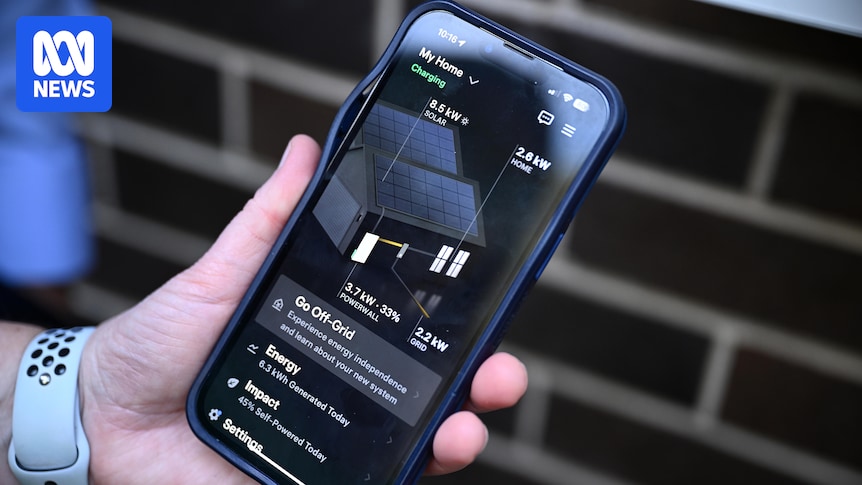
The surge in home batteries is helping to stabilise the national grid, experts say. (ABC News: Cath McAloon)
Johanna Bowyer from the Institute for Energy Economics and Financial Analysis (IEEFA) said the Cheaper Home Batteries Program had driven the surge in small-scale storage.
“The ISP emphasises the key role that households are playing in the energy transition by installing their own solar and batteries, improving the energy efficiency of their homes and moving towards electric cars and appliances,” she said.
Energy Consumers Australia (ECA) general manager of advocacy and policy Brian Spak said the ISP highlighted the role households were playing in the transition beyond just lowering their own cost of electricity.
“As the report notes, the investments consumers are making in these resources benefit everyone in the National Electricity Market. They reduce the need for massive grid-scale investments, ultimately lowering costs for all consumers,” he said.
“Consumers shouldn’t pay a cent more for their energy than they need to,”
Mr Spak said.
An old coal-fired power plant is being deconstructed alongside a brand new big battery in Kwinana, WA. (ABC News: Clint Jasper)
This rise in battery storage has reduced the pressure on transmission lines, however, AEMO is still forecasting 6,000 kilometres of transmission lines will still need to be built, a reduction of almost 1,500km from the last ISP.
“Delivering these transmission projects without delay is critical, as the need and consumer benefits are clear,”
AEMO CEO Daniel Westerman said.
“Australia’s energy transition requires a whole-of-system approach, one that maximises value from generation, storage and transmission with the growing contribution of homes and businesses through rooftop solar, batteries and more flexible energy use,” he said.
As projects come online, and prices of batteries and solar drop, the amount of investment required for the transition to 2050 has fallen since the last ISP to $106 billion in today’s dollars.
Importantly this figure does not refer to government funding, but private investment, although the federal government is supporting the shift to renewables through mechanisms like the renewable energy target, and the capacity investment scheme, which underwrites projects.
Mr Westerman said transmission would cost $6 billion of that, but would save consumers $28 billion.
“Transmission is a relatively small share of overall system investment but delivers substantial benefits for consumers by unlocking lower-cost energy across the National Electricity Market,” he said.
Energy Minister Chris Bowen said Australia’s independent market operator had confirmed the cheapest path forward for the energy system was “renewable energy, backed by gas and battery storage”.
AEMO’s report includes its own qualification that the ISP “seeks the optimal development path while meeting government policies”.
More wind needed
While we already have more than enough battery capacity in the pipeline for the next few years, AEMO is warning that renewables, in particular wind, are not being built fast enough to meet the government’s goal of 82 per cent renewables by 2030.
“In total, approximately 38GW of new grid-scale solar and wind is required by 2030 under the ODP,” the report said.
AEMO warns renewables, in particular wind, are not being built fast enough to meet the government’s target. (ABC News: Nathan Morris)
But approval process delays, particularly for the portion of energy needed from wind, is lagging.
“Only 9GW of the 18GW of new wind is in the pipeline,”
the report said.
“To date, both solar and wind projects have taken about four years on average to progress …concerted efforts are being made to streamline all aspects of development and delivery.”
Data centre surge
As AI continues to push into all corners of our lives, the physical electricity demand on the National Electricity Market to support it is becoming clearer.
By 2050, the grid will be significantly larger, but despite a growing population and electrification, households will actually draw less from it than they do today, relying instead on rooftop solar and batteries.
Instead the growth will come from business, and AEMO has singled out data centres.
AEMO notes that there are more than 160 data centres in operation in Australia, almost half in Sydney, the rest in Melbourne, Brisbane and Perth.
“They account for around 2 per cent of today’s grid-supplied electricity use. However, that use is projected to grow in the ISP by around 25 per cent annually to reach almost 10 per cent of the NEM’s underlying demand by 2050 — five times the share it has today and the equivalent of 20 per cent of today’s total demand,” the report said.
The AEMO plan did not give any specifics, but the regulator said it had been considering the implications of data centres and “investigating options to minimise system impacts, maximise potential system benefits, and ensure regulatory frameworks for data centres remain appropriate.”
Decline of coal continues
It also raised a warning about the reliability of Australia’s aging coal fleet, two thirds of which it forecasts will be retired by 2035, with no coal power by 2050.
But AEMO says the transition from coal was well underway, and what was happening in Australia is a reflection of the growing global shift towards renewables driven by economics.
“In the first half of 2025 and for the first time, more of the world’s energy was delivered by renewables than by coal,” the report said.
AEMO forecasts that two thirds of the national coal fleet will close by 2035, and all will close by 2050. (Supplied: AEMO)
AEMO said renewable energy sources, both domestic and grid scale, met about 45 per cent of all demand for electricity in the 2025-26 financial year.
In the December quarter of 2025, renewable energy supplied more than 50 per cent of the demand and reached nearly 80 per cent for a half-hour block in October 2025.
“These record levels vary with the year’s seasons, but are consistently rising,”
the AEMO report said.
“The shift to renewables is happening globally.”
And globally, in 2024 and 2025, AEMO said renewables received three times as much investment as coal.
“Decisions on how best to replace the NEM’s coal-fired plants are ultimately made by private investors. That investment favours renewable energy and supporting technologies over continued coal-fired generation,” the report said.
Falling costs — and batteries — are fuelling growth in solar farms. (Supplied: NSW Government)
Despite being firm on the direction, Mr Westerman acknowledged the transition faced more than technical challenges.
Alongside approval delays, workforce shortages and rising costs, AEMO says community trust and “social licence” are key factors in how quickly, and cheaply, new electricity infrastructure can be built.
“While momentum in investment and delivery continues to build, challenges remain in delivering essential infrastructure at the pace required,” Mr Westerman said.
“Slower progress will erode benefits to consumers and present risks to reliability.”