






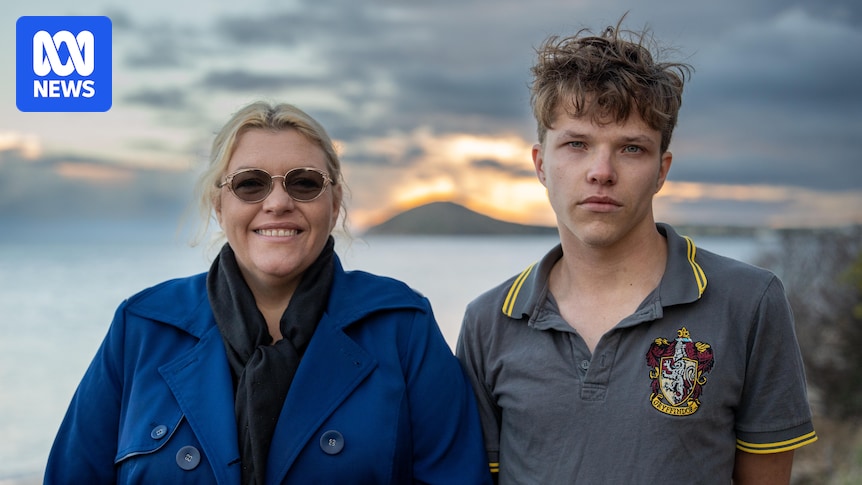
In the peak of South Australia’s algal bloom outbreak, asthmatic Victor Harbor resident Jackson Baker was coughing so much every day it hurt.
The harmful algal bloom was first detected on his coastal town’s shore in March 2025, before it spread across the state’s coast.
Since then, varying levels of algal bloom species, including Karenia cristata and Karenia mikimotoi, have caused discoloured foam and water on beaches, along with airborne particles which can cause flu-like symptoms for those close by.
For Mr Baker, it stopped him from swimming, fishing and whale watching at the beach which he said have been crucial to his mental health routine.
He said low Karenia counts near his home meant he was coughing less, but his fear of the beach remained.
“Since the algae happened I just don’t feel comfortable swimming in there,” he said.
Ms Whitehead said she found the health advice about the algal boom inaccessible and inconsistent. (ABC News: Trent Murphy)
“I actually love doing boogie boarding … I haven’t done it since.”
Questions about advice and information
The 18-year-old has the genetic condition neurofibromatosis, an intellectual disability as well as other health conditions.
Mr Baker and his mother Kirsty Whitehead said public health information about the bloom had been “inaccessible”.
“There has definitely been a gap in inclusive information such as easy read … which is such a big tool that we use when it comes to someone who has cognitive issues and intellectual disability,” she said.
Ms Whitehead said she didn’t think the health advice honestly reflected some of the realities locals were experiencing. (ABC News: Trent Murphy)
The SA government’s easy read format presents information in plain language, short sentences and can include pictures to support the meaning of words.
Ms Whitehead claimed she could not find an easy read version of health information from the state government until January 2026.
SA Health told ABC News tailored communications materials could take longer to publish as all content is thoroughly reviewed to ensure it remains accurate.
Ms Whitehead also said she believed health advice was “inconsistent” with the experiences from the local community.
Originally, SA Health advice stated that algal particles could cause short-term skin and eye irritation, cough and shortness of breath.
Dead octopuses washed up on Basham Beach near Victor Harbor. (ABC News)
The advice was updated in late 2025 for people with asthma to carry their reliever medication.
Ms Whitehead said both she and her son had experienced headaches during the height of the algal bloom, a symptom not listed in official health advice.
“The messaging was inconsistent, it was unclear and I don’t think it honestly reflected some of the real realities of what people were feeling and experiencing,” Ms Whitehead said.
“It was underplaying, especially with the election that was coming.
“(The SA government) would say that everything was fine … whereas living it every day, it definitely wasn’t.”
Health survey conducted by volunteers
In the wake of the bloom, a group of volunteer experts in public health, data analysis, ecology and marine science created The Algal Bloom Shed.
Flinders University Professor Jacqueline Stephens said initially, there was nowhere for South Australians to report their symptoms. (ABC News: Daniel Taylor)
The group wanted to collate human and pet symptoms not “captured in other healthcare settings”.
“There was a lot of public concern about potential health impacts,” epidemiologist and Flinders University public health researcher Jacqueline Stephens told ABC News.
“People clearly wanted to report (their symptoms) but had nowhere to put it.”
The Shed opened an anonymous survey online which received 235 submissions for humans and 26 for pets between November last year and February this year.
Of the symptoms experienced by humans, about 59 per cent of respondents had a scratchy cough, 48 per cent had a sore throat and almost 38 per cent had a headache.
The survey recorded when people experienced the symptoms and where, with most submissions coming from metropolitan Adelaide beaches.
Associate Professor Stephens described the respondent’s symptoms as “low-grade” and “transient” which she said mirrored the impact of algal blooms overseas.
However the epidemiologist acknowledged some people could have more serious responses and advised them to seek medical attention.
“We can’t say for certain that the symptoms people have reported into the system are actually caused by the algal bloom,” she said.
The researcher said she can’t say for certain that the symptoms people have reported are actually caused by the algal bloom. (ABC News: Daniel Taylor)
One in three of the survey’s respondents said they sought medical attention which included pharmacy assistance and over-the-counter medication.
Ms Stephens said gastrointestinal related symptoms were not significant enough to be included in The Shed’s preliminary findings, but 26 respondents with pets reported a 54 per cent incidence of vomiting and 12 per cent diarrhoea.
The advice for pets has been to keep them out of the water when there is foam present, and not let them eat dead fish.
In a statement, SA Chief Public Health Officer Professor Nicola Spurrier said its advice was “evidence-based, drawing on international research and reinforced by what we have learned about the nature of the algae contributing to the unprecedented algal bloom in South Australia”.
South Australia’s Chief Public Health Officer Nicola Spurrier said SA Health advice did not include survey participant experiences due to the “non-specific nature of the symptoms and anecdotal data”. (ABC News: Lincoln Rothall)
When asked why SA Health advice did not include survey participant experiences of headache and nausea, Professor Spurrier said “there could be any number of causes for these general symptoms”.
“Any analyses need control for other relevant data that could explain such symptoms,” she said.
Ms Stephens said The Shed hoped to expand data collected in the future and directly speak with participants for more information.
In March 2026, Ms Spurrier revealed SA Health would study algal bloom-related hospitalisations.
Dead garfish in waters off South Australia’s coast during the devastating algal bloom. (Supplied: Stefan Andrews)
She said the study recently received ethics approval, and the process of extracting and reviewing the de-identified data from the state’s medical records system was underway.
“It will take some months to cross-reference medical presentation data with weather conditions, location of onset of symptoms, Karenia counts at the time, the number of respiratory virus infections in the community and relevant other health conditions,” she said.
Professor Spurrier announced earlier this year SA Health would study algal bloom-related hospitalisations. (ABC News: Che Chorley)
“There remains no indication of an increase in presentations to emergency departments or hospitalisations as a result of the bloom.”
Ms Stephens said The Shed was working collaboratively with the SA government, reporting their findings to assist with decision making and policy development.
“So that we can put some learnings in place for if and when the algal bloom re-emerges across our coastline,” she said.
Jackson’s journey continues
With the help of his family and support workers, Jackson Baker is working to feel more comfortable at the beach.
“He’s been too scared to go into the water and with his intellectual disability it’s been quite challenging to get the information through to him that it’s safe,” his mother Kirsty Whitehead said.
But there was a small glimmer of hope for the year 12 student, as he spoke to ABC News at the beach.
“I saw a splash,” he said, eager to spot one of the whales hanging out in the Harbor.
Mr Baker said he hasn’t boogie boarded since the algal bloom began. (ABC News: Trent Murphy)
Ms Whitehead said it would be an ongoing hurdle to balance the reality of the algal bloom’s impact without evoking alarm.
“The government needs to be aware there are differing people in the community, that some people may not speak English as a first language, that some people may have an intellectual disability,” she said.
“But also how can we minimise some of the impacts that it does have on health and look at the long-term effects … if this is going to be our new normal.”