






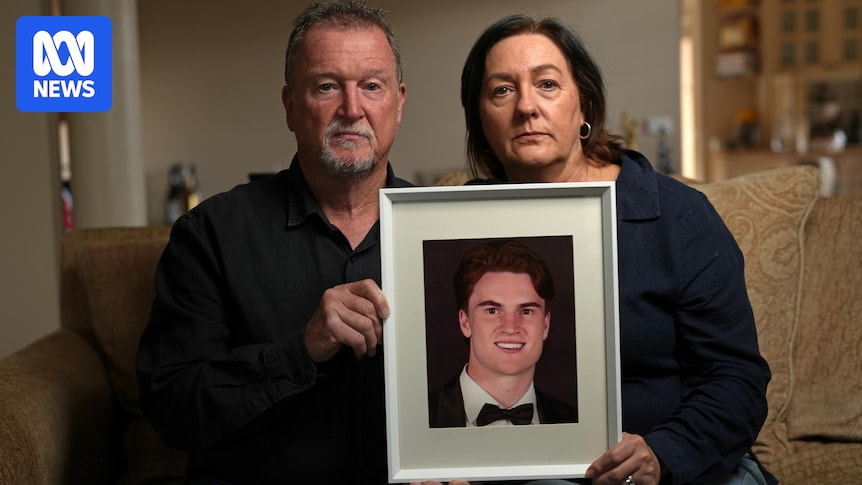
Growing up, Nick Lowden always had a footy in hand. He relished the rough and tumble of a hard-fought game. Like many kids, he dreamt of making it big.
His parents, Kerry and Tony, could see their boy was talented, a team player and that the AFL was within reach.
What they couldn’t see, what no-one could, was what the sport he loved was doing to his brain. The knocks, bumps, hits and collisions were adding up.
“And now it’s too late, he’s gone,” Kerry says.
Nick Lowden died at 23. He is the youngest Aussie Rules player to be diagnosed with chronic traumatic encephalopathy (CTE).
The degenerative brain disease, caused by repetitive hits to the head, has been found in former AFL star Danny Frawley, Richmond’s Shane Tuck and AFLW premiership player Heather Anderson.
But a growing number of young amateur and semi-professional players are now being diagnosed with CTE.
The Lowdens are telling Nick’s story so other parents and players know what they did not know. They say the AFL needs to take more responsibility in communicating the risks of playing the game.
Best and fairest
Energetic and athletic, boisterous and adventurous, by eight, Nick was playing for his local Aussie Rules club in Traralgon. The game came to him easily. He would go on to collect five junior best and fairest awards in a row.
“I know he was my son, but he was a natural,” Tony says.
Despite his clear talent, Nick was selfless on the field, known for passing off the ball to help lesser skilled players get a touch or a goal.
“We loved those years and he was just so happy playing and doing what he loved,” Kerry says.
The AFL was his dream.
“He’d be asking me, ‘Do you think I’m good enough, Dad?’ And, I said, ‘Of course you are,'” Tony says, ‘You’re as good as any of the others.'”
His parents would remind him that footy “wasn’t everything”. “There’s other things that are great in life besides football, but he loved football and that’s the path he wanted to go on,” Kerry says.
He made a state representative team, then was selected to an elite junior AFL team, Gippsland Power.
“They’re the gateway to the AFL and the kids are there to demonstrate their abilities,” Kerry says. “And Nick’s first year there was really good.”
But his parents say one moment in the fourth quarter of a 2017 game triggered an enormous change in their 17-year-old son.
Nick, in his number 13 jersey, leapt for a mark.
Loading…
“It looks like he’s had his legs taken out from underneath him,” Tony says. “And then he’s just come down, hit his head on the ground and you could tell he was out for a couple of seconds.”
Against the AFL’s own junior footy concussion protocols, he was sent back out to play. Afterwards, Nick was showing signs of memory loss. He couldn’t recall the words to the team song and repeatedly asked if they had won.
Nick’s mental health started to rapidly decline.
“Over the next 12 months he started to deteriorate,” Kerry says. He was sensitive to light, was quick to anger, would have mood changes, self-doubt, frustration, depression.
“We couldn’t understand it.
“We would say to him, ‘Nick, you’ve got everything going for you.'”
Rough and tumble
There’s no way of knowing, while a person is alive, if they’re developing CTE. There’s no test, no scan.
It occurs when an abnormal protein builds up in the brain’s nerve cells, causing them to malfunction and die.
Neuropathologist Michael Buckland, who found CTE in Nick’s brain after he died, says the damage may have started in his teen years.
While Nick suffered only one known concussion, it’s not only concussions that cause CTE.
“What drives CTE risk is exposure to repeated head impacts,” Dr Buckland says.
“Most of those won’t give you any signs or symptoms, they’ll just be part of the rough and tumble of the game, but each of one of those is doing microscopic damage.”
Dr Buckland says an average person may get hit in the head a couple of dozen times in their life. But people who play a lot of contact sports are exposed to “thousands, if not tens of thousands of these impacts”.
Commonly reported CTE symptoms include problems with mood, memory and impulse control. Several Australian players who’ve been diagnosed have died by suicide.
“We don’t really have enough data to draw a sort of a causal link between the two, but … it’s a disturbing association, which I think needs more investigation,” Dr Buckland says.
He believes the AFL, like all major contact sports, needs a CTE prevention protocol.
“The way we’re going prevent it is by reducing exposure, just like skin cancer and the summer sun, you reduce your risk by reducing exposure.”
Warning: The next section contains references to suicide.
‘A beast that he couldn’t beat’
On the surface, life looked great for Nick.
He’d carved out a strong semi-professional career, playing for the Casey Demons in the Victorian Football League then for Norwood in South Australia’s league.
He was at uni, had a loving girlfriend, an adoring family and supportive friends.
But privately, his mental health was a constant battle.
Nick tried medication. He tried psychologists. His mum Kerry says he was confused as to why nothing could remedy his anguish.
“He said, ‘Why am I like this? What is wrong with me? What is wrong with my brain?'” she says.
“He trained hard, he ate well, he wasn’t a drinker, didn’t do drugs, he was totally focused on being the best he could physically and mentally be.”
“That was really distressing to watch him trying so hard, but he was fighting a beast that he couldn’t beat.”
Amid the battle, there was a day of joy. His team won the 2022 SA premiership.
Loading…
But by next July, Nick’s mental health was in crisis again.
Kerry and Tony had become extremely concerned. He had expressed feelings that he couldn’t go on.
“He just sounded real lost,” Tony says. “He was sliding, and he made both of us cry and he was crying himself when he was on the phone.”
Kerry remembers Nick telling her: “Mum, I’m 23 and what have I achieved?'”
Several week later, Kerry and Tony were on their way back from a trip. Nick was recovering from a calf injury at the family home in Traralgon.
“When we were driving back, I remember just feeling this feeling of dread because the last couple of days he cut contact and Tony was trying to ring him,” Kerry says.
“I rang him a couple of times and it just went to message bank,” Tony says.
When they got home, Kerry burst through their front door.
“I couldn’t wait to get in to see him,” she says.
Kerry called out for Nick and then she found him. He had taken his life.
“I was screaming out the front and the neighbours came out and I just screamed at them: ‘Get an ambulance, get the police,'” Kerry says.
“He was gone and we’ll never unsee that.”
Kerry says they laid with Nick and cried.
“We couldn’t let him go.”
The Lowdens received a call from the coroner’s office asking if they would consider donating Nick’s brain for research. Kerry, Tony and Nick’s three sisters decided they would.
“Our rationale … [was] maybe they can study a depressed brain, because we just thought Nick had a depressed brain,” Kerry says.
They were shocked to be told that Nick had been suffering from a disease they had never heard of, CTE.
“I just can’t believe that we didn’t know about it and that the general public don’t know about it,” Kerry says.
“We find out after our son passes that there’s this insidious degenerative disease that’s been kept fairly quiet.”
Risk and responsibility
The AFL says no-one has been kept in the dark about CTE.
While it doesn’t have a specific CTE prevention policy, it says the health and safety of players is its highest priority and it provides thorough education about the issue, as well the risk of concussion and the potential long-term impacts of the sport. It has also increased penalties for dangerous tackles.
The AFL says it has made more than 30 changes to its rules over more than a decade to protect the brain health of its players.
“We feel that we’ve been able to make the game safer and keep it entertaining and good to watch for our fans and fun to play and fun to participate in but safer,” Laura Kane, the AFL’s executive general manager for health and operations, told Four Corners.
“The safety of our players playing our game all the way from grassroots to our elite competition is our number one priority.”
When asked directly about the death of Nick Lowden and his parents not knowing what CTE was, Laura Kane insisted the league was doing enough to educate players.
“Those stories are incredibly sad. They’re sad for anyone who’s close to those people,” Ms Kane says.
“What it tells me is that we all need to learn and there’s more to learn about CTE and understanding the link between contact sports and CTE.”
She says it isn’t necessarily the AFL’s job to communicate research findings.
“Our job is not to communicate every single aspect of risk that exists in our game,” she says.
“Our job is to govern our sport … and it’s a responsibility shared by everyone who works in contact sport.”
Kerry Lowden was shocked by the AFL’s response.
“The risks involved in that game is 100 per cent their responsibility,” Kerry says.
“I’m absolutely gobsmacked that she’s saying that they will act when they have the right findings, and saying that risk isn’t their responsibility, of course it is.
“Unless someone knows what the dangers are, they can’t protect themselves, like our son didn’t know, we didn’t know.”
Legacy
Nick’s name is inscribed in a shield and a medal at the Combined Saints Junior Football Club in Traralgon. The under-15s best and fairest is now awarded in his honour.
Standing at the club’s presentation day, looking out at the boys in blue and white, Tony urges the recipient to carry forward Nick’s memory and his spirit of determination and loyalty.
“For Nick, football wasn’t just about kicking goals or winning games. Combined Saints gave him community, belonging and purpose.”
“Nick’s story is also one of deep tragedy,” he says, fighting back tears.
“He lost his life after a battle with CTE, something no young athlete, no young person, should ever have to face. But his legacy, the way he played the game and the values he lived by remain with us.”
Watch Four Corners’ full investigation into the AFL’s brain trauma crisis Monday night from 8:30pm on ABC TV and ABC iview.
Credits
Story by: Jessica Halloran, Amy Donaldson, Wendy Carlisle and Dylan Welch
Edited by: Nick Wiggins
Photos and video: Ryan Sheridan, Lowden family, Tania Price, Robert Prezioso, Graham Denholm