







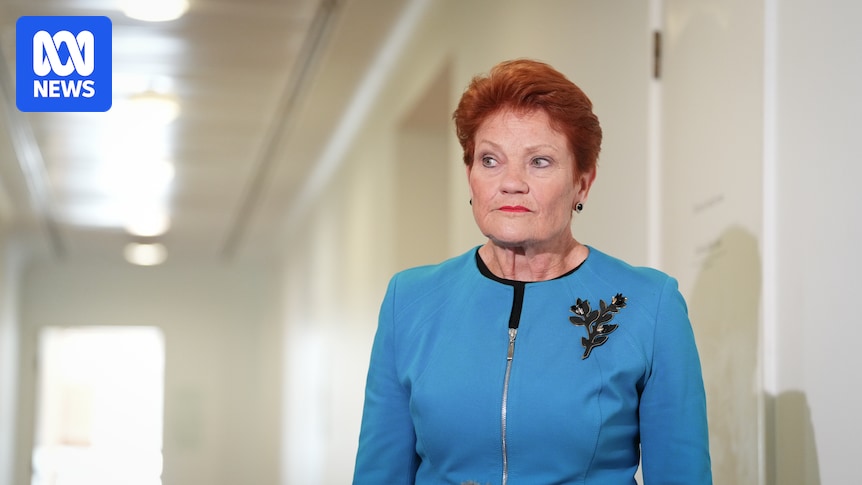
Pauline Hanson’s claims that Australian businesses are “tied” to lazy workers they “can’t sack,” have been labelled inaccurate by some employment law experts and small business advocates.
But some leaders managing day-to-day human resources for small business suggest the reality on the ground is weighted against employers.
Senator Hanson made the comments during her National Press Club address on Wednesday, calling for a “complete overhaul” of industrial relations laws, and claiming businesses have “had enough”.
“Industrial relations, I can assure you, needs a complete overhaul, because it’s not working. Businesses also tell me you can’t sack people these days,” she said.
“[Workers are] on their phones, they don’t work, they don’t turn up, they actually are lazy, and businesses are tied to it. They’ve had enough.”
ASU national secretary Emeline Gaske says the issue is more about how workplaces manage performance. (AAP: James Ross)
However, CEO of the Small Business Association Anne Nalder disagreed with Senator Hanson’s comments, saying existing laws allowed employers to dismiss staff, as long as they followed a clear process.
“It’s not true that you can’t sack workers,” Ms Nalder said.
“But you have to follow the rules.”
That includes having a valid reason — such as poor performance, misconduct or redundancy — and applying the law consistently, she said.
Australian Services Union national secretary Emeline Gaske said Ms Hanson’s claims did not hold up under scrutiny.
“It’s just not borne out by facts or evidence,” she said.
Ms Gaske argued the real issue was not the legal framework but how workplaces managed performance.
“I have never seen an employer not be able to deal with genuine performance issues,” she said.
HR specialist Emily Jaksch said a lot of employers believed the system favoured workers. (Supplied)
But Emily Jaksch, CEO and founder of HR Gurus, said Ms Hanson’s assessment of a broken industrial relations system “very much resonated” with her, noting many of her clients were currently “overwhelmed” and “burnt out” by a system they believed favoured workers.
With the cost to lodge a claim at the Fair Work Commission being only $90, Ms Jaksch said there was a huge increase in employees exercising workplace rights to “drag out” investigations and secure payouts.
“They are absolutely terrified of unfair dismissal claims and adverse action claims, which are both on the rise and part of that is due to AI and just how much it costs to put in a claim,” she said.
How difficult is it to fire an underperforming employee?
Unlike the US, Australia does not have “at‑will” firing.
Eligible employees may be able to bring an unfair dismissal claim under the Fair Work Act, if there is no valid reason for the termination, or the employer has failed to follow a fair process.
Unions say they have not seen employers unable to deal with genuine performance issues. (ABC News: Lucas Hill)
Associate professor Tess Hardy said that unfair dismissal framework had existed at the federal level since 1993.
There were some major changes during John Howard’s Work Choices era in 2006-07, but these were largely reversed under subsequent governments.
“This notion that it’s harder to sack someone ‘these days’ … isn’t accurate,”
she said.
Employers can dismiss staff for poor performance, misconduct or capacity — but they must clearly explain the issue and give the employee an opportunity to respond.
Serious misconduct, such as theft or violence, can justify immediate dismissal.
HSF Kramer employment lawyer Natalie Gaspar, who exclusively represents large businesses, agreed, noting the laws had “been in place since the mid-90s, largely unchanged”, with employers required to show a valid reason and provide procedural fairness before terminating employment.
Small businesses have slightly different rules. Those with fewer than 15 employees can use a simplified dismissal code.
“Small businesses are in a better position to defend an unfair dismissal claim, because the employee has to be engaged for more than 12 months before they can bring an unfair dismissal claim,” Dr Hardy said.
Surge in Fair Work applications
Ms Gaspar said the Fair Work Commission was under pressure with a surge in applications
She said this was fuelled by the low-cost, accessible nature of the system and the rise of AI-assisted claims, noting there was “very little disincentive” for employees to lodge applications.
Ms Jaksch says more workers are lodging claims with the Fair Work Commission. (ABC News: Lucas Hill)
Crucially, she said, most cases never reached a formal ruling.
In 2024–25, the Fair Work Commission received 44,075 applications — a 10 per cent increase on the previous year — with unfair dismissal claims the largest category at about 16,500 cases.
Most were resolved without a formal hearing, and only a small number proceeded to final decision.
The federal government is attempting to reduce the volume of unfair dismissal claims, with proposed laws before Parliament aimed at helping the Fair Work Commission weed out weak or unmeritorious cases more quickly.
“Fair Work is complex and it means different things depending on the size and type of business,” Ms Naldar said.
“It is true that the IR laws could be made a little bit easier.
“I think there are issues, but it’s not as bleak as Pauline makes it out to be.”
Representatives from the council of small businesses organisations Australia (COSBOA), which represents more than a million businesses, and the Australian Council of Trade Unions, declined interview requests.