






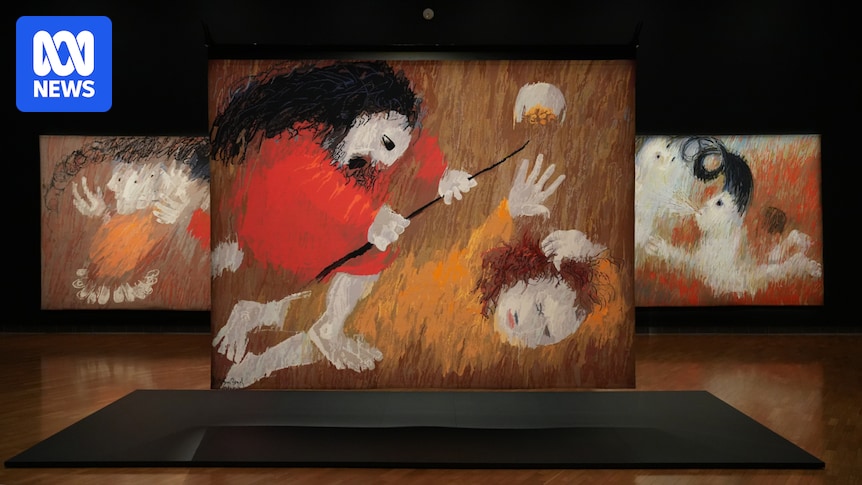
For five decades, a collection of 20 monumental tapestries commissioned by one of Australia’s most significant 20th-century artists has largely sat in storage.
Arthur Boyd never saw the full series displayed before he died in 1999.
For the first time, the entire collection of tapestries will finally be available to the public at the National Gallery of Australia (NGA) in Canberra.
Elspeth Pitt says there has long been a desire for the collection to be displayed in full. (ABC News: Lily Nothling)
“This exhibition has been 50 years in the making,” senior curator Elspeth Pitt said.
“There’s been a long-held ambition to display them, and we’ve finally after all of these years made it happen.”
In the late 1960s, Boyd approached a Portuguese workshop about translating his pastels depicting Saint Francis of Assisi into enormous tapestries.
Between 1970 and 1974, teams of weavers at the Manufactura de Tapeçarias de Portalegre painstakingly brought his vision to life.
“Each of the 20 tapestries comprises between 4 and 8 million individual stitches,”
Ms Pitt said.
Each work measures 2.5 metres by 3.4 metres.
Vera Fino says the tapestries were all woven by hand. (ABC News: Lily Nothling)
The workshop’s director, Vera Fino, said weavers worked shoulder to shoulder around the clock, adding 3 centimetres to the tapestries each day.
“The weaving is all done by hand with no instruments,”
she said.
“In some of the cases, Boyd was in a hurry to get them … which means they were done in [three, eight-hour] shifts … so the tapestries could be finished in time.”
Despite the NGA’s efforts, the names of only some of the weavers involved at the time could be unearthed.
The artist and the saint
Ms Pitt said the Saint Francis tapestries were a “big undertaking” for Boyd.
Arthur Boyd, pictured in 1993, died before getting to see the full tapestry series displayed. (Supplied: National Gallery of Australia / Gregory Weight)
“He paid an equivalent sum for the works of about three quarters of a million dollars in today’s money,” Ms Pitt said.
The medieval Italian saint was a longtime source of fascination for the artist.
“It may seem strange that this Australian artist working in the middle of the 20th century was so interested in the life of this saint … but I think for Boyd, Saint Francis was a touchpoint throughout his life,” Ms Pitt said.
“Saint Francis, like Boyd, was an artist, a poet, an environmentalist, a pacifist.
“So I think there was a resonance between these two men.”
St Francis cleansing the leper, 1973, is one of the 20 tapestries on display in the exhibition. (Supplied: National Gallery of Australia)
The tapestries were acquired by the NGA in 1975 — seven years before the gallery opened to the public.
While some of the tapestries have been brought out of storage in the past, the exhibition marks the first time the full suite has been hung together.
“It is quite emotional, in a way, to be able see these works come together — and to see them in a way Arthur Boyd wasn’t able to,”
Ms Pitt said.
The exhibition opens to the public on Saturday.