






Albury residents could face one of the largest NSW council rate increases of recent years, with councillors voting to seek community feedback on plans to help address its estimated $18 million of debt.
Albury City Council will consult the community on two special rate variation (SRV) options, including increasing rates by 40 per cent over three years or 42 per cent over two years.
If approved by the NSW Independent Pricing and Regulatory Tribunal (IPART) either proposal would exceed most special rate variations granted across the state last year.
Only North Sydney Council’s 52.66 per cent increase over three years and Glen Innes Severn Council’s 48 per cent rise have been approved by IPART at a higher level.
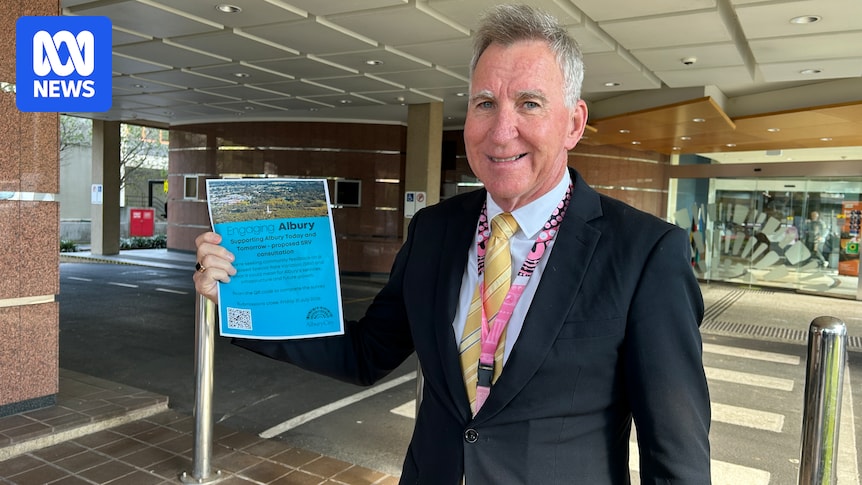
Mayor Kevin Mack said the decision was a “catch 22” situation and was made after significant savings had already been made over the last eight months, along with increases in wages and fuel costs.
“The figure at 40 and 42 per cent is the worst case scenario,” Cr Mack said.
“We haven’t even arrived at what that final figure will be, but better to deal in that space than have to come back again and say we got it wrong.
He also criticised cost shifting from federal and state governments, along with the rate peg never being in line with inflation, as other factors forming the decision.
“There’s multiple inquiries at the state and federal level about the practical nature of funding local government and how we can sustain local government, but nothing happens,”
he said.
Albury City Council is considering a rate rise of up to 42 per cent over the next two years. (ABC News: Ashlee Aldridge)
Needing to meet community expectations
All but one councillor voted in favour of the motion put to council, but many spoke out against the SRV, citing financial pressures on the community.
Deputy Mayor Jess Kellahan said she would make it clear she does not approve of the extreme rate hike and said council needed to look harder at its own spending.
“The people of Albury did not decide to undercharge developer contribution for years, they did not determine borrowing strategies, they did not approve capital projects or create structural imbalance between income and expenditure,” she said.
“Yet they have now been asked to pay the bill.”
Jess Kellahan said she could not support the large proposed standard rate variations. (Facebook)
Cr Darren Cameron, who was the only vote against the council’s motion, said it was beyond him why anyone would consider an SRV.
“Special rate variations are an admission of failure,”
Cr Cameron said.
“We continue to spend $2.5 million a year on [the Murray Art Museum Albury] … despite the promises that we were given in the past of philanthropic funding coming along to save us all, like a knight on a white horse.
“These are not core areas of local government. We need to be tough.”
Cr Geoff Hudson said the idea of roads, rates, and rubbish was no longer in line with community expectations, and it was important to continue providing other services like community halls.
Albury will be one of the most expensive councils in terms of household rates in NSW if the rate rise is approved. (ABC News: Ashlee Aldridge)
He said it was also important to be up-front about the council’s financial situation.
“Our community cannot, in my view, accept the level of cuts that would be necessary to avoid this special rate variation,” Cr Hudson said.
“We know that even if we did apply the $18 million or so in cuts necessary to avoid it, we would actually just be back here in the next five to 10 years anyway.”
Albury could become ‘unaffordable’
Resident Charlie Mitchell spoke against the proposed rate rise options at a public forum last week, saying the council faced a significant debt challenge but the increases being considered were unaffordable for many residents.
“We know Albury Council has a serious general fund debt problem. If council simply relies on the normal rate peg borrowings will rise to over $250 million over the next 10 years,” he said.
“Which is not sustainable.”
Mr Mitchell said he doubted council’s proposal would meet the affordability criteria required by IPART.
“Based on financial modelling across 128 NSW councils, once the proposed rate increases are applied Albury will be one of the most unaffordable councils in the whole state when household income is considered,”
he said.
Mr Mitchell said the proposed increases would have a lasting impact on households because they would be permanently built into rates.
“For the average residential rate payer that is around $760 to $860 per year for the period,” he said.
He said the increases would affect not only home owners but also renters, as landlords passed on higher costs.
“It affects fixed income pensioners, it impacts people already trying to manage food, fuel, insurance, electricity, school costs and medical expenses,” Mr Mitchell said.
“Residents are already under financial stress.”
Mr Mitchell proposed an alternative of four annual increases of five per cent, which he said would allow council to manage its budget while remaining below debt ratio thresholds.
Steve McGrath said there will be plenty of work over the next six weeks to identify what the community accepts. (Supplied: Albury City Council)
Albury CEO Steve McGrath said there were limited opportunities outside of rates to reduce debt.
But he also anticipated that the 40 and 42 per cent options could be reduced when the proposal was brought back to the council following feedback.
“What that looks like I am not in a position to say,” he said.
“That’s the subject of some further work over the next month to six weeks.”
The council will make a final decision on the SRV later this year before applying to IPART.