




Iran’s ‘Shirzanen’ or ‘Lionesses’ have been fighting for rights since the 1979 Revolution, when the hardline Islamist regime made the hijab mandatory.
But for every one of them, there are other women: the ones who support the Ayatollah and the strict observance of Shia Islam.
They are vocal and ready to strike at those they see as the ultimate infidels. As the ABC travels around inside Tehran, they tell us their stories.
These women are the faithful foot soldiers of the Islamic Republic of Iran, and since the outbreak of the war with Israel and the United States on February 28, they have been mobilising across the country.
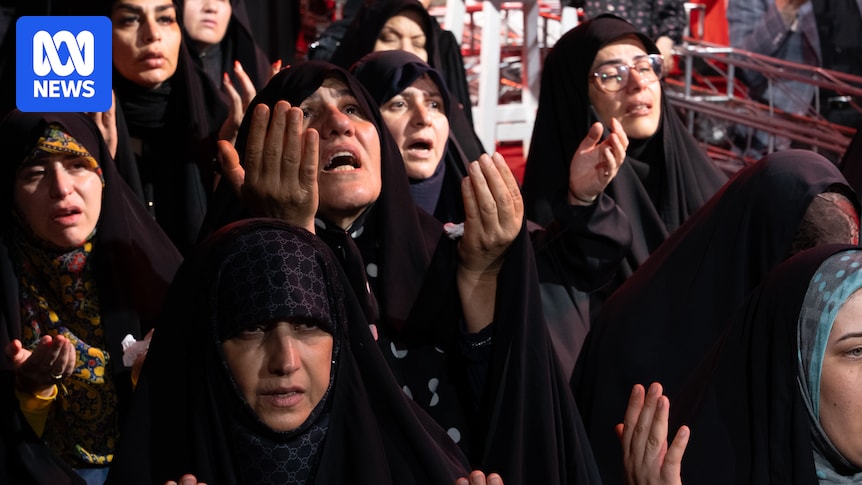
On this cool night in Tehran, they are huddled together on the edge of Engelab or Revolution Square.
They are surrounded by hundreds of people waving Iran’s green, white and red flag.
The air is thick with patriotism and disdain for the United States and Israel.
As the women gather, music blares from speakers and they strain to hear instructions on how to use high-powered weapons.
“In a combat zone, if I have cover, like a vehicle, a building, or a trench … then I fire standing up,” says the woman standing in the middle of the huddle, brandishing an AK-47.
She has thick, shapely eyebrows and wears military fatigues under a black chador that flows from her head to her feet.
“And let me say something else: with weapons, physical strength is not what matters,” she says.
This scene plays out in Tehran’s public squares as women gather and vow to fight and die for leaders who are accused of brutalising them.
“Iran’s enemies are America and the Zionist regime of Israel, who have proven their cruelty and injustice by killing children and innocent people,” says Zahra Taheri, a studious-looking 14-year-old who had been listening intently to the woman with the gun.
“We were deeply outraged. But we still believe that we will never back down in the face of the enemy.“
In May, the ABC was given rare access to the country on the condition that we remain in Tehran and work with a translator from a pre-approved local media company. The translations were independently verified for accuracy.
The first event we are directed to is the pro-regime rally at Enqelab Square, a sign of the support for a war that started when former Supreme Leader Ali Khamenei was killed in a joint US-Israeli strike.
The people attending these rallies represent a specific segment of Iranian society — those who are deeply conservative and deeply committed to a strict observance of Shia Islam espoused by the clerical government.
Almost all the women at the rallies are dressed in the traditional chador.
Their attire is in stark contrast to women in most neighbourhoods we visit throughout Tehran, where many do not even wear a headscarf.
This community remains enraged by the killing of the 86-year-old Supreme Leader in February.
For almost 37 years, he was the ultimate defender of their faith and the only political leader many Iranians had ever known.
He was also the leader who oversaw the brutal repression of protesters against his regime.
Three months on from his death, and under the rule of his son Ayatollah Mojtaba Khamenei, the rage felt by his supporters is still palpable at a memorial site erected at the entrance of Khamenei senior’s bombed-out compound.
Hundreds of people, the majority of whom are women, congregate here every night to mourn his death.
“I loved him more than my own father,” says Zeinab, 33, her face wet with tears.
“Our leader gave us women freedom. He gave us women critical thought. He taught us independence.
“And Trump killed him. I only want revenge.“
Martyr versus the ultimate ‘infidel’
Amongst Iran’s most devout Shias, Ali Khamenei is revered as a martyr, while US President Donald Trump is viewed as the ultimate ‘infidel’.
In April the president threatened to annihilate Iran, saying that “a whole civilisation will die tonight” unless the country agrees on a deal to end a war that the US and Israel initiated.
Since then human rights monitors estimate that more than 1,700 civilians have been killed in attacks on Iran alone.
Amongst the dead are the 120 children killed in the southern city of Minab when a suspected American tomahawk missile struck their primary school.
While the US government has not accepted responsibility, some reports suggest the US military mistook the school for a neighbouring military base.
“Every time I see images of that school, it breaks my heart,” says Rahele Najafizadeh, 47, a mother of three and Qur’anic studies teacher at one of the Islamic Azad Universities in Tehran.
“Maybe it’s because I have a child of that age myself. I simply cannot accept it.”
She attends rallies almost every night since the war erupted, chanting “Death to the US, Death to Israel”.
“What I have witnessed in society is that it has had a very powerful impact,” Rahele tells 7.30.
“The deaths of the children of Minab showed many people the cruelty of the United States and Israel.
“For a large number of people, this has been an awakening.”
Authorities have fuelled this anger by erecting wall-sized photos of the dead children along busy roads in the capital, a chilling reminder of the price innocent Iranians have paid in this war.
Across Tehran there are also several murals painted on walls, depicting anti-American rhetoric.
And while the public outrage is genuine, activists say the Islamic Republic continues to use America’s air strikes and attacks to deflect attention away from its own deadly repression of those who speak out against the regime.
Surviving the ‘hunting season’
Just four months ago crowds of people mobilised across the country in the largest uprising Iran has seen since the 1979 Revolution.
According to a UN Fact-Finding Mission, the demonstrations began after merchants in Tehran’s Grand Bazaar went on strike over a collapsing currency and food inflation spiking above 70 per cent.
The unrest rapidly spread across all 31 provinces in the country.
People demanded their basic right to earn a living. What they got was the most violent crackdown inflicted on Iranians in decades.
Thousands were killed by security forces.
“I use the phrase ‘hunting season’. That’s exactly what it was like,” says a female protester in her 20s, who participated in the uprising and sent 7.30 anonymous voice notes from inside Iran.
“It’s like it was a game for them, like entertainment.
“They had weapons and we were bare-handed. They were murdering us … they would make us run through the streets and then shoot at us.
“There was blood flowing in the streets.“
At the time Amnesty International reported that eyewitness accounts and verified videos showed security forces firing metal pellets into crowds from street level and rooftops, including mosques, frequently targeting people’s heads and torsos.
Supreme Leader Ali Khamenei denounced the demonstrators as “rioters”. Then on January 8 and 9, the repression escalated into a full-blown blood bath.
“On Enqelab Street, when I saw people falling, I didn’t understand what was happening,” the protester tells 7.30.
“I didn’t realise that the person who had fallen had been killed by bullets. There wasn’t even a chance to get to them.”
Medical facilities were reportedly overwhelmed. Families frantically searched morgues stacked with bodies for missing loved ones.
“On January 8, when a young man was shot in his throat, I performed CPR on him with my own hands,” says a doctor in his 40s, who doesn’t give his name out of fear of punishment.
“While I was giving him mouth-to-mouth resuscitation, he died. My mouth was full of his blood. I failed to save him.”
The UN Special Rapporteur on Iran, Mai Sato, said that at least 5,000 people had been killed, while the US-based Human Rights Activists News Agency (HRANA) estimated the death toll was 6,508, a figure that does not include the deaths of more than 220 children.
HRANA is still reviewing some 11,700 cases.
Authorities say that at least 300 members of the security forces were killed but the true extent of the January massacre may never be known.
A government-imposed internet blackout that lasted almost 90 days cut the flow of information to the outside world.
Is ‘real freedom’ possible?
This latest revolt comes just three years after the “Woman, Life, Freedom” movement, which was triggered by the death of 22-year-old Mahsa Amini, who was detained by the morality police for failing to strictly follow the hijab dress code.
At least 550 people, including women and girls, were killed during those protests, according to HRANA.
Iran’s Foreign Minister and the Vice President for Women & Family Affairs did not grant the ABC’s request for an interview when we were in Iran but during our time in Tehran, we see women of all ages openly flouting the hijab laws and no longer wearing their headscarves.
It appears Iran is now at a crucial crossroads, caught between its commitment to faith and its struggle for freedom.
“What I want is to live in a society where people — men and women — love God and strive to do what he asks of them,” Rahele tells 7.30.
“If everyone loved God and followed His teachings, there would be no wars and no injustice. People would live together in peace.”
Peace is also what the young protester wants, but she says it will only come if the regime falls.
“My dream for the future is to see a free Iran soon,” she says.
“Freedom is not just about wearing a hijab. Real freedom is when you don’t fear speaking or expressing your views. It means not being afraid simply to exist.”
Credits:
Reporter: Karishma Vyas
Photography: Daniel Pannett
Digital production: Jenny Ky and Myles Wearring
Editor: Paul Johnson
Watch 7.30, Mondays to Thursdays 7:30pm on ABC iview and ABC TV