


One of Australia’s leading figures in rainforest conservation, Dr Tony Parkes AO, has died aged 96, leaving a legacy of groundbreaking science and millions of replanted trees.
A merchant banker turned conservationist, Parkes had said his conservation work got him out of bed every morning.
“I’m one of those fortunate groups of people who are now termed biophiles,” he told the ABC in 2024.
“We have a strong connection with and love of the natural environment, and that’s really been a guiding principle of my whole life.”
Parkes grew up in Hobart, where his earliest memories are of playing in boats and in the nearby bushland.
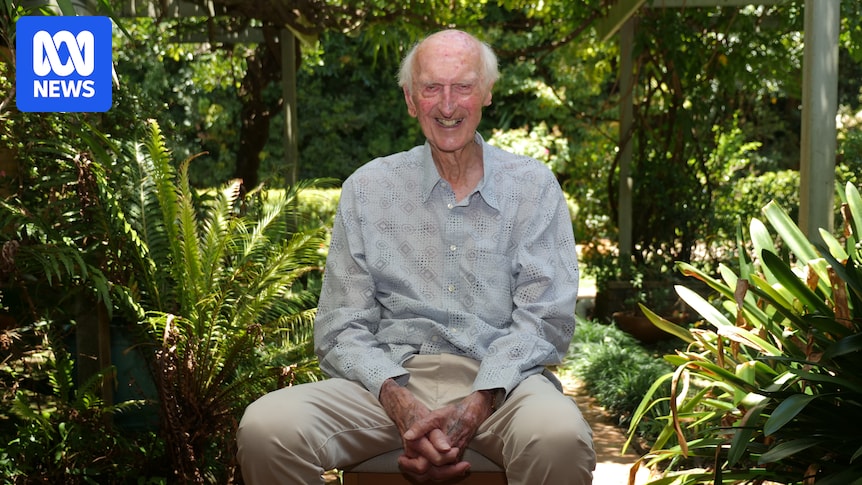
Parkes said planting 40,000 rainforest trees on his property had been the joy of his life. (ABC News: Emma Rennie)
After gaining a PhD in chemistry and postgraduate qualifications in business, much of his career was spent in what was, at the time, a relatively new field: investment banking.
His roles ranged from being the general manager of a fertiliser company to being the chairman of a merchant bank.
“I always had a plan to quit in my mid-50s to spend more time with my gorgeous wife and to get out of the corporate field. I’d had enough of that,” he said.
He and his wife, Rowena, chose to build a home in the NSW Northern Rivers, and during this time, Parkes learned about the Big Scrub rainforest, which traced its origins back millions of years to the Gondwana supercontinent.
The Big Scrub is descended from the Gondwana rainforest that covered Australia 40 million years ago. (Supplied)
By the time he moved to the Northern Rivers in about 1990, the Big Scrub was reduced to about 80 remnants scattered across the region after decades of land clearing.
“I can remember going in there and being absolutely stunned by the diversity of life forms,” Parkes recalled of his first trip into a pocket of Big Scrub.
“There are trees and fungi and ferns, and a whole diversity of each of those life forms.
“The extent of the biodiversity is mind blowing and beautiful beyond description.
“I fell in love with the rainforest on that first visit, and I’m still madly in love with it 35 years later.”
A chance encounter with rainforest ecologist and nursery owner Mark Dunphy sparked a new venture that would push rainforest conservation forward in leaps and bounds in the form of the Big Scrub Landcare. This was later rebranded as the Big Scrub Rainforest Conservancy.
The group spearheaded a campaign to protect the remaining rainforest remnants and promote regeneration.
Mark Dunphy co-founded the Big Scrub Landcare group with Tony Parkes in 1993. (ABC News: Emma Rennie)
“I thought, ‘Well, how’s this merchant banker who doesn’t have my politics going to work in this conservation restoration industry?,” Mr Dunphy had said in the years prior to Parkes’s death.
“But he brought all these fantastic skills to the table. His ability to manage money, and raise money, and manage projects has been just exemplary.
“He’s been an absolutely amazing leader. He’s been like a father figure to me in many ways.“
United by their shared loved of the rainforest, Mark said Tony had been like a father to him. (ABC News: Emma Rennie)
World-leading work an ongoing legacy
The conservancy grew to oversee about 200,000 trees planted annually in restoration projects.
But Parkes and his colleagues were determined to do even more.
“The problem we’ve had from the outset with the remnants is, because they’re isolated and scattered, there’s not much flow of pollen or seed between them,” he said.
The conservancy began working with scientists to analyse the genome of rainforest species.
The ongoing project uses that data to identify and propagate the strongest examples of each species to ensure the best genetics are used in future planting.
“This is world-leading application of genome science to restoring critically endangered ecosystems,” Parkes had said.
Mark Dunphy, Tony Parkes and members of the Science Saving Rainforests team in 2024 at a macadamia plantation that was going to be turned into rainforest conservation. (ABC North Coast: Hannah Ross)
In 2019, Parkes was named an Officer of the Order of Australia for his conservation efforts, which had also included planting 40,000 trees on his own property.
He said he had been blessed over the 35-year journey.
“I love planting trees, it’s the joy of my life,” he said.
And he was never interested in retirement.
“I wouldn’t ever retire. This is too important. It gets me up every morning,” he said.
“I love this project, I love the people I work with. I love the rainforest. And what better way could there be to spend your time than helping to save it?”
Parkes is survived by his brother Anton, his children Abby, Trina and Richard, Richard’s wife Yiska, grandchildren, and a great-grandchild.
Richard said his father had shown incredible will and passion for his work that he hoped would inspire others.
“Tony was always driven by an undying curiosity and a desire for understanding and truth, and this drove his zest for life right up until his dying breath,” he said.
The Big Scrub Foundation said: “Tony leaves an extraordinary legacy that will continue to shape rainforest conservation and restoration for generations to come.”