








Artist David Hockney, whose paintings of pools shimmering in the Los Angeles sunshine became icons of 20th-century art, has died at the age of 88, his publicist has announced.
Hockney was born in the north of England but lived much of his life in Southern California, making its sun-drenched suburban views a major motif.
Later in life, he returned to Europe, finding renewed inspiration in the wooded hills of his native county of Yorkshire and the fields and trees of France’s Normandy region.
He became one of the UK’s most treasured artists, his works selling for record prices at auction.
Historian Simon Schama said that “the popularity and durability of David Hockney’s art, through all his shape-shifts and restlessly inventive experiments, are really no mystery”.
David Hockney’s Portrait of an Artist (Pool with Two Figures) sold for more than $US124 million ($176 million) at auction in 2019. (Supplied: Christie’s/David Hockney)
“His work is admired — loved is not too strong a word — by the millions who, worldwide, flock to see it because it presupposes an expectation of pleasure,” Schama wrote in an essay accompanying a 2025 Hockney exhibition in Paris.
Hockney’s publicist, Erica Bolton, says he died a few weeks short of his 89th birthday.
With his trademark round glasses and bleached-blond hair, Hockney was a well-known figure in the swinging British and American art scenes of the 1960s, even before he reached the age of 30.
His paintings were just as distinctive, many of them creating a dreamlike world of patterned light bouncing off water and windows, and human forms rendered in flattened, simplified shapes in matte acrylic paint.
“I’m excited every day,” he told the Los Angeles Times in 1979.
“London has lots of dreary parts but I never find anything dreary in Los Angeles.”
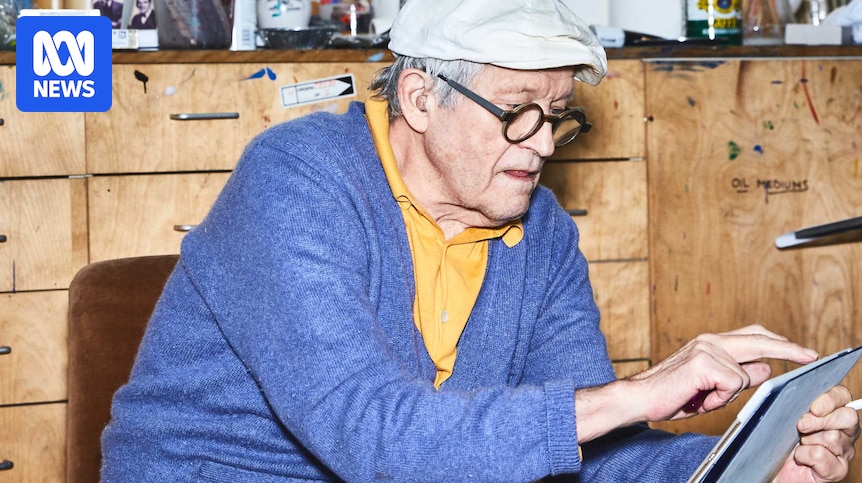
David Hockney in his studio in Los Angeles in 2017. (Supplied: Shaughn and John)
He shared with other pop artists an interest in the polished surface of modern life. And, like Andy Warhol with his Brillo boxes and Campbell’s soup cans, Hockney occasionally incorporated advertising labels, such as a British Typhoo Tea box used in his 1961 “Tea Painting in an Illusionistic Style”.
He told The New York Times in 1964 he enjoyed the burgeoning pop art scene in New York but wasn’t sure he was part of it.
“I’m just an ordinary artist,” he said.
“I do admire American pop — in fact it seems that everything fresh-looking and vital in England these days has been coming from the US.”
Nonetheless, he still considered himself “very much an artist in the English tradition,” he said in 1995.
Even his move to California had a historic precedent, he noted, since earlier generations of English artists had sought out the brilliant light of Italy.
As an openly gay man, Hockney explored erotic themes, giving youthful male bodies the same tender scrutiny that artists had been giving the female nude for centuries. Friends and lovers frequently posed as models, and some images were based on photos in men’s bodybuilding magazines.
AP/ABC