







Mining billionaire Andrew Forrest has denied his agreements with Indigenous people need to be reworked after a landmark Federal Court decision ordered his company to pay one group $150 million in compensation.
Mr Forrest’s Fortescue was last month ordered to pay the record-breaking sum to the Yindjibarndi people, finding the miner had destroyed 124 sacred sites while building its Solomon Hub mines without permission.
Speaking to the ABC for the first time since the ruling, Mr Forrest insisted his company’s seven existing arrangements with Pilbara traditional owners were fair.
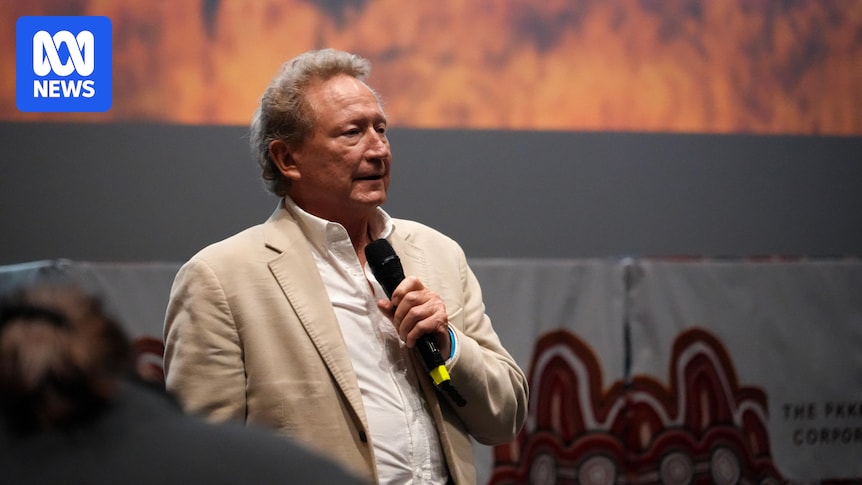
Andrew Forrest spoke to the ABC at the signing of another agreement with First Nations people in Karratha. (ABC News: Alistair Bates)
“We’re not finding these agreements difficult nine out of ten times,” he said.
“One out of ten you have a disagreement. That’s because it’s a proper family, it’s a proper relationship.
“It’s not just ‘what do you want? Here’s a cheque.’
“We’re about to sail through $7 billion in Indigenous business contracts. That’s what we’ve done across the Pilbara to all our agreements.”
Fortescue founder Andrew Forrest landed in Karratha on Thursday. (ABC Pilbara: Alistair Bates)
Asked if Fortescue would review its attitude or approach to native title negotiations in light of the Federal Court loss, Mr Forrest rejected the idea.
“Mate, I’m here respecting the Federal Court, so I won’t get drawn on that,” he said.
“But I can say go ask people who are seriously independent, who have made their own way and they’re Indigenous. They’ll tell you all over the world.
“If you just had [cash handouts] … you wouldn’t be standing where you are.”
The Yindjibarndi people are still weighing up whether to appeal against the $150 million ruling which is a fraction of the almost $2 billion they were asking for.
Fresh deal signed
Mr Forrest was speaking in Karratha, a mining city in WA’s Pilbara, to ink a fresh deal with another group of traditional owners, the Punti Kunti Kuruma and Pinikura (PKKP) people.
An existing agreement written in 2010 saw Fortescue’s lucrative Eliwana mine produce its first iron ore in late 2020.
The project now boasts a production capacity of up to 31 million tonnes of ore per year, with further expansion proposed to extend the project’s life for more than a decade.
The new deal replaces a 16-year-old land use agreement after three years of negotiation and costs covered by Fortescue. (ABC Pilbara: Alistair Bates)
“This agreement confirms our entire attitude towards native title which is a help up, a hand up, not a handout,” Mr Forrest said.
“So, yes, there’s always some cash involved, but the PKKP went hard on business opportunities, on employment, on things which they know are going to lift their people, and then the cash goes into a trust.”
PKKP land committee chair Burchell Hayes said the financial benefits were far from front of mind during the mediation process.
Rather, it was preventing a repeat of the blasting of Juukan Gorge by Rio Tinto almost six years ago on his country.
“The main focus for me was ensuring that we never ever experience another devastating event on PKKP country ever again,” Mr Hayes said.
The destruction of two 47,000-year-old rock shelters at Juukan Gorge shed harsh light on the shortcomings of Western Australia’s Aboriginal heritage laws which allowed the dynamiting to occur with state government sign-off.
Having come to a new deal with Rio Tinto last year, PKKP said they have now secured an “exclusion” mechanism with Fortescue.
PKKP lands and waters span almost 11,000 square kilometres of WA’s Pilbara region between Onslow and Tom Price. (Supplied: PKKP)
It will allow them to carve out culturally significant areas from operations, regardless of government approvals.
These zones are subject to expert archaeological backing, with the burden of proof to be determined on a site-by-site basis.
It is understood to be the only measure of its kind in any of Fortescue’s agreements with traditional owners.
“We can’t rely on government legislation to help us protect our country, especially our significant country,” Mr Hayes said.
“So it will enable us to work outside that legislation.”