








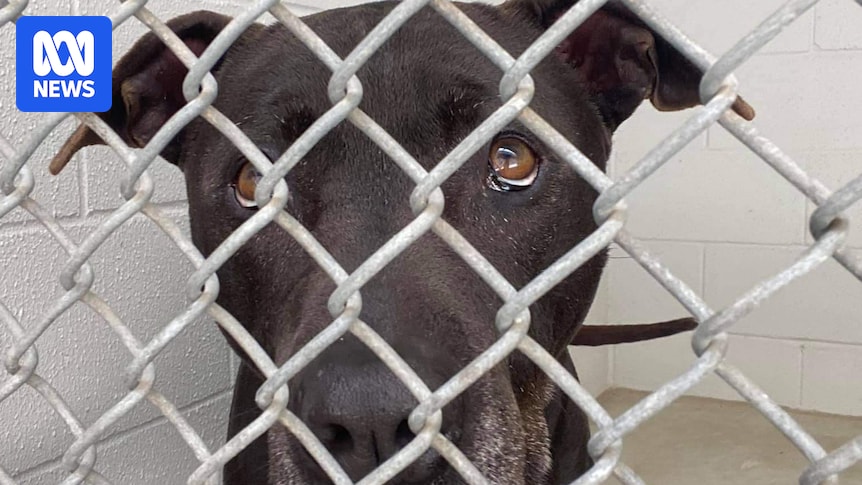
A Queensland council says new laws are behind a 150 per cent increase in dogs being euthanased.
Data from a Right to Information (RTI) request published by the Sunshine Coast Council show it euthanased 82 dogs in the year after the laws were introduced in 2024, up from 32 the year before.
The figures show this trend continued in the following 12 months, with 101 dogs put down last year.
Sunshine Coast Council says the increase “reflects changes introduced” by the state government.
“Council is legally required to comply with these provisions,” it said in a statement.
Kara Chaplin with her dog, Sarge, before he was put down. (Supplied: Kara Chaplin)
For Kara Chaplin, the debate about dangerous dog laws is personal.
The Sunshine Coast resident’s dog, Sarge, was euthanased in 2019, before the 2024 law changes, following three incidents with other animals, one of which resulted in the death of a small dog.
Ms Chaplin said she spent more than $60,000 trying to stop the American Staffordshire terrier from being put down.
“He was family to us,” she said.
Ms Chaplin said she was concerned the recent law changes might leave less scope for individual circumstances to be considered in some cases.
“I spent years fighting the decision because I believed there were inaccuracies in our case,”
she said.
New laws and ‘destruction orders’
The new laws followed high-profile attacks and made it a requirement for a dog to be euthanased if it was already regulated, meaning it had been declared dangerous, menacing or a restricted breed, and was involved in a subsequent serious attack.
So-called destruction orders can be made if a regulated dog kills, seriously injures or is deemed to pose a significant future risk. However, court decisions and reviews can sometimes delay and change outcomes.
Sunshine Coast Council says responsible owners prevent dog attacks. (Supplied: Sunshine Coast Council)
Sunshine Coast Council did not say how many dogs were linked to destruction orders following attacks.
However, RTI data shows that of the 82 dogs put down in the 2024-25 financial year, three were due to an “attack”, 36 failed a temperament test, 21 were “aggressive”, and 10 were deemed “a regulated dog”.
The figures show that four dogs were put down for health reasons in the same period.
The council said euthanasia was “always a last resort” and it “understands that decisions affecting animals can be upsetting”.
More deaths than larger Queensland councils
Queensland dog attack, euthanasia and destruction order data is not routinely published publicly, and many local governments gather information in different ways, making broad statewide comparisons difficult.
But, when compared to attacks, data suggests the Sunshine Coast’s euthanasia rates outpaced cities across Queensland last year, alongside Cairns.
Of more than 800 dog attacks and incidents reported to the Cairns Regional Council in 2025, destruction orders were issued for 12, and 288 were euthanased due to aggression, serious health or behaviour issues, and included those voluntarily surrendered by owners who were “unable to continue care”.
A CRC spokesperson said 991 dogs were also impounded last year, hundreds more than other larger regions in the south-east.
Meanwhile, on the Sunshine Coast, there were 309 reported dog attacks and 101 dogs euthanased.
In Brisbane, home to roughly a million more people than the Sunshine Coast, there were more than 1,400 recorded attacks, while 88 dogs were euthanased in the same period.
The Brisbane City Council said about a quarter of the deaths were linked to destruction orders.
A new Gold Coast City Council campaign aims to remind dog owners of the tougher penalties. (Supplied: Gold Coast City Council)
On the Gold Coast, the city said there were more than 600 attacks, and 61 euthanased, with 10 per cent receiving destruction orders.
Brisbane-based behaviour veterinarian Cam Day said the increase in euthanasia because of the legislation was “worrisome”.
Dr Day said it was important that reporting and statistics on dog attacks and euthanasia rates were transparent.
Campbell Day with his German shepherd, Shadow. (Supplied: Dr Cam Day)
He added that the data required careful interpretation to accurately determine what had caused the increase in dogs euthanased on the Sunshine Coast and other local governments.
“We need to look at where the statistics come from,” Dr Day said.
“It could just be an increased number of dogs in the community.”
Euthanasia a ‘foreseeable consequence’
Dr Day said in his experience, more dog attacks did not involve inherent aggression.
“The ones I get involved in are often accidental, the dog accidentally escapes or has a startle response,” he said.
He said responsible pet ownership and understanding how pets interact with people and other animals were important to avoid authorities becoming involved.
“I know the councils always regard euthanasia of a dangerous dog as the very last course of action,” Dr Day said.
Amanda Kennedy specialises in animal management law and regulation. (Supplied: QUT)
Queensland University of Technology law professor Amanda Kennedy said the law change had reduced councils’ discretion in the most serious cases.
“Where a regulated dog seriously attacks again, destruction is now legally mandated rather than a matter of judgement,” Professor Kennedy said.
“This may produce outcomes [in some instances] that could feel disproportionate.“
She said an increase in euthanasia was a “foreseeable consequence” of the changes.
The Department of Primary Industries said the law amendments were made to strengthen the management of regulated dogs and to “minimise risk to community health and safety”.
It said primary responsibility for enforcing the laws fell to local councils.