








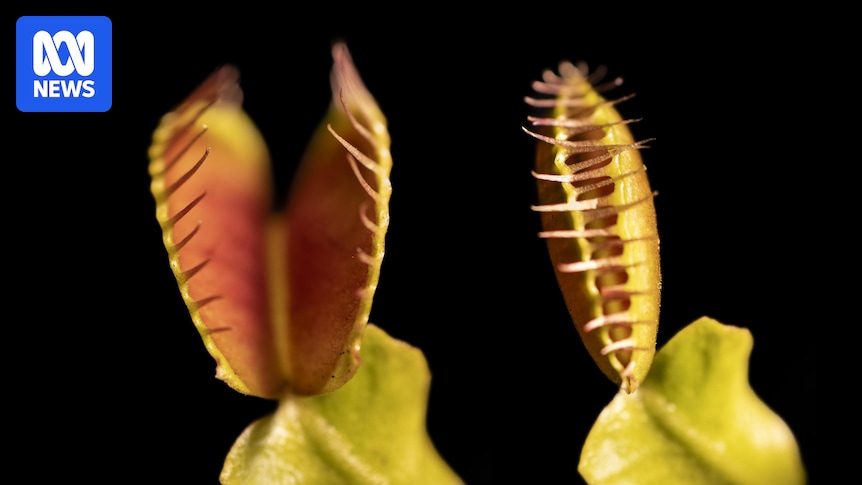
The Venus flytrap’s ability to snap shut without using muscles, has perplexed scientists for more than a century.
When the jaw-like leaves of the plant detect an insect, they swing closed in about a tenth of a second, trapping prey inside.
But it’s still not clear exactly how the leaves can close so fast.
A new study published in the journal Science claims to have solved a key part of the mystery.
Yoël Forterre, a co-author on the paper and a physicist at Aix-Marseille University said that the plant has been difficult to study because its movement was so fast.
“Classical techniques are often too invasive and immediately trigger the trap, making it very difficult to probe the plant’s mechanical state,” Professor Forterre said.
There are two existing theories for how Venus flytraps shut, once they’re triggered by something touching the tiny hairs on the insides of their leaves.
One theory was that water moved to cells in the outer layer of the trap’s leaves, swelled them and forced the leaves to clamp shut.
The other theory suggested the walls of these cells in the outer layer of the leaves softened, or relaxed, which caused the more rigid inner sides of the leaves to buckle together.
Testing the Venus flytrap mechanism
The researchers designed experiments to test both of these theories by slicing Venus flytrap jaws open.
“We literally modified the geometry of the trap by cutting thin slices into it,” Professor Forterre said.
This removed the trap’s clam shell-like geometry, which made it harder to see what was going on inside.
The researchers also glued traps open with dental impression paste.
“This kept the trap fully functional while preventing the large movements that would otherwise interfere with the measurements,” Professor Forterre said.
Loading…
To test the water-transport theory, the researchers used tiny needles to inject water into cells, measuring how quickly it spread through the plant’s tissue when it was triggered.
Then, on separate plants, they measured cell wall stiffness with an equally tiny probe while the trap was triggered.
They then did subsequent tests with moulds of the traps, to check that there weren’t other things throwing off their cell wall measurements.
Study suggests cell walls snap the trap shut
The researchers said their modelling suggested that water moves too slowly through the plant to be the mechanism that shuts the trap.
Instead, they think their results support the second theory: that the relaxing cell wall cause flytraps to close.
“What surprised us most was not only that water transport turned out to be too slow, but also that the mechanical signature of closure pointed so clearly to a rapid softening of the cell wall,” Professor Forterre said.
Venus flytraps fascinated Charles Darwin, and scientists have been trying to understand their mechanisms ever since. (Supplied: Jeanne Bourdier/Corentin Mollier)
Kim Johnson, a researcher at La Trobe University who wasn’t involved in the study, said that researchers were starting to understand that cell walls could have a bigger influence than previously thought on the skin of plants.
“But what they’ve shown that’s really novel is just how quickly that can happen.”
She said that the study reinforced the importance of cell walls in plant physiology.
Australian National University plant scientist Marilyn Ball, who also wasn’t involved in the research, said the new study was “extraordinary” with its mechanical explanation for how a flytrap snaps.
She said the results were striking considering other developments in our understanding of plant cell walls.
“Cell walls are now recognised as lively and dynamic participants in cellular responses to environmental and biotic stresses,” Professor Ball said.
Loading…
Professor Ball also noted other studies had found plant proteins which could respond to stressors within a few seconds, and these could be what was driving the flytrap jaws shut.
“This raises the intriguing possibility that complex systems that have evolved to maintain cellular functions may have been further deployed in the evolution of complex systems to trap prey,” she said.
But Sergey Shabala, a plant physiologist at the University of Western Australia, was not convinced by the study’s findings.
Professor Shabala said there was another mechanism for water transport that the researchers hadn’t considered, which would make it fast enough to drive the trap shut.
Water in a line of cells could move simultaneously, allowing for faster transport than if it shifted from cell to cell, he said.
“There’s an assumption that the water moves from one cell to another one, [but] the water can move in parallel, not necessarily consecutively.”
Venus flytraps are native to the US and are a threatened species in the wild due to illegal collecting. (Flickr: Gemma Sarracenia, Venus flytrap, CC BY 2.0)
He also didn’t believe it was likely for a cell wall to relax as quickly as the researchers proposed, because there wasn’t a biological mechanism that could do it fast enough.
“There is absolutely no way it can occur in a couple of seconds.”
Professor Shabala added that the researchers’ theory didn’t explain how the trap could reopen in five minutes after it shut.
“Nature is very complicated. There are many complementary parallel mechanisms,” he said.
“So maybe the change in property of the cell wall has something to do with it, but it does not rule out water transport and it cannot be the primary reason for closure.“
However, Dr Johnson said that there were possible ways for the cell wall to react as quickly as the study suggests that it did.
But she said that more research needed to be done to confirm this, since the study relied on very indirect measurements.
“A lot of it has to be inferred because it’s really difficult to measure these types of things at that scale.”
More work needed to probe mechanisms
Professor Forterre said his team would need to collaborate closely with biologists to understand the Venus flytrap’s mechanism more deeply.
“We believe we have identified the physical mechanism responsible for closure, but we still do not know how the plant controls it.”
But, if the plant is using this relaxing cell wall mechanism to shut, he said it could lead to new avenues of engineering.
“This concept could inspire new types of soft robotic systems or adaptive materials that remain stable for long periods, store significant amounts of energy, and then produce very rapid movements on demand.”