





Pope Leo XIV has celebrated Spain’s Sagrada Familia Basilica as a masterpiece of “stones, colours and light,” as he marked the centenary of the death of its architect Antoni Gaudí, with a mass to inaugurate its final soaring sandcastle spire.
Pope Leo called Gaudí’s unfinished temple in Barcelona — one of the world’s most visited monuments — a “sign of unity and harmony for all of Spain”, and likened the ongoing construction project to the lifelong journey all Christians make to find God.
Leo’s visit to the Sagrada Familia is the third by a pontiff, and the first time a pope has visited in 15 years. (Reuters: Michele Spatari)
“We are all the living stones of this edifice,” he said from the altar of the basilica in Barcelona, with Spanish King Felipe VI and Queen Letizia sitting to his side and a hundreds-strong choir filling the basilica with song.
An estimated 120,000 people lined the streets around the Sagrada Familia for the event on Wednesday, local time, with streets closed to traffic and a heavy police presence to accommodate the royal couple and Prime Minister Pedro Sánchez.
The crowds remained after the pope’s mass to watch as the pope inaugurated the basilica’s final Tower of Jesus Christ, which has made it the world’s tallest church.
Speaking in Catalan and Spanish, he blessed the tower and its illuminated ceramic cross from outside the basilica, surrounded by bishops craning their mitre-capped heads to look up.
The pope led a mass in the central hall of the Sagrada Familia, attended by members of the Catholic Church clergy. (Reuters: Yara Nardi)
An angelic boy’s choir sang as a spectacular light show lit up the basilica’s stained glass windows from the inside and fireworks shot off its facade.
The service marked the highlight of Pope Leo’s week-long visit to Spain, the first by a pope in 15 years to the once staunchly Catholic European country that, like many others, has experienced secularising trends.
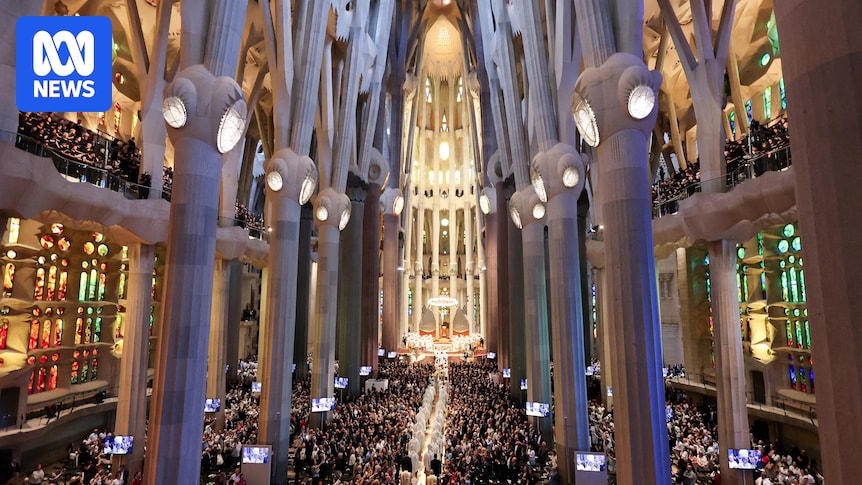
The interior floor of the Sagrada Familia was filled with attendees, including Spanish King Felipe VI and Queen Letizia. (Reuters: Yara Nardi)
The visit is the third by a pope to the basilica and comes a year after the Vatican, whose media portal has called Gaudí “God’s architect”, approved an important step towards sainthood for the visionary.
The trip also underscored how the country of 50 million people, which experienced a religious crisis after its 20th-century dictatorship ended, still has plenty of faithful Catholics who have turned out in droves to welcome the American pope.
Pope Leo heralded the Sagrada Familia as an “architectural masterpiece”. (Reuters: Bruna Casas)
Pope’s tribute to ‘an architectural masterpiece’
The highlight of Leo’s visit was his Mass at the Sagrada Familia to commemorate the 100th anniversary of the death of its famed Catalan designer, Gaudí, who worked on the basilica for more than 40 years before his death, aged 73, after a 1926 tram accident.
A century after construction began during the pontificate of Leo’s namesake, Pope Leo XIII, the basilica has become one of the world’s most visited yet unfinished monuments, drawing upward of five million visitors annually.
The Sagrada Familia is an architectural and geometrical masterpiece, formed to celebrate the form and symbol of Christianity and God’s creation through stone and light. (AP: Bernat Armangue)
Completing the massive project, which has three facades in different architectural styles and 18 nature-inspired towers, has been challenging.
It was meant to be finished this year, but the goal has now been pushed back to 2035.
Commemorating Gaudí’s death, Pope Leo said he wanted to give thanks to all the supporters, artists and workers who “cooperated in the construction of an architectural masterpiece, which is also an eloquent catechesis made of stones, colours and light”.
The basilica, which remains incomplete, has three facades in different architectural styles and 18 nature-inspired towers. (Reuters: Yara Nardi)
Gaudí, who is on the path to possible sainthood, spent four decades designing and building the temple as a summary of the Christian faith carved in stone.
The most important stories of Jesus’s life, the Nativity and Passion, are etched into the basilica’s east and west facades. A third facade, the Glory, facing south will serve as the basilica’s main entrance when finished.
The temple is an architectural and geometrical masterpiece inside and out, an Art Nouveau celebration in form and symbol of Christianity and God’s creation through stone and light.
The interior floor and halls of the Sagrada Familia are shaped as a cross and a sculpture of Jesus Christ hangs at the altar. (Reuters: Yara Nardi)
“Much more than a monument, the Basilica of the Sagrada Familia remains a work in progress today, reminding us that the Christian life is always a journey, because it is a project that God is carrying out,” Pope Leo said.
A total of 18 sandcastle spires rise up from the top and pierce Barcelona’s skyline: 12 to symbolise Christ’s 12 apostles, four for each of the four Evangelists who recorded Christ’s life in the Gospels, one topped with a star over the apse honouring the Virgin Mary, and, tallest among them, the Tower of Jesus Christ.
When the final Christ tower was finished last year at a height of 172.5 metres, it made the Sagrada Familia the world’s tallest church.
“The entire structure of the Sagrada Familia is striking,” Laura Rincón, who was on hand outside along with two friends for the Mass, said after she finished work in a nearby shop.
The Sagrada Familia’s final Christ tower was finished last year at a height of 172.5 metres, making it the world’s tallest church. (Reuters: Nacho Doce)
She said that she was sure the pope would be impressed by the church she marvelled at every time she passed by.
“If you look at it just for its architecture, it is amazing,” she said.
A stained glass forest drenched in light
The basilica’s cross-shaped interior, with the altar at the apse, is an homage to light and nature.
Pope Leo’s visit to the Sagrada Familia extended into the evening, when he held another ceremony to inaugurate the basilica’s newest tower. (Reuters: Nacho Doce)
Tree-like columns soar to the sky, coloured by constantly changing light filtered through stained glass windows like the sun poking through leaves in a forest.
“Nature is my teacher,” Gaudí once said.
“Everything comes from the great book of nature, always open that we must read.”
A cross atop the Sagrada Familia’s new Tower of Jesus Christ was illuminated during the inauguration ceremony. (Reuters: Nacho Doce)
The colours of the window glass have meaning: The blues and greens of the eastern portal windows, where the facade depicts Christ’s birth, look more joyful and are most brilliant when the sun rises, and light passes through.
The coarser shades of red and orange, illuminated by the setting sun on the western portals, colour the side of the basilica that depicts Christ’s Passion.
Behind the altar and above the cross are yellows and gold that glimmer in the noon sun.
A fireworks display lit up the church after the conclusion of the pope’s ceremony. (Reuters: Nacho Doce)
Historian Mònica Santín, who leads tours of the basilica, said that in designing the Sagrada Familia, Gaudí was guided by two books: the Gospels and nature.
“The way he lets in the natural light is also an invitation to the Christian mystery,” she said, citing the three facades depicting Christ’s birth, death and glory.
“And when you enter inside, it is all light.
“What is that the symbol of? We can’t see God, but we perceive his light all around us. I think that is how you can read this message, and it is fascinating.“
AP/Reuters