










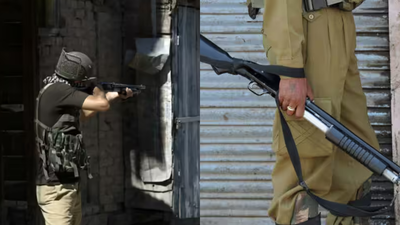
A pellet gun fires cartridges containing multiple metal or rubber pellets, which disperse over a wide area. (File photo used for representational purpose)
NEW DELHI: As the debate over the alleged use of pellet guns against student protesters during CJP‘s July 20 ‘Sansad Chalo’ march from Jantar Mantar rages, experts have warned that pellet injuries can cause irreversible damage, particularly when they involve major nerves, blood vessels, bones, joints or vital organs, news agency ANI reported.As per the PTI report, the students protesting against alleged irregularities in the NEET examination were allegedly subjected to police action while marching from Jantar Mantar towards Parliament.Police used tear gas shells and batons to disperse the protesters, while images and videos of students with pellet injuries emerged online later.What is a pellet gun?A pellet gun fires cartridges containing multiple metal or rubber pellets, which disperse over a wide area. The severity of injuries depends on several factors, including the firing distance, pellet size, impact velocity, angle of impact and the anatomical structures struck, forensic ballistics expert Shalini Solanki, faculty member at the School of Studies in Forensic Science, Samrat Vikramaditya Vishwavidyalaya in Ujjain, Madhya Pradesh, told PTI.The CRPF, however, has maintained that its Rapid Action Force (RAF) followed all standard operating procedures and anti-riot drills during the July 20 clashes, according to a report published by The Times of India.A CRPF post-event analysis reportedly said the authorised use of “non-lethal” means, including pellet guns, came only after lower-grade measures such as public announcements for crowd dispersal, tear gas and lathicharge failed to control the crowd.CRPF sources, as reported by TOI, said around three to five protesters were injured by metal pellets, while 47 RAF personnel were injured, including six who suffered head injuries. The sources also claimed that some “motivated elements” in the crowd attacked Delhi Police and RAF personnel with stones and, in some instances, iron rails.The report further said that the use of anti-riot gear by the RAF requires authorisation, which in this case was allegedly provided by the DCP or ACP in charge of the protest site. An officer quoted by TOI said such authorisation is given in writing and follows a standard format used at sites where an unlawful assembly has gathered.However, medical experts have highlighted the potentially lasting consequences of pellet injuries.“Pellets fired from a distance tend to cause multiple superficial wounds with limited tissue damage. However, at close range, pellets bunch together and strike as a single mass, causing massive and complex tissue destruction, soft tissue loss, and extensive bleeding,” said Dr Nikhil Valsangkar, senior consultant and unit head, department of orthopaedics and robotic joint replacement, Sarvodaya Hospital in Greater Noida west.He said damage could become irreversible in cases involving substantial soft-tissue loss, bone defects or disruption of nerve and blood vessel continuity.One teenager, Sahil Lochab, may lose vision in his right eye following his injuries, while other protesters reportedly suffered wounds to their faces, necks, chests, arms and legs.The RAF, in a statement on July 28, said it had used anti-riot gear and fired multiple rounds of non-lethal munitions, including two rounds of plastic pellets.Experts have also warned that the consequences of pellet injuries can extend beyond immediate physical trauma.Dr Sakshi Singhal, consultant, surgical oncology, Yatharth Hospital in New Delhi, said possible long-term outcomes include blindness, hearing loss, chronic pain, joint stiffness and psychological trauma or PTSD.Meanwhile, the CRPF’s position that the force gradient was followed during the July 20 action is likely to remain central to the wider debate over the use of force during the CJP-led protest, particularly as questions continue to be raised over the injuries sustained by students during the clashes.(With agency inputs)