







The allure of vapes and cigarettes appears to be wearing off, but for Australians who do use nicotine, average consumption may be on the rise.
While daily vaping rates among younger Australians has also dropped, some have turned to an increasingly popular oral nicotine, commonly called snus.
The Australian Institute of Health and Welfare data, released on Friday, found smoking rates across the country have fallen to a historic low of 5.8 per cent.
That equates to 500,000 fewer daily smokers than three years ago, a drop nearly twice the government’s 2025 target.
However, the National Drug Strategy Household Survey, sampling 17,500 people aged 14 and over, found use of multiple forms of nicotine has doubled in the last year.
“This is an emerging area of concern and could potentially represent an increase in the average amount of nicotine being consumed by people who smoke, use e-cigarettes and also use other nicotine products,” the report stated.
Among the products is snus, a nicotine pouch placed between the lip and the gum, which has gained in popularity, appearing on the data set for the first time.
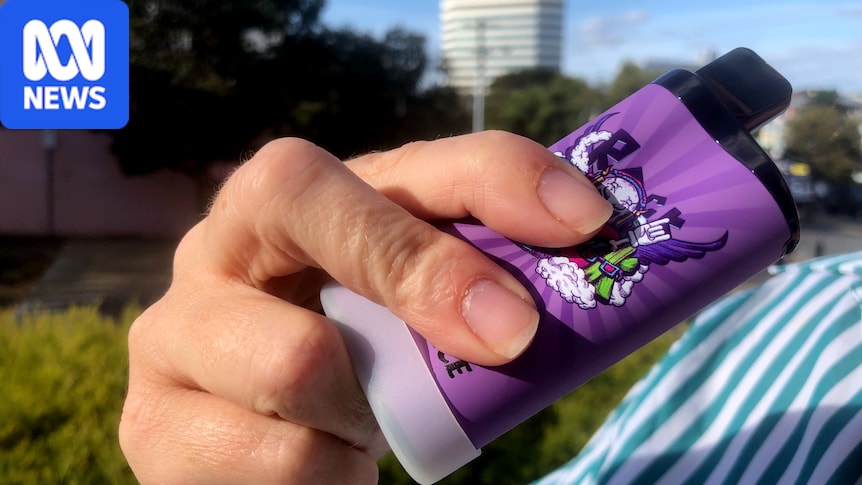
Nationwide vaping has been on the decline, dropping from 7 per cent to 6 per cent. (ABC News)
The use of snus and nicotine pouches was the highest among Australians aged 18 to 24 in 2025.
Reported separately for the first time, the survey found, 3.6 per cent have used snus and 8.4 per cent used nicotine pouches in the last year.
Daily vaping rates among the same young cohort have dropped from 11.3 per cent in 2022-23 to 5.8 per cent in 2025.
Nationwide vaping has been on the decline, dropping from 7 per cent to 6 per cent over the same period.
Crackdown on nicotine pouches
The government has acknowledged a shift in tobacco use, cracking down on the importing of nicotine pouches and their access through unapproved therapeutic goods pathways.
As of next Friday, Australians will not be able to buy nicotine pouches, even if they have a prescription.
Health Minister Mark Butler said the government is focused on protecting younger Australians and stopping the illicit tobacco trade.
“Anyone unlawfully selling nicotine pouches in Australia has been put on notice,”
Mr Butler said.
“The Australian government is committed to protecting the community from the harms of nicotine pouches and regulatory and enforcement action will be strong and ongoing.”
With up to four in five cigarettes now smoked in Australia illegal, according to last month’s Australian Bureau of Statistics data, the government has struggled to battle the illicit tobacco trade.
The ABS found illicit nicotine product consumption — including e-cigarettes, vapes and loose-leaf tobacco — jumped from 12 per cent in 2017 to 80 per cent in 2025.
The boom is costing the government billions, with the May budget forecasting an $8 billion shortfall in revenue over five years.
Health Minister Mark Butler has put anyone selling nicotine pouches unlawfully “on notice”. (ABC News: Matt Roberts)
In recent months, there has been debate about cutting the high tobacco excise — currently roughly $30 for a 20-cigarette packet.
However, last week, the illicit tobacco and e-cigarette commissioner told a conference of economists that abolishing the excise was unlikely to stop the criminal trade.
The Australian Council on Smoking and Health (ACOSH) welcomed the results but was concerned that access to cheap illicit tobacco and high-nicotine products like vapes may prolong dependence.
ACOSH CEO Laura Hunter called on the government to ramp up its efforts to reduce the illicit tobacco trade.
“Governments must continue shutting down the illicit tobacco and vape market by beefing up enforcement to close illegal retailers and disrupt organised crime supply chains,” she said in a statement.
“This needs money to bring in more boots on the ground and political will across every state and territory to strengthen and enforce tobacco laws.”