





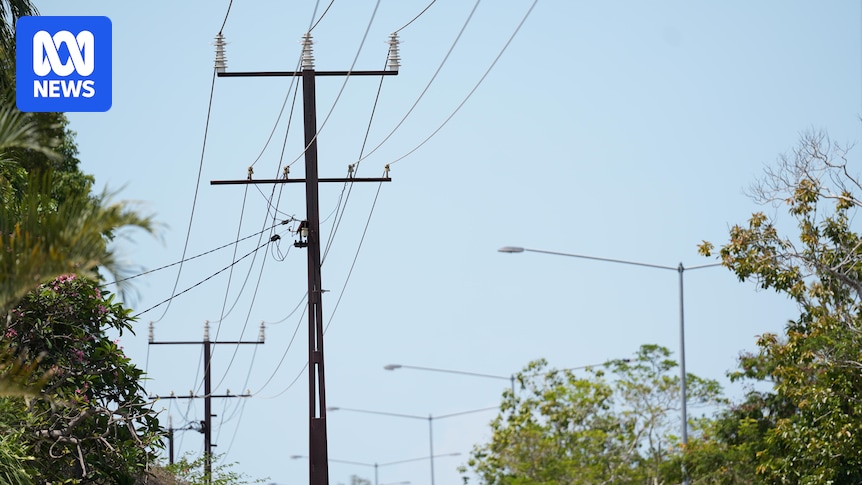
Power, water and sewerage prices in the Northern Territory will rise by 5.3 per cent from today, higher than last financial year’s 3 per cent increase.
The three major utilities in the NT are publicly-owned and their price fluctuations are dictated by the territory government’s treasurer.
Usually loosely tied to inflation, today’s price hike is larger than than the usual 3 per cent and has been criticised by the NT opposition and the body representing senior Territorians.
Treasurer Bill Yan said the 5.3 per cent increase was in line with the 5.2 per cent inflation figure forecast for June in the NT budget, handed down in May.
Bill Yan said the increase was in line with the 5.2 per cent inflation figure forecast for June. (ABC News: Pete Garnish)
The actual June CPI figure has not yet been published by Treasury, but in the year to May, inflation rose in Darwin by 3.9 per cent.
“When we were formulating the budget, we do projections on CPI … and they’re printed in our budget papers at 5.2 per cent [for the year to June],” Mr Yan said.
“As we were working out what the forecasts were going to look like, we landed at 5.3 per cent for our [power] tariff changes.
“So, there’s a 0.1 per cent difference between those figures, which is absolutely minimal.”
This year’s power price rise is higher than last financial year’s 3 per cent increase. (ABC News: Dane Hirst)
While the price of power will rise for customers, the NT government is also paying more to subsidise prices.
Its community service obligation subsidy will increase by more than $58 million in 2026-27 to $252 million.
“If we took away the the community service obligation, people’s residential power prices would increase by 74 per cent,” Mr Yan said.
“It would cost over $2,000 extra for every mum and dad’s power bill across the Territory [each year] if we removed the community service obligation.“
Mr Yan said the increase in the community service obligation was due to higher gas prices the NT government is paying suppliers.
Eni’s Blacktip gas field was meant to supply the NT with its energy needs until 2031, but it started drying up in 2021.
That shortfall has forced the government to buy emergency gas from exporters Santos and Inpex, at much higher prices, to keep the lights on.
The government was forced to buy emergency gas from exporter Inpex. (ABC News: Dane Hirst)
Mr Yan said the gas expected to be supplied from the Beetaloo Basin in the second half of this year would come at “good rates”.
“I can’t tell anybody what [the rates] are, of course they are commercial in confidence, but we’ll start to see a reduction in cost of generation as we see some of that cheaper gas coming into Darwin out of the Beetaloo,” he said.
Price hike criticised by Labor, seniors
The 5.3 per cent price increase is also higher than the 2.6 per cent wage growth forecast in May’s budget.
Opposition Leader Selena Uibo said the NT government should have increased the community service obligation subsidy.
Selena Uibo says the NT government should absorb more of the costs. (ABC News: Marcus Kennedy)
“The CLP government has already admitted it can absorb these costs,” she said.
“It chose how much to absorb, and how much to pass on to households.”
Mr Yan said the government did consider lowering the 5.3 per cent hike, but ultimately decided against it.
“Those considerations were there, but if you look at a 5.3 per cent change on your residential tariffs, it’s not a lot,” he said.
“It’s really not going to hurt Territorians too much in the back pocket.
“I don’t make light of that of course.”
Council of the Ageing NT chief executive Sue Shearer said the price increase was “not fair” and pensioners would be reluctant to turn on energy-intensive air conditioners in the territory heat.
Sue Shearer says the price hike would make pensioners reluctant to use air conditioners. (ABC News: Pete Garnish)
“I fear older people especially won’t turn their aircon on,” she said.
“If we have a wet season with the temperatures soaring through the roof, we might see deaths as well because they don’t want to turn their aircons on, because they can’t afford it.
“Is that the society we want our seniors to live in?”
The NT government’s concession scheme allows eligible people to claim up to $1,200 per year towards electricity costs, $800 in water concessions and $486 in sewerage concessions, but Ms Shearer said those subsidies hadn’t been increased since 2018.