








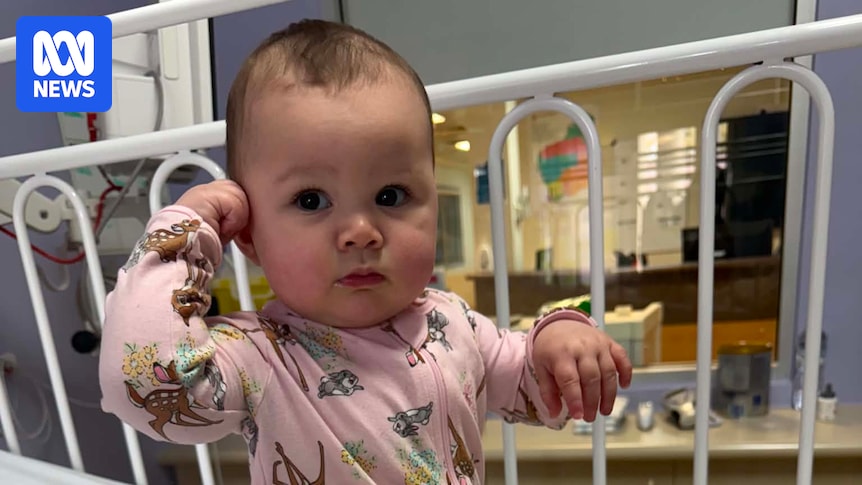
Western Australia’s health minister says she would welcome a coronial inquest into the death of an eight-month-old girl in a regional hospital, but has stopped short of formally requesting one.
Willow Katarina Horne died at Kalgoorlie Health Campus on the morning of September 9, 2025, two days after she was admitted with respiratory issues.
A clinical review into her care identified several opportunities to improve practices at the hospital, but her exact cause of death is yet to be determined.
Her parents, Kaydence Sutherland and William Horne, have called for a coronial inquest.
Health Minister Meredith Hammat said she would welcome such an inquiry but has not formally requested one, which she can do by writing to the coroner or asking the attorney-general to do so.
Health Minister Meredith Hammat says the government would welcome a coronial inquest. (ABC News: Courtney Withers)
“Can I just start by … expressing my deepest sympathy to Kaydence and William on the loss of their baby, Willow,” she told reporters on Monday.
“It is a terrible tragedy and I think for most of us, we can’t imagine what it would be like to lose a child.
“We’re very mindful of the independence of the coroner, and they need to be able to make their own decisions about where they conduct those inquiries, so I’m very mindful and respectful of that.
“But I do want to be clear, we would welcome a coronial inquest, we would take a lot of value from those inquiries, and those recommendations of learning are incredibly valuable to our health system.”
‘It destroyed us’
Ms Sutherland and Mr Horne said their daughter’s death “destroyed” them, especially as it was not the outcome they felt they were being prepared for while at the hospital.
Willow’s parents Kaydence Sutherland and William Horne. (ABC News)
“When we took her in she was still very happy … she was playing and giggling and moving around … seeing her deteriorate within those … two days, it was really horrible,” Ms Sutherland told 102.5 ABC Perth.
“They were very focused on telling us we got her to the right place at the right time and everything was going to be OK, but in reality I feel like it’s the complete opposite.”
Mr Horne recalled being told Willow’s condition was nothing to worry about.
“It destroyed us, just not us, our families on both sides. Our lives sort of went to a stop, you know, we struggled a lot mentally … it’s just a bit hard to talk about,” he said.
Flight diverted
Willow was admitted to the hospital’s paediatric ward very soon after presentation and was initially treated for pneumonia and slight dehydration.
She was monitored consistently and when her condition deteriorated, plans were put in place to transport her to Perth Children’s Hospital (PCH) by the Royal Flying Doctor Service (RFDS).
That flight was diverted when another patient considered a higher priority took precedence, and Willow was due to be transported next.
Doctors do not know the exact cause of Willow’s death. (Supplied)
But Willow died before she could be transferred.
Mr Horne was on already on a flight in anticipation of meeting Ms Sutherland and Willow at PCH when his daughter went into cardiac arrest.
“They called code blue over the hospital and I just absolutely freaked out … it was just as my dad arrived and my dad grabbed me and was crying.”
Medical staff worked on Willow for an hour, but she could not be saved.
“We were in there holding her little hand and just asking her to come back,”
Mr Horne said.
‘Areas for improvement’
The clinical review identified several areas for improvement in relation to escalating Willow’s care, including the consideration of a different diagnosis, more communication between staff and better oversight of staffing levels at the RFDS.
And while the exact cause of her death has not yet been determined, the review panel, led by WA Country Health Service executive director of clinical excellence Helen Van Gessell, identified myocarditis as the likely underlying health issue.
“Myocarditis is inflammation of the heart muscle, usually related to a viral infection,” Ms Van Gessel said on Sunday.
“It is very rare, difficult to diagnose and unfortunately, when it causes heart failure … it has a very high fatality rate, especially in young children.
Helen Van Gessel from the WA Country Health Service led a clinical review into Willow’s care. (Supplied)
“Even in cases where the care is through specialist paediatric hospitals, unfortunately children with myocarditis sometimes die.”
Implementation has begun on seven recommendations that came from the review.
No staff have been reprimanded and Ms Van Gessel said there was no suggestion of medical negligence or malpractice.
Parents still seeking answers
Ms Sutherland said having access to the review’s report, which they only received after requesting it, had provided her some clarity, but she felt further investigation would help prevent future tragedies.
“Having someone go through that report with me really helped me understand, it was quite emotional for me to read through all of that … seeing in the report how many times things could have been different,” she said.
“I wish I could go back in time and advocate for those things to be different, but I was in a situation where I didn’t know any better.
“I do believe what they are saying, there is the chance that … if it had gone how it should have, she could have still not been here.
“We will never know though. We never got to have the chance of getting her to Perth.”