







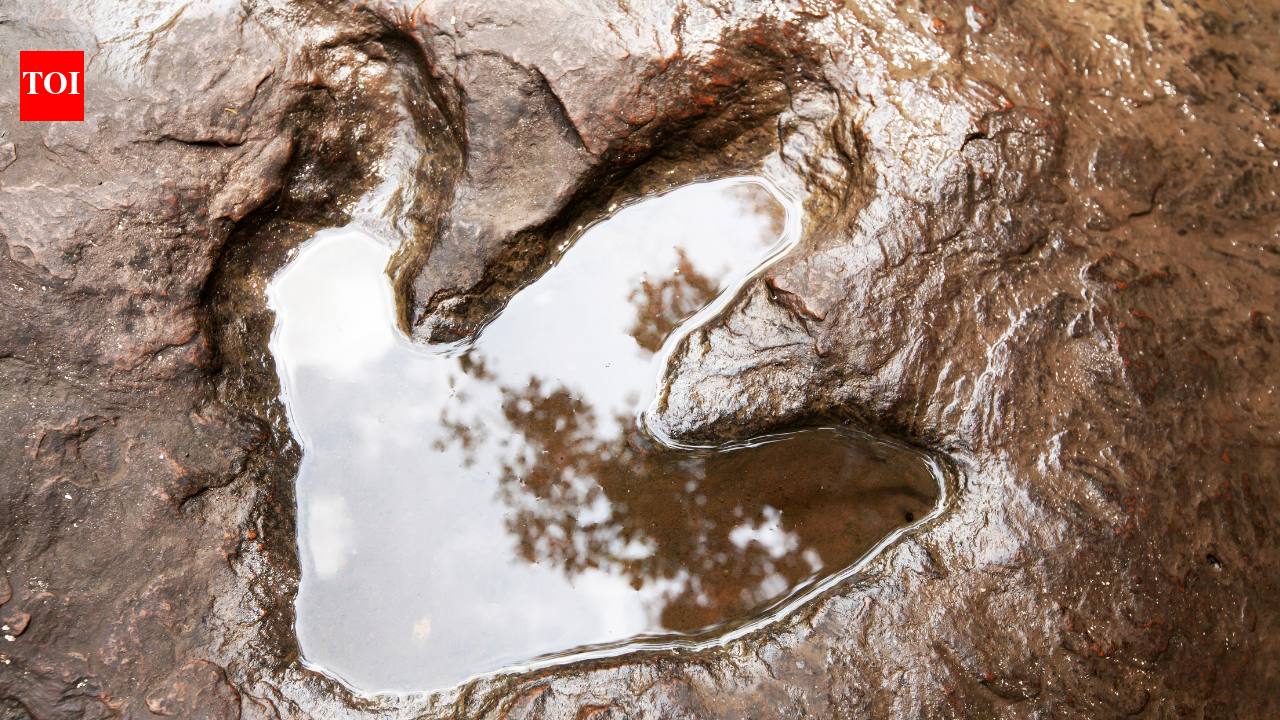
Dinosaurs are the most fearsome creatures to have roamed across the Earth millions of years ago and left their indelible mark on the planet, and quite literally, with their footprints.Even today, any discovery made about their whereabouts, what they ate, and how they lived is still among the most intriguing ones.Recently, one such discovery was made that remained hidden in plain sight for at least 200 million years in Stelvio National Park, high in the Italian Alps, where a wildlife photographer chasing deer and bearded vultures through his lens stumbled onto something far older than any animal he was hunting for.He saw thousands of dinosaur footprints, pressed into a near-vertical rock face more than 2,000 metres above sea level.
Photographer accidentally spotted 200 million-year-old dinosaur footprints by pure accident
The tracks were first spotted in September by a wildlife photographer who was in the Valle di Fraele photographing deer and bearded vultures, not dinosaurs!What he noticed on the rock face turned out to be one of the most significant paleontological finds in Italy in decades. According to a Reuters report, paleontologist Cristiano Dal Sasso of Milan’s Natural History Museum said, “This is one of the largest and oldest footprint sites in Italy, and among the most spectacular I’ve seen in 35 years”.
But how did the dinosaurs climb such high mountains?
Around 200 million years ago, the region wasn’t alpine at all, it was a warm, shallow lagoon on the edge of the Tethys Ocean. Ichnologist Fabio Massimo Petti of Trento’s MUSE museum explained that the footprints were pressed into soft sediment on wide tidal flats bordering that ancient sea. As those muds hardened into rock over millions of years, they locked in extraordinarily fine anatomical detail, including individual toe impressions and claw marks, details rarely preserved this clearly in fossil tracks.
The seabed turned into a mountain!
The site’s unusual vertical orientation is itself part of the story. As the African plate slowly drifted north, it squeezed the Tethys Ocean shut, folding and compressing the seabed’s sedimentary layers. That collision built the Alps, and in the process rotated the then-horizontal tidal flats into the steep, near-vertical rock faces seen today. The dinosaur tracks, originally pressed into level ground, now run down a mountainside instead of across a beach.
So, who do these footprints belong to?
According to the Department of Earth Sciences, University of Milan, ” Ardito Desio, ” the tracks belonged to herds of large, long-necked herbivorous dinosaurs, most likely plateosaurs, ancient relatives of the giant sauropods that came later.These animals might have moved in groups along the lagoon’s tidal flats, leaving repeated overlapping trails in the mud. The sheer density and stretch of prints, five kilometres of them, suggests this wasn’t a one-off crossing but a route regularly used by dinosaur herds over an extended period of time.Because the footprint site sits on an inaccessible, near-vertical cliff with no trails leading to it, researchers will have to depend on drones and remote sensing technology to study it properly in the coming years.