






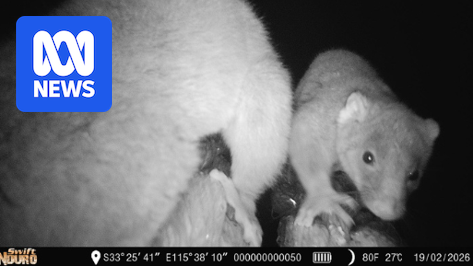
The West Australian government is celebrating signs of success of wildlife crossings built along a major highway in the South West, with thousands of recorded uses by the endangered species, such as brush-tailed phascogales and western ringtail possums.
WA’s Main Roads has told the ABC that night-vision cameras have recorded thousands of critters using the mix of 19 rope bridges, 24 underpasses and two land bridges built along the $1.46 billion Wilman Wadandi Highway, about 170 kilometres south of Perth.
“Monitoring to date has far exceeded our expectations and has shown regular and widespread use of the structures,”
a spokesperson said.
The early data challenges previous scepticism about the fauna infrastructure design, particularly the rope bridges and underpasses.
The multi-lane highway took four years to build, and expected to slice 18-minutes off the commute for those travelling to the region from Perth and reducing congestion during peak times for locals.
A key part of the Environmental Protection Agency’s recommendations was to ensure safe crossings for possums towards their new habitat.
Local environmental groups and wildlife carers said the early data was encouraging, but they were not yet convinced that the highway’s fauna infrastructure was a success.
Main Roads says it has recorded, on average, 75 animals using the infrastructure per night during spring and summer. (Supplied: WA Department of Transport)
Thousands of recorded uses
Main Roads began monitoring fauna crossings in April 2025, using 50 motion-sensor cameras.
“A sample review of 12 nights of monitoring across spring 2025 and summer 2026 recorded almost 1,000 images of possums and phascogales using the structures across 46 cameras,” a spokesperson said.
“This equates to an average of more than 75 recorded uses each night.“
Main Roads said no further fauna infrastructure was necessary based on monitoring to date.
The Wilman Wadandi Highway is lined with 62,400 metres of continuous fauna fencing. (Supplied: WA Department of Transport)
A South West independent environmental body said the released data was not detailed enough to draw any final conclusions.
“I don’t think we have enough information to say that yet, and I know there’s been a lot of scepticism about whether they’re working,” South West NRM chief executive Manda Page told the ABC.
Dr Page said previous research on fauna crossings across smaller roadways had demonstrated success, but building wildlife crossings across a bustling multi-lane highway was another matter.
“This was a great experiment to find out if these sorts of structures across much wider roads were going to be used by wildlife and I really look forward to delving into the data,” she said.
Caring for injured western ringtail possums is the norm for Suzie Strapp. (ABC South West: Madigan Landry)
Skepticism remains among carers
Local wildlife carers, such as FAWNA (Fostering and Assistance for Wildlife Needing Aid) president Suzanne Strap, have reported scores of native animals being killed along the roadway, including possums and kangaroos.
They have previously raised concerns of kangaroos and echidnas being trapped within the 64,200 metres of fauna fencing, and possum rope bridges not being attached to appropriate habitat.
“They’re getting caught in there, they panic, and then they get killed,”
Ms Strapp said.
The Busselton wildlife carer said she had her doubts about the figures supplied by Main Roads.
A ringtail possum joey being hand fed by wildlife carers. (ABC South West: Madigan Landry)
She is calling for more granular figures on successful crossings, not just general uses, and specific figures on individual structure types and species.
A Main Roads spokesperson said more detailed figures would be provided in due course.
“Whilst the data showing the number of crossings over the possum bridges has been collected, it is still being collated and is therefore not ready for release at this time,” a spokesperson said.
“A technical paper about the movement of western ringtail possums and other fauna is also being prepared.”