





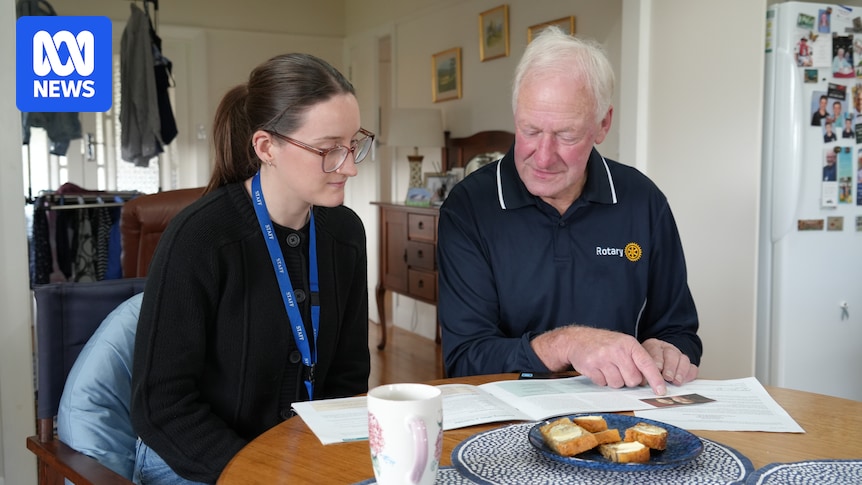
When Peter Taylor’s nephew took his own life three years ago, the Portland resident knew he needed to change the way he thought about mental health.
Portland is in Glenelg Shire, in the far south-west of Victoria, a region where the suicide rate between 2020 and 2024 was 45 per cent higher than the state average.
Mr Taylor is part of a cohort of locals with an ambitious plan to fight back against suicide by training about 1,500 locals in suicide prevention first aid by 2029.
Peter Taylor wants to encourage more conversations about mental health. (ABC News: Jean Bell)
Could a conversation save a life?
When Mr Taylor’s nephew died by suicide, he was 46 years old and left behind a wife and two young daughters.
He said he was aware his nephew was struggling, but felt uncomfortable discussing mental health with him directly.
“I had the false belief at that stage that if I talked to him about suicide, I’d encourage him to do it,”
Mr Taylor said.
After attending suicide prevention training, he said he wondered if a conversation could have saved his nephew’s life.
“I would’ve actually asked him, ‘Are you contemplating suicide?’ Mr Taylor said.
“He would’ve twisted and turned and tried to avoid the question.
“Now, I would have the confidence to say, ‘Hang on a minute mate, you haven’t answered my question: Are you contemplating suicide?'”
A life-changing workshop
Mr Taylor said he was not aware of a single mental health service in his local area at the time of his nephew’s death, but began to search for the support he felt was missing.
He is now the chair of Portland Rotary Club’s Mental Health Committee.
“Once we had the funeral, and life started going back to some sort of normality, I started thinking there’s got to be a better way,” Mr Taylor said.
“I don’t want to be in this position again and I want to do whatever I can to ensure other people don’t have to be in this position.“
He drove three hours from his home in Portland to a suicide prevention workshop in Ballarat operated by the company LivingWorks.
Mr Taylor described the workshop as life-changing.
The four-hour training course aimed to give participants the confidence to have tough conversations about suicide and know where to seek help.
The first two workshops in Glenelg Shire were fully booked. (Supplied: Maddi Cram)
Within four months of attending the workshop, Mr Taylor gathered funds and support from his community to hold the first suicide prevention workshops in Portland and the nearby town of Heywood in August 2024.
Both workshops were booked out in days, and a waiting list formed.
A quest to train 1,500 people
Portland District Health and Portland Rotary Club raised $32,000 through small grants and donations to hold more courses.
The only government funding it was able to access was through the Department of Veterans’ Affairs, despite the training not being exclusive to veterans.
Since 2024, they have trained 170 people.
About 20,000 people live in the Glenelg Shire, with about half living in the town of Portland. (ABC News: Emily Bissland)
Mr Taylor said the goal of the project was to reach 10 per cent of Glenelg Shire’s working adult population of approximately 15,000 people.
“We create a support network. If you’re in a sporting club, there’s not just one that’s done [the training], there might be half a dozen that’s done it,” he said.
“If they see someone that don’t look quite right, I’m hopeful those half dozen will talk amongst themselves: ‘How do you think Joe’s travelling and what can we do about it?'”
Each workshop was offered for free or paid for by local businesses to train their own staff.
The race is on
Initially, it cost more than $5,000 to train just 30 individuals, which was not financially sustainable to reach the project target of almost 1,500 people.
Health Promotion Practitioner at Portland District Health Maddi Cram said they salvaged the project by appointing local volunteer instructors.
Ms Cram said that when the local instructors take over the workshops this July, it will cut operating costs to a fifth of the original price.
Maddi Cram says the workshops teach participants how to seek support. (ABC News: Jean Bell)
“We have a waiting list of community groups and local organisations that would like sessions run and now that we have our own facilitators, it will be quicker and cheaper,” she said.
The Royal Commission into Victoria’s Mental Health System called for the federal and state governments to fund suicide prevention programs in 2021.
The Victorian government outlined designing suicide prevention programs as part of a 10-year strategy ending in 2034.
Mr Taylor said he felt an urgency to continue educating the community on suicide prevention after witnessing so many people reveal they knew someone who took their own life.
“People will always come up, two or three people will come at the end [of the workshop and] will say, ‘I can relate to this’,” he said.