







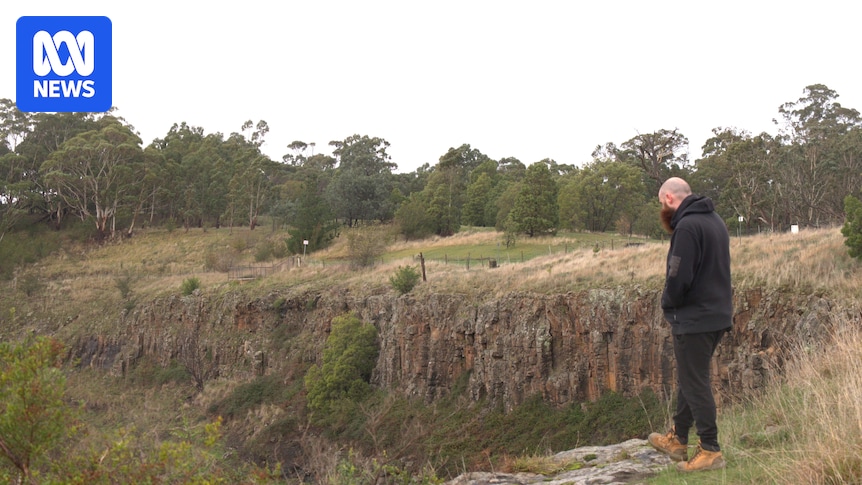
At the Lal Lal Falls Reserve, 20 minutes south-east of Ballarat, the sounds of country are everywhere.
The wind whistles through red gums, magpies warble, and frogs sing.
To the Wadawurrung people, they are biyal, parrwang, and djirm respectively.
But one sound is missing: the sound of the waterfall that makes this site special.
Lal Lal means “falling waters”, but Indigenous and environment groups say the greed of a property owner upstream has caused the sacred falls to run dry.
Koby Phillips say Lal Lal Falls is a sacred site that “has helped him through hard times”. (ABC News: Laura Mayers)
A sacred site
When a wedge-tailed eagle, or bunjil, takes flight over Lal Lal Falls, Wadawurrung man Koby Phillips stops to watch.
In Wadawurrung culture, the falls are the home of the All Father or Creator, also called Bunjil.
“[Bunjil] created a man and a woman there … and told them to look after their country,” Mr Phillips said.
“He created the parrwang, who sings in the morning.
“Parrwang, that’s where the Barwon River gets its name from, that’s the river that [Lal Lal creek] joins up with.
“So, these connections, these creation stories, these animals, we are all here to take care of country and we are here to take care of this river.”
Lal Lal was one of the first areas in the state to be declared a Victorian place of Indigenous cultural significance.
Mr Phillips said Lal Lal Falls had been a site of great importance to him, and to other members of the Wadawurrung community.
“This is a place of reflection for me. I’ll go down to the bottom, that’s a place I’ll go by myself, and it’s gotten me through some hard times.“
A drone shot of Lal Lal in early 2023, when the waterway was flushed and full. (ABC News)
Mr Phillips said even today along the banks of Lal Lal Creek, there are still traces and remnants of his ancestors.
“When we bring people to this site, and we tell people how we connect to the site,” he said.
“We can see where we’ve been [but] it’s a living landscape for us. We’re still coming, we’re still using this, we’re still enjoying it.
“And we’re just noticing different changes in the seasons, natural or unnatural, I’m not sure.“
A small basin of water above the cliff face is stagnant and filled with azolla, a type of native aquatic fern.
At this time of the year, the azolla should be flushed out of the water downstream by the flows of the creek.
Advocates said it was not just the lack of rain leading to the dry falls.
Advocates say the lack of flow at Lal Lal Falls is due to “hoarding” on a nearby agricultural property. (ABC News: Laura Mayers)
The tale of two dams
Just 12.5 kilometres away, the overseas proprietors of homestead Lal Lal Estate have applied for a retrospective dam permit.
Tianyu Wool has been quietly expanding a second agricultural dam over several years at the estate.
Southern Rural Water placed a public notice in the Ballarat Times in April, advising of the application for Lal Lal Estate to “take and use” 250.0 megalitres of surface water for “domestic and stock purposes”.
“All surfacewater proposed to be extracted will be sourced from the Granite Creek,” the public notice reads.
Granite Creek is one of the waterways that ultimately makes up the Lal Lal Creek.
According to Australian Wool Innovation, Tianyu Wool is one of China’s biggest wool operators and is the largest single buyer of Australian wool.
A small, depleted basin of water above the Lal Lal Falls is flush with Azolla. Azolla is a native Australian fern and is non-harmful. (ABC News: Laura Mayers)
Cameron Steele, Coordinator of People for a Living Moorabool, or PALM, has been heading up opposition to the retrospective permit.
PALM estimated the dam had expanded in volume three and a half times, from 168 megalitres to 581.
“There are two major dams on that property,” Mr Steele said.
“One is on Lal Lal Creek, and we see evidence … that there is a pipe going from that dam on Lal Lal Creek, to their big major storage.
“So, it’s not fed by its own catchment, it’s fed by water pumped out of Lal Lal Creek up to this dam.
“That dam would’ve spilled [into the creek] in earlier times, if these large amounts of water weren’t being siphoned off to feed this other, massive, dam.“
Dozens of people have objected to the retrospective planning application, saying it was the dams that had dried up Lal Lal Falls.
Google Earth images of the dam at Lal Lal Estate between 2006 and 2016, and in 2026. (Supplied: Google Earth)
Local knowledge
Jane Robson has lived in the area her whole life.
Ms Robson and her husband, Noel, purchased a farming property at Lal Lal 35 years ago under the assumption that access to Lal Lal Creek would make their farm droughtproof.
“It was a very, very reliable creek,” Ms Robson said.
The Robsons’ farm is the closest western neighbour to the 5,000ha Lal Lal Estate.
“Between the two dams [at their property], it’s stopped the flow of the creek in its entirety,” she said.
Ms Robson said the previous owners of the estate would regularly, and without having to be asked, make discretionary releases of water from the dam into Lal Lal Creek to ensure the local ecosystem was supported.
The Robsons’ cattle would regularly drink from the creek.
In 2023, Ms Robson and her husband approached the managers of the Lal Lal Estate and asked them to do the same.
They are still waiting.
Lal Lal Estate is Jane Robson’s closest neighbour, sharing a western border. (ABC News: Laura Mayers)
Ms Robson said she was told by water authority Southern Rural Water that it had directed Tianyu Wool, which bought the estate in 2014, to release water from the dam.
“I was told that [Southern Rural Water] were aware of the unpermitted dam on Granite Creek and that they were looking into it, and that it was a compliance issue, and that [the owners] would be made to revert [the dam] to its previous size,” Ms Robson said.
“Unfortunately, apparently, Southern Rural Water didn’t word the order well enough … they sent an inspector out, the inspector said the water level had dropped as per compliance.
“But what [the owners] had done was pump water back to the [other] dam back at the homestead.“
Water directions
When the ABC asked Southern Rural Water specifically what directions were given to Tianyu Wool on its water release, Southern Rural Water managing director Scott Cornish would not reveal what it had said.
“A compliance inspection of the Lal Lal Estate property was undertaken on 3 June, 2026,” Mr Cornish said.
“This inspection was conducted to assess compliance with a notice issued to the landowner, and, at the time of inspection, the landowner was complying with the requirements of that notice.”
When asked about the pump, Tianyu Wool said: “Southern Rural Water inspected the property on 3rd June for compliance and no issues [were] reported.”
Lal Lal Estate is owned by Tianyu Wool. Its retrospective application is still under consideration by Southern Rural Water. (ABC News: Laura Mayers)
Tinayu Wool also confirmed the company had made no discretionary or managed water releases.
“Water from that dam would only move downstream when the dam reaches a level at which it spills or discharges naturally,” a spokesperson said.
“Based on our observations, that has rarely occurred in recent conditions.”
Ms Robson said she had to install a bore on her property for the first time ever to ensure her own water supply and was forced to downsize the herd.
“I don’t know if whether it’s greed, or whether it’s ignorance … either way, it’s a very detrimental impact and they just can’t be allowed to do what they’ve done,”
she said
Lal Lal Falls is one of Victoria’s most significant Indigenous cultural sites. (ABC News: Laura Mayers)
A wider conversation
Jayden Woolley works at the Wadawurrung Traditional Owners Aboriginal Corporation as water resources manager.
Mr Woolley said cultural water releases and water access for Indigenous Australians is finally being discussed.
“One of the priorities for Wadawurrung is having healthy, connected waterways,” he said.
“Over time since European settlement there’s been a lot of changes to [the waterways].
“The Moorabool system is one of the most heavily extracted in Victoria [and] that impacts on cultural values.“
Jayden Woolley says the Moorabool system is one of the most heavily extracted in Victoria. (ABC News: Laura Mayers)
Mr Woolley said he, along with other stakeholders, Wadawurrung and the state government, was working on returning water back to country through the Sustainable Water Strategy.
“That is due to come online later this year, which will mean that Wadawurrung can release the water from Lal Lal Reservoir downstream, and also from Bostock Reservoir,” he said.
“Any increased take in the upper catchment will reduce the inflows into Lal Lal Reservoir, which impacts on the future Wadawurrung entitlement, and all other water users in the system.“
The Department of Energy, Environment, and Climate Action was asked about whether it would intervene if a landowner was hoarding water.
The department did not respond.