






To its supporters, a $10 billion artificial intelligence factory proposed for South Australia will provide much-needed regional jobs, but in the nation’s driest state, critics say the draw on the River Murray to cool the machines could be too great.
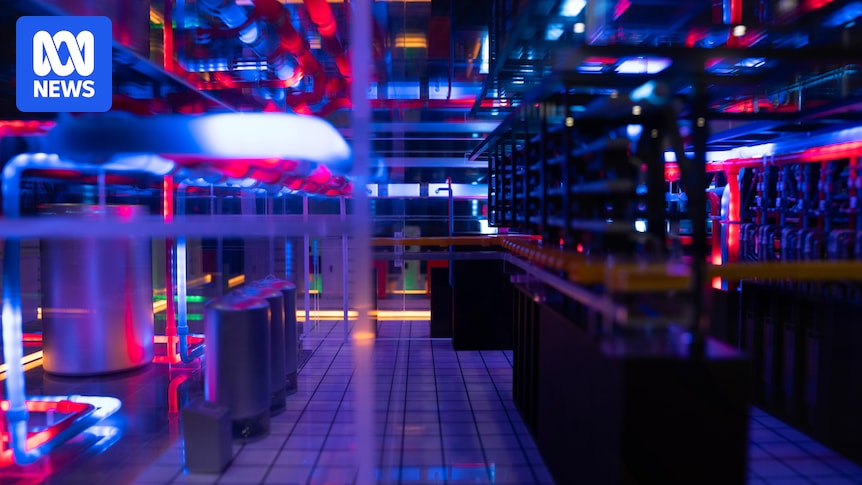
From the country to the city, AI data centre developments are accelerating. Industry figures show there are already 162 operating across Australia and 90 in the pipeline.
The Greens want a moratorium on “hyperscale” developments, like the one proposed forSA.
AI advisor Stefan Hajkowicz says the investment in data centres is “up there with the mining sector boom”. (ABC News: Chris Gillette)
“This is up there with the mining sector boom. This is a huge amount of investment,” CSIRO chief research consultant and AI advisor Stefan Hajkowicz says.
“So every time you do a query on ChatGPT, a bunch of computer chips and machines whirr somewhere using a bit of energy to make all the calculations and to give you the answer, and that’s what goes on in a data centre.“
Nasdaq-listed tech company IREN is behind the massive data centre, which is proposed to be operating in 2028 at Bundey, two-and-a-half hours north east of Adelaide.
The proposed data centre would be located near this substation at Bundey. (ABC News: Carl Saville)
“It’ll be one of the biggest in the Asia Pacific region ever built,” Mr Hajkowicz said.
The centre will need up to 800 megawatts of electricity, the equivalent of powering around 800,000 Australian homes.
Goyder Regional Council Mayor Bill Gebhardt told 7.30 the proposal would be a shot in the arm for the struggling area, creating 500 jobs during construction and 200 ongoing positions.
“We need some form of growth to keep us going and we need some young ones to be coming continually to the centres,” he said.
The town of Burra is a 30-minute drive from where the proposed data centre would be located. (ABC News: Carl Saville)
“The school’s battling at the moment, everything’s battling with numbers.
“So if we can get numbers in the community to keep these things open, it’s going to be a game changer for us.”
Bundey is home to hundreds of sheep but no people. Mog’s Cafe owner Megan Gill said her local town of Burra, 30 minutes west, would be a big winner.
Burra cafe owner Megan Gill believes the proposed data centre would be good for business in the town. (ABC News: Angelique Donnellan)
“We generally rely on the tourist season, which runs between Easter and the October long weekend. After that it gets a bit slow, so having some consistent business in town will be really beneficial for us,” Ms Gill said.
But another resident, Sue Ryan, was more circumspect about the project.
“It’s sitting on the fence at the moment because there’s a lot of questions to be answered,” she said.
Water concerns
Irrigators in the region want to know how much water the data centre will take from the Murray River. (ABC News: Carl Saville)
One of those questions is about water use. Data centre infrastructure uses significant volumes of water to keep machines cool.
It is not clear how much water the Bundey data centre will use.
IREN declined 7.30’s request for an interview but, in a statement, said the facility would not “consume water on an ongoing basis” and would use a “closed system that circulates coolant in a sealed loop”.
“After the initial fill, less than 1 per cent of our total on-site tank capacity will be depleted annually. This is a deliberate design choice, reflecting our commitment to operate sustainably,” the statement said.
“We want to be a good neighbour and a long-term partner, not just an infrastructure operator.”
Last month, the Greens established a federal parliamentary inquiry into AI data centres. South Australian Senator Sarah Hanson-Young is worried about the draw on the vulnerable River Murray.
Water being pumped out of the Murray River. (ABC News: Carl Saville)
“We know already that there is limited amount of water in the Murray River,”
she said.
“These companies are coming to Australia because they see that we are cheap pickings, and that’s because the governments, state and federal, are just rolling over and at the end of the day, it’ll be the community that carries the burden.”
Jeff Knispel runs Nippy’s, a citrus supplier and juice maker in South Australia’s Riverland region. He’s not opposed to data centres but wants to know how much River Murray water the proposed Bundey data centre will use.
Jeff Knispel, who runs citrus supplier Nippy’s, wants to know how much water the data centre will use. (ABC News: Carl Saville)
“The fact that they’ve built it right next door to a pipeline … makes you a bit nervous,” he told 7.30.
“Is this going to consume megalitre after megalitre of water?
“Given that we are the driest state and the driest continent on earth, that is a worry.”
With the Murray River predicted to have lower flows due to a below-average rainfall outlook in parts of the Murray-Darling basin, irrigators in South Australia’s Riverland, such as Mr Knispel, are facing a 20 per cent cut in their annual water allocation from July.
A worker at citrus supplier Nippy’s in the Riverland region. (ABC News: Carl Saville)
He said his business could have to spend hundreds of thousands of dollars to buy water to make up the shortfall.
“Every grower is out mad scrambling to try and buy water,” he said.
‘Worried we’re sleepwalking into a catastrophe’
Greens Senator Sarah Hanson-Young wants strict rules in place for data centre water usage. (ABC News: Craig Hansen)
The federal government has set out a list of data centre “expectations” tech companies should follow, including for energy and sustainable water usage, but they’re voluntary.
Senator Hanson-Young said a tougher approach was needed.
“I think the idea of putting down some principles make sense, but this has got to be legally binding and this can’t just be hoping that the AI companies do thisof their goodwill,” she told 7.30.
“I’m very worried that we are sleepwalking into a catastrophe because governments are too bamboozled and being starry-eyed and naive about this.”
Science and Innovation Minister Tim Ayres at a data centre summit in Sydney. (ABC News: Jerry Rickard)
Federal Industry and InnovationMinister Tim Ayres said ultimately these developments were approved by state governments and he expected them to follow his government’s “expectations”.
He believed Australia’s water resources would cope with AI infrastructure growth.
“The data centre expectations make it really clear that water security plans and effective water security management is fundamental to the Commonwealth government support for these projects,” he told 7.30.
Mr Ayres said data centres would lead to investment in new power generation and he was confident energy prices wouldn’t rise due to data centres coming online.
A model of data centre infrastructure. (ABC News: Jerry Rickard)
“Currently, data centres use about 2 per cent of Australia’s electricity. As we head past 2030, about 12 per cent of Australia’s electricity is the forecast demand,” he said.
“That is an enormous opportunity to use that investment to drive additional electricity generation, new transmission, and to use these centres to support demand management in the grid.”
Mayor Gebhardt said he understood the division over data centres but was hopeful “once everyone has the facts” there would be broad support for the Bundey proposal.
Bill Gebhardt is optimistic about the benefits the proposed data centre could bring to the area. (ABC News: Carl Saville)
“It definitely would be a lifeline … a new lease on life,” he said.
“They’ve [IREN] offered a community fund, which is significant and that helps our communities.”
The company has yet to submit a development application.
“[The proposal has] got a little way to go. It’s got a few hurdles to jump but I think we’ll get there,” Mr Gebhardt said.
Watch 7.30, Mondays to Thursdays 7:30pm on ABC iview and ABC TV