






After they made the atomic bomb, scientists came up with the Doomsday Clock.
The symbolic clock, launched by the Bulletin of Atomic Scientists, warned how close humanity might be to destroying itself in the form of “minutes to midnight”.
Since 1947, its hands have been moved closer and further away from midnight in response to major events such as nuclear weapons proliferation, the emerging understanding of climate change, or new and dangerous technologies.
This year, for the first time, a theoretical biological technology called “mirror life” was included in the list of threats that prompted scientists to move the clock’s hands closer to midnight.
David Relman, a microbiologist at Stanford University and a member of the board of experts who advises clock movements, says such life has the potential to be calamitous.
“This might be as close to an existential threat of a biological sort as we have considered so far.“
The catastrophic risk of mirror life
Mirror life is the name scientists have given to a theoretical type of synthetic bacteria that, if made, could grow with almost no hindrance.
It would do this by being chemically identical, but geometrically different, to naturally occurring bacteria.
Many of the molecules that make up life, including proteins and DNA, can be formed in two separate ways, with one the mirror image of the other.
Chemists call this property “chirality”, which comes from the ancient Greek word for “hand”. Hands, in fact, share the same mirror geometry: your left hand is the same shape as your right, but it still won’t fit into a right-handed glove.
The molecules which form proteins are all “left-handed”: it’s possible to make proteins from identical “right-handed” molecules, but they don’t exist naturally. (NASA via Wikimedia Commons)
All life on Earth has just one type of chiral DNA and proteins. DNA is always “right-handed”, while most protein components are “left-handed”.
Researchers can make DNA and proteins with the opposite handedness in labs, but they don’t occur naturally.
In recent years, mirror proteins with unnatural handedness have shown promise as potential medical treatments. The immune system doesn’t recognise them, so they don’t prompt immune reactions and could work in the body for much longer.
But, for the same reason that individual proteins could be helpful, an entire cell constructed from wrong-handed proteins and DNA could be dangerous.
A first attempt at mirror life would likely be a very weak and inefficient cell, but later generations could get better. (US NIAID via Wikimedia Commons)
A mirror bacterium could use the environment’s nutrients to multiply, and it wouldn’t face immune resistance from humans, plants, or any other life form it infected.
“This thing would grow, but it wouldn’t be constrained,” Professor Relman says.
“The result of that would be death or displacement of many, many species of life on the planet, and even potential disruption of the basic geochemical cycles that maintain the environment.”
Nor could mirror life reliably be contained in a laboratory, according to Professor Relman.
“We have no laboratories that have been perfect in preventing escape. None.“
How dangerous could mirror life get?
Mirror life is not an imminent threat. There’s a suite of difficult scientific problems that need to be solved before any research lab could make it, which Professor Relman estimates would take years of work and upwards of a billion dollars in funding.
Right now, no-one is enthusiastic about doing or funding that work.
Professor Relman, who is a member of the Doomsday Clock expert panel, says mirror life has the potential to be calamitous. (Supplied: David Relman)
Professor Relman was one of several dozen co-authors on a 2024 paper in the journal Science, which called for a halt to attempts to make mirror life.
“Our conclusions were embraced by essentially all of the scientists who had been pursuing mirror life, and they said, ‘We now realise this was a really stupid thing to have been doing,'” Professor Relman says.
But Ricard Solé, from the Universitat Pompeau Fabra in Barcelona, isn’t so sure mirror life may be inherently dangerous.
He’s recently co-authored a preprint (non-peer reviewed) study modelling how potential mirror bacteria could multiply in an ecosystem.
Their study suggested that mirror life would struggle to find the nutrients it needs to grow, because it would be outcompeted by naturally occurring organisms.
“We know that 95 per cent of invaders fail, and that’s because biodiversity is a very strong firewall,” Professor Solé says.
He worries that stringent bans on mirror life research could halt useful avenues of science. Professor Solé and his colleagues are meeting with co-authors from the Science paper to discuss their research.
“I hope this is a constructive thing, that helps to maybe join forces and push research in some interesting direction,” he says.
Regulating risky technology
Mirror life is far from the first dangerous biological technology. Countries and international bodies have regulated a number of technologies over the years that pose varying levels of risk, like genetic modification and stem cell research.
Scientists have theorised about the possibility of opposite-handed life forms since chirality was first identified. (ABC News: Ellen Phiddian)
Christopher Rudge, a researcher in human health law at the University of Sydney, says mirror life is high risk because it’s “irreversible”: once made, there’s no reliable way to unmake it.
“When things are irreversible, prohibition is the natural regulatory response. The danger is just too high,” Dr Rudge says.
But these bans need to be carefully developed, or they risk capturing less risky areas of science that could prove useful.
Individual mirror proteins, for instance, could still be good medicines, and there are ways to make them without any chance they’d assemble into a self-replicating cell.
“The goal isn’t to slow science down. It’s to keep the handful of genuinely unrecallable experiments off the table while we get on with everything else,” Dr Rudge says.
Dr Rudge says it’s important to get the wording right when developing regulations on dangerous scientific technologies. (Supplied: Maja Baska)
Patrick Foong, a researcher in law at Western Sydney University, says expert discussions are an important first step in moderating biological threats, but the public eventually needs to be involved.
“Scientists have a moral duty to educate the public and to invite debates on this kind of matter.“
Eventually, he says, legislation and “soft law” can work together to prevent threats: legislation can put up strict guardrails, while more detailed guidelines can allow some flexibility when research prompts new directions.
Realising their own dangers
This year the Doomsday clock shifted four seconds closer to midnight; it only moved one second in 2025.
Mirror life was one of four biological dangers Professor Relman and his colleagues cited when moving the Doomsday Clock closer to midnight.
Biological weaponry, AI in biological design, and the degradation of trust and funding in the US health system were also threats.
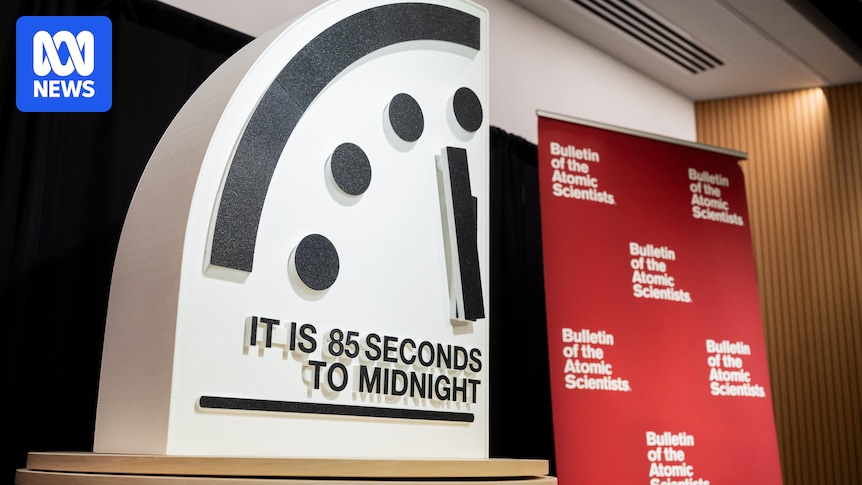
At 85 seconds it is now the closest to midnight than it has ever been.
Professor Relman says there isn’t an exact science to deciding new times.
“We want the announced clock time to be useful in moving public opinion and motivating action,” he says.
The experts advising the Doomsday Clock are now starting to discuss whether its time should be changed again in 2027.
The Doomsday Clock now aims to highlight many technologies that pose a serious risk to the world. (Supplied: Bulletin of the Atomic Scientists)
Professor Relman says he’s even more concerned by some of the listed biological threats than he was a year ago — particularly the convergence of AI and biological tools.
But on the spectre of mirror life, he’s cautiously optimistic.
“My hope is that the public will look at this and go, well, here’s at least one example where scientists seem to be able to largely self-regulate themselves and make the right call,” he says.
The mirror life question is far from answered, but the careful discussions happening around it might show that researchers can recognise a threat of their own making.
Professor Relman hopes this will bolster us against another big risk: declining trust in science.
“I’m hoping that we can start to rebuild the trust that’s been lost by doing more of that.”