






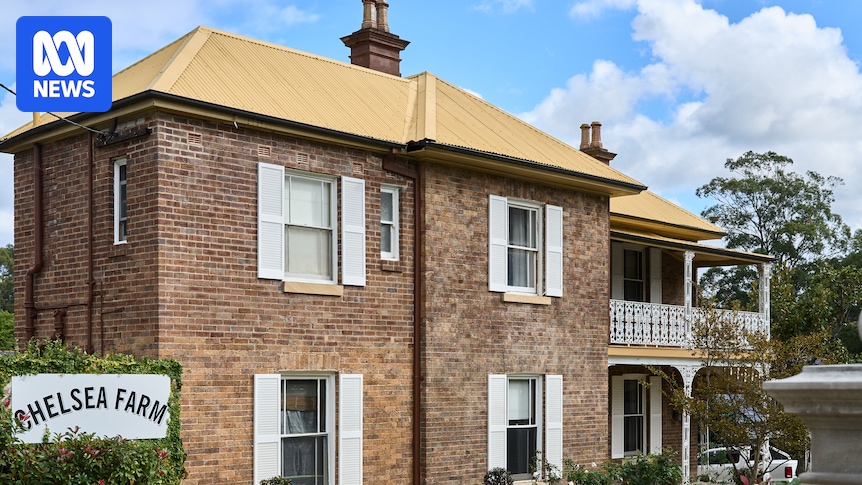
When the Tedesco family bought a sprawling property in Sydney’s Hills District, they knew nothing of its more than 220-year history.
Nicolas Tedesco’s elderly parents jumped at the opportunity to buy the heritage-listed Baulkham Hills home three years ago, with hopes of passing it down through their family.
They had wanted a smaller “family farm” to replace their 12-acre home of many years near the Blue Mountains which had become too much to maintain.
The Baulkham Hills homestead’s charming features, including three separate living quarters, original floorboards, a main central staircase and a 1930s AGA cooktop hinted at its age.
The heritage-listed home is more than 220 years old. (ABC News: Timothy Ailwood)
The 1930s AGA cooktop in the kitchen. (ABC News: Timothy Ailwood)
Two barns on the property, both with original fireplaces, dated to around 1938.
“At first it was barely liveable, and we knew it would cost a fair bit to restore. But dad was thrilled it wouldn’t be knocked down,” Nicolas said.
“It was a place where they could continue to plant and grow fruit and vegetables for themselves … All we had to do was fix it all up.”
The homestead’s floorboards, architraves and skirting boards are mostly original. (ABC News: Timothy Ailwood)
Nicolas’s son Joel now lives there with his grandparents and decided to research the history of their home.
“There was an old, rotting sign in one of the sheds out the back that said ‘Chelsea Farm’,” Joel said.
“So I searched it online and my jaw kept hitting the floor with each discovery.“
Nicolas and Joel are passionate about the Baulkham Hills property’s history. (ABC News: Timothy Ailwood)
From backyard oranges to a blossom festival
From the Granny Smith apple in Eastwood to the orange orchards in Baulkham Hills, Sydney’s backyards raised some of the earliest successful fruit trees in the new colony.
George Suttor was a botanist and farmer. (Supplied: Australian National Botanic Gardens)
From the early 1800s, the Hills Shire was a major citrus producing region.
In Baulkham Hills, in 1801, British settler George Suttor and his family from Chelsea, London began clearing a parcel of land and went on to build a home and plant orange trees.
The property later became known as Chelsea Farm.
Haining Lenane, a local history officer from the Hills Shire Council, said Suttor’s oranges were sold for two shillings and sixpence per dozen at the market by 1807.
“Suttor was the first to produce fruit for commercial sale,” she said.
Chelsea Farm in 1891. (Supplied: Royal Australian Historical Society/State Library of New South Wales)
The Tedescos now grow fruit and vegetables on the property. (ABC News: Timothy Ailwood)
Ms Lenane said preserving sites like Chelsea Farm would ensure “the history of the community is not forgotten, but remembered and valued by future generations”.
“The present house is the last visible remnant of the original property and has high historical significance, as Suttor was a pioneer nurseryman of the Hills District,” she said.
The area’s legacy is celebrated annually each September through The Hills Shire Council’s Orange Blossom Festival.
The parade in Castle Hill pictured in 1983. (Supplied: Hills Shire Council)
The festival marked the orange trees’ first blossoms. (Supplied: Hills Shire Council)
The Orange Blossom Festival has been around for decades. (Supplied: Hills Shire Council)
Chelsea Farm’s Jewish migrant legacy
Between 1938 and 1951, Chelsea Farm was owned and operated by the Australian Jewish Welfare Society (AJWS), which aimed to support European Jews affected by Nazi persecution.
Chelsea Farm provided Jewish refugees with farming skills and helped them assimilate into Australian society.
Care was provided to the Jews upon arrival to Australia. (Supplied: State Library of New South Wales)
The society later focused on post-war refugee resettlement. (Supplied: State Library of New South Wales)
Men were trained to gain employment on farms and cattle stations. (Supplied: State Library of New South Wales)
Nicolas and Joel Tedesco visited the Australian Jewish Historical Society Archives (AJHS), located at the Sydney Jewish Museum, where boxes of information relating specifically to Jewish farming history were held.
AJHS head archivist Sabrina Elias noted the “pivotal role” Chelsea Farm played in rescuing and resettling Jews who would be trained as small farmers, fruit and poultry raisers and domestic workers.
“As a very small community, it’s important to preserve this history to ensure that our cultural, social, and artistic footprint is not forgotten,” she said of Australian Jewish identity.
Nicolas feels grateful to further highlight Australia’s migrant stories. (ABC News: Timothy Ailwood)
For Nicolas, a first-generation Australian of Italian origin, connecting with migrant history felt emotional.
“You can’t put a price on it, they’re little vignettes of pure beauty,” he said.
“I have the feeling that this building is wanting us to find more of those special moments.”
Nicolas’s father had wanted a home that would not be demolished, as the last one he built himself was. (ABC News: Timothy Ailwood)
The property was also leased to the Australian military at various intervals between 1941 and 1944, serving as an operational base during World War II.
“Someone who lived down the road in her childhood, now in her 80s, had memories of Chelsea Farm’s military history,” Joel said of a recent interaction with a Baulkham Hills local.
“She said when she was a little girl, her mother would take the old bomb casings to use as pots for pot plants just after the Second World War.”
The property was leased to the Australian military during World War II. (ABC News: Timothy Ailwood)
The Tedesco family have worked intricately on the restoration. (ABC News: Timothy Ailwood)
Community connects over historic house
Chelsea Farm went into private residential ownership in 1952.
An architect by trade, Nicolas said his ultimate goal was to create a legacy for his father, restore the historic house and “hopefully not send the family broke in the process”.
“We’re less than 20 per cent of the way through the restoration, because we want to check twice, cut once and do this right,” he said.
Joel has enjoyed connecting with others interested in local history. (ABC News: Timothy Ailwood)
Recently Joel and Nicolas opened their family home to the community for a day, expecting a few curious people to show up. Eighty did.
“It’s still shocking to me that anyone else cares besides dad and I,” Joel said.
“We want to hear from other people with their own memories, because it’s still a mystery being unfurled.“
Nicolas also hopes to hear from the community.
“I’ve always told my kids, everyone has a story to tell — so try to listen every now and then. It feels funny to have ended up with this building that is screaming for us to find more stories about it.
“If we can fill some of the gaps, that would be very special.”