






Over 80 years since Allied forces landed on the beaches of Normandy, the physical marks left from D-Day do not entirely vanish; they have simply become less visible.Visitors to Omaha Beach know the site’s wartime history, but a scientific study has found microscopic remnants of the assault in the sand. According to a 2011 study published in The Sedimentary Record, around four per cent of one analysed sand sample from Omaha Beach consisted of tiny iron particles interpreted as wartime metallic fragments. A larger follow-up study published in 2026 later estimated that metallic grains account for an average of about 0.4 per cent of beach sediments across all five D-Day beaches.A holiday memento that became a scientific breakthroughThe discovery was not made by military scientists working intentionally on the site.During a field trip to France in 1988, sedimentary geologists Earle F. McBride of the University of Texas at Austin and M. Dane Picard of the University of Utah came across Omaha Beach. Sedimentary geologists often collect sand on field trips. Thus, they collected the sample of sand without any expectation.Only years later, when analyzing the grains under the scanning electron microscope, they found out that the sample contained many metal particles amidst the quartz sand. The researchers published their findings in the September 2011 issue of The Sedimentary Record, the quarterly journal of the Society for Sedimentary Geology (SEPM).As was stated in the paper, the sample contained about 78 per cent quartz, 9 per cent feldspar, 4 per cent carbonate grains, 3 per cent heavy minerals, 2 per cent chert and other rock fragments, and 4 per cent metallic fragments.The figures applied only to that individual sample and were not intended to represent the entire beach.
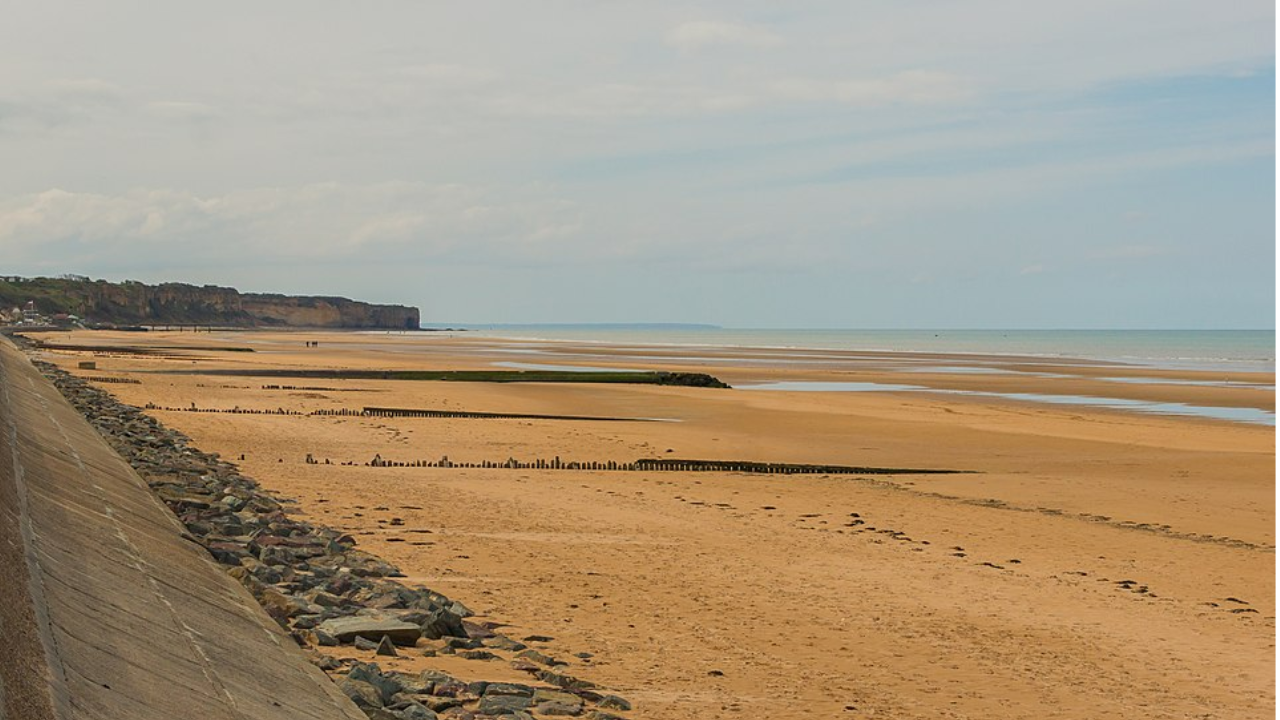
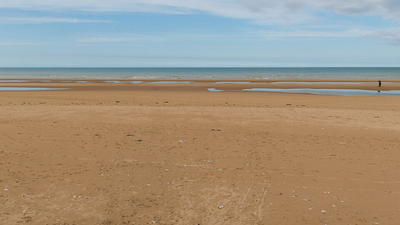
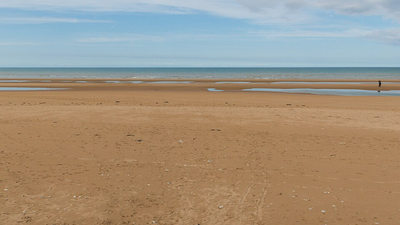
Omaha Beach. Image Credit: Wikimedia Commons
The metal particles narrate the events of June 6, 1944The researchers suggested that many of the iron particles likely originated during the Normandy landings of June 6, 1944, when Allied forces launched Operation Overlord. However, a larger 2026 study noted that some metallic grains may also have originated from later industrial activity, foundries, shipbuilding and other human sources.These were particles measuring 0.06 mm and one mm in diameter. Under the microscope, most of them appeared to have sharp, irregular edges, although years of waves action has worn down the edges. These particles also had layers of rust and corrosion, an indication of their prolonged exposure to seawater. Scientists were also able to find some tiny spherical beads made up of iron and glass in the sample. They claimed that these had formed as a result of the intense heat from explosions melting iron and even quartz to form beads before cooling.The scientists state that these tiny particles are distinguishable from the regular mineral particles due to their unique shapes and composition.Scientists say that the four per cent ratio is not applicable to the entire beachEven though the number has received much attention, scientists themselves advised people not to overstate it.Their calculation can only be applied to the sample that they have been working on. Since there are many processes taking place on beaches, such as the movement of sand through currents and waves, they are able to distribute heavier substances around. As stated by the authors in the scientific article, they were not able to identify if the particular sample was representing the entire Omaha Beach since natural sorting through waves might increase or decrease the metallic fragments in the area.A much larger survey published in 2026 analysed 460 samples collected across all five D-Day beaches. Researchers found that metallic grains made up an average of 0.4 per cent of beach sediments, while Omaha Beach itself averaged 0.18 per cent metallic sediment.The researchers further pointed out that while metallic grains may have been associated with D-Day landings, lack of control samples made it impossible to eliminate contribution from industrial activities, foundry work, shipbuilding, and water transport over the years.The microevidence is slowly disappearingAccording to the researchers, these fragments cannot be preserved forever.Iron corrodes quickly in salt water, which gradually breaks the particles down. As rust forms on the outer layer, waves wear it away and expose the layers beneath. This process continues over time, reducing the particles until they disappear. McBride and Picard estimated that within about another hundred years, these particles can become so worn out that they would be unidentifiable in the beach sand.In other words, one of the last physical pieces of evidence of the battle is slowly being washed away by natural processes, not by any man-made means.A case where history manages to exist in an unusual wayOmaha Beach is still considered one of the most important places related to the Allied invasion of Normandy. Many people died during the invasion, and Omaha Beach attracts many tourists from all over the world in order to see how the invasion took place.It appears that the existence of microscopic metallic fragments gives us yet another view at that period of history. It means that nature managed to preserve the pieces of history that happened here, although other evidence has been erased from the site.These pieces might not be visible to the eyes of visitors, but they give an example of the fact that history might leave some traces in unusual ways. Natural processes continue to act on the beach. As a result, corrosion and tidal changes are expected to destroy even this microscopic evidence of D-Day, leaving museum pieces as the main reminders of that day.The latest study describes these deposits as “conflict sands”, reflecting how microscopic traces of warfare can persist in beach sediments decades after a battle. Even though most of the physical remains of the war have been lost due to erosion, the very smallest particles are still present in the form of microscopic metals in the sands. These too, of course, will be erased one day by erosion.