





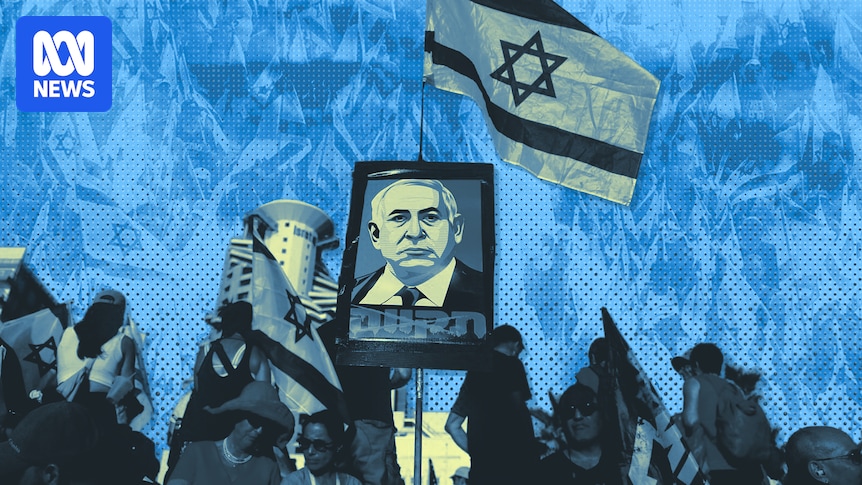
A Trumpian clash between the Netanyahu government and Israel’s most senior court is rapidly building into a major constitutional crisis.
The issue ultimately at stake is control of a television station that is critical of Benjamin Netanyahu’s government, and follows other moves designed to clamp down on domestic and international media criticism of the government.
Netanyahu’s government has also sought to limit the powers of the Supreme Court, a move in 2022 which sparked mass protests in Israel.
The government has often cast both the judiciary and critical media as left-wing elitist institutions.
Opposition parties argue that, above and beyond the implications for the media, an unprecedented declaration by the government last weekend that it would defy a Supreme Court ruling on media regulation could signal its preparedness to do so on other issues, including the conduct of looming elections later this year.
“These developments suggest the latest clash is not an isolated legal disagreement, but part of a broader campaign to redefine the balance of power between Israel’s democratic institutions,” wrote Australian publication the Jewish Independent.
In the torrid world of Israeli politics, the current conflict between the government and the court is playing out as a story that reveals the deep ruptures in the halls of power in Jerusalem.
A rare government declaration to defy a court
The current controversy relates to a ruling by Israel’s Supreme Court’s decision last month that enables the Council of the Second Authority for Television and Radio, the commercial broadcasting regulatory body, to resume operations despite lacking a two-thirds quorum of members.
It sounds like a pretty obscure issue to spark a constitutional crisis.
It was originally sparked by Communications Minister Shlomo Karhi’s move to replace the Second Authority’s council and director, a move which could have cleared the way for a board stacked with political allies to approve ownership changes at Channel 13, which has been a long-term critic of the government.
The government had attempted to impose an alternative board of directors at the regulator. The Supreme Court ruled the alternative board illegal.
When outgoing council members departed, the remaining council fell below the quorum required to operate legally.
The court ruled last month that the regulatory body must continue its work despite this shortage, preventing the minister from unilaterally replacing the board with political allies.
In a statement on Sunday, the government said last month’s ruling was a clear case of judicial overreach, and Shlomo and Justice Minister Yariv Levin said the ruling would not be respected, with Levin saying “the court is not above the law and there is no anarchy here”.
Shlomo Karhi, Yariv Levin and Israel Katz have all criticised media coverage in Israel.
(ABC News)
Israeli President Isaac Herzog, the Israeli attorney-general, and opposition party leaders have all attacked the government’s declaration that it will defy the court’s ruling.
“Statements calling for noncompliance with [High Court] rulings strike at the heart of the nation’s unity,” Herzog wrote on X.
“Non-compliance with a court ruling is a red line that must not be crossed under any circumstances.”
But the battle over the regulatory body is also a reflection of the government’s wider attempts to control the domestic and international media, which have seen the country drop four points in the Press Freedom Index to 116th out of 180.
“The reason that the government actually objected [to the court ruling] so hard is the fact that they want to gain more power over the communication and media markets in Israel,” said Tehilla Shwartz Altshuler, an expert on media and technology policy at the Israel Democracy Institute.
A ‘master plan to weaken the free press’
Israel has traditionally had a vibrant media sector.
Television and radio stations include KAN, a publicly owned television station; Army Radio, the Israeli army’s official station; Channel 12, a popular commercial TV channel; Channel 13, a government critic; and Channel 14, an ultranationalist right wing and often shrill supporter of the government, which has at times been accused of inciting war crimes by civil rights groups inside Israel.
Channel 14 has been exempted from several standard regulations covering fair news coverage and promotes the view that law enforcement and the judiciary are illegally targeting the prime minister.
The current government has taken a range of measures to clamp down or intimidate other more critical media.
Some of the measures it has taken may sound familiar to an Australian audience, particularly its attempts to constrain or intimidate the public broadcaster.
And there are also familiar echoes of Donald Trump’s attacks on the media in America.
Journalists covering Benjamin Netanyahu’s corruption trial have been targeted. (ABC News)
Anat Saragusti, a veteran Israeli journalist and director of press freedom at the Israel Union of Journalists, says that since the current government took office, it has had a “well-crafted master plan to weaken the free press in the country”.
This has included earlier pieces of legislation targeting the public broadcaster, KAN.
There is now legislation before the Israeli parliament, the Knesset, to dismantle the guaranteed independent funding structure of the KAN public broadcaster and instead force it to have its budget set, and potentially cut, by the government each year.
(By comparison, the ABC’s funding is set by the government and parliament but currently works on the basis of a five-year cycle, which seeks to keep it out of the three-year election cycle.)
There has also been interference in the appointment of KAN board members, with only five of the 12 positions on the board filled. With seven votes needed for a quorum, the board is in limbo and cannot confirm its annual budget or appoint a new chief executive.
The government has also closed down the operations of the Qatar-based Al Jazeera in Israel.
The Israeli cabinet also voted in December to close down the publicly funded Army Radio, which it said was critical of the IDF. This move too has been stymied by the Supreme Court.
Israeli government ‘speeding up’ attempts to control media
These changes come on top of the conspicuous ban on foreign journalists entering the Gaza Strip, except when escorted by the IDF, under which they must comply with military censorship. The Israeli Union of Journalists is supporting the Foreign Press Association’s attempts to overturn this ban.
“It’s very intense,” Saragusti says. “And now since we are getting into election year or months, you know, they’re speeding up.”
The government has also targeted critical media, including Israel’s oldest newspaper Haaretz, using other editorial and financial means, including banning journalists from press events and banning government advertising in the newspaper.
Haaretz has been one of the few newspapers to criticise the large civilian death toll in Gaza, a subject rarely reported on or discussed in Israel.
Conferences have become a vital form of financial support for media around the world.
The Netanyahu government refuses to take part in conferences organised by Haaretz.
Saragusti notes that Defence Minister Israel Katz has “called upon all the generals in the army not to cooperate with Haaretz’s correspondents, not to give them any background talks or whatever” while Minister for National Security Itamar Ben-Gvir doesn’t answer any requests for his comments from Haaretz correspondents.
“The minister of economics, who is the richest politician in Israel,” she says, “sued Channel 12 news, because of an investigative piece about him, for 12 million shekels [$5.73 million] and also established a fund to help anybody who wants to sue Channel 12 news.”
The refusal to accept the High Court’s ruling threatens to become a constitutional crisis. (ABC News)
The Union of Journalists has taken legal action in the Supreme Court on both the treatment of Haaretz, and Army Radio, as well as in the most recent case about the media regulator.
There is also a very organised and orchestrated campaign against critical journalists on social media and on billboards.
Saragusti says journalists who cover Netanyahu’s corruption trial have been particular targets and says journalists now face intimidation near their homes.
“Some of them had to hire bodyguards,” she says. “It really is very effective.”
Despite having led his country into war on two fronts this year (against Iran and Hezbollah in Lebanon), Netanyahu rarely gives interviews in Hebrew or opens his press conferences for questions, instead relying on pre-recorded video messages.
The Israeli prime minister’s office was approached for comment, but did not respond.
Media reporting in Gaza ‘one-sided’, journalist says
The consequences of these attempts of control have been sinister, critics say, particularly in Israeli media’s coverage of the war in Gaza.
Saragusti says it has led “self-censorship” and “one-sided” coverage that “[echoes] the narrative of the IDF”.
“[The Israeli media’s coverage] was so biased. It was like a one-sided war,” she says.
“Nothing about Palestinians. It was praising the heroism of the [IDF] soldiers.”
Saragusti argues that while the Israeli media have effectively made the sufferings of the Palestinians invisible, they still played a crucial role in reporting what happened on October 7 and afterwards, including putting pressure on the Israeli government.
“[Journalists] were the first to understand the scale of the massacre,” she says.
“Before the state agencies woke up and understood what’s going on, it was the journalists who … drove into this area and were exposed to threats and life threats.”
Benjamin Netanyahu generally prefers to give televised statements, over press conferences. (ABC News)
In the second phase of the attacks, she says it was journalists who were criticising “the state agencies that were not addressing any needs of the evacuated communities from the border who were subject to this event, this slaughter.”
It took the government days to mobilise in support of the October 7 victims, she says.
Saragusti also says the Israeli media were “the only ones that put the hostages very high on the public agenda daily”.
“And if it was not for them, the government would throw it out the window … they didn’t care about the hostages at all,” she says.
“But in terms of the humanitarian crisis in Gaza — silent.”
Journalist in Israel ‘shocked’ by state of media
Despite the government’s pressure on the media, there is still a lively political debate taking place inside Israel.
The widespread unpopularity of the Netanyahu government means what is happening there is still discussed in the political and media realm, even with the absence of much detail about what has happened in Gaza, from those who don’t approve of the war with Iran and Lebanon, to the majority who think neither has gone far enough, and to the many who argue the prime minister’s actions are overwhelmingly designed to keep him in office and out of the hands of an anti-corruption investigation.
To Australian eyes though, there are mystifying elements to the internal debate.
For example, while there was little criticism of the actions of either settlers or the IDF against Palestinians in the West Bank, there was significant prominence given to stories about the desecration of statues of Jesus Christ by IDF soldiers in Lebanon, and their public chastisement from not reflecting the values of the Israeli defence forces.
“You could kill whole families, a tribe, and nobody would say anything,” Saragusti says.
“And suddenly, because of a statue of Jesus … this is the thing that you flag?
“It doesn’t comply with the army ethics, yet in Gaza, they bombed universities, hospitals, schools.”
Saragusti is a veteran of conflict reporting, including in Gaza and Lebanon.
“I’m shocked to see that even the core muscle of curiosity that journalists need is completely numb,” she says.
“They immediately adopt the official narrative of the Israelis. And this is what [is] so disappointing for me.”
The Netanyahu government’s battles with the judiciary and the media have coalesced in this recent defiant declaration by the cabinet against the Supreme Court.
It’s not clear where the case will go next.
But it has highlighted the troubling decline of a free media in Israel and raised concerns about a government willing to defy a country’s highest court.