






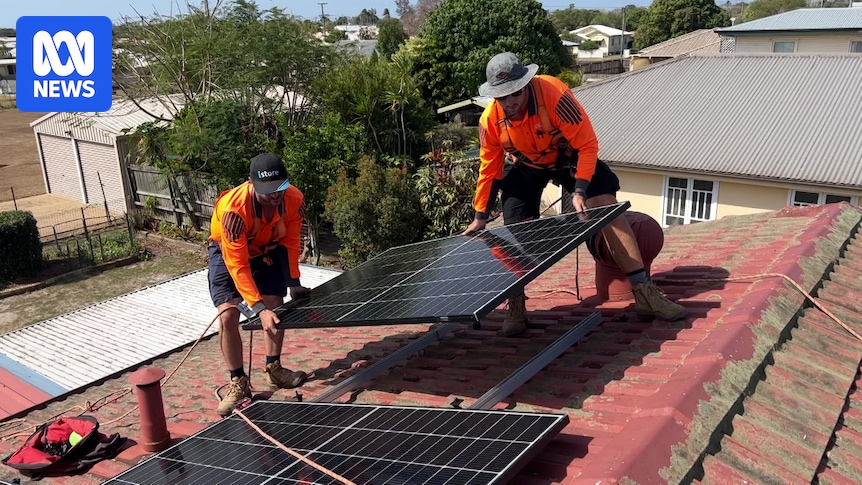
Interest-free loans and cash subsidies are being offered by the New South Wales government to encourage the uptake of renewable energy measures like solar panels and household batteries.
From today, home owners with a combined household income of $210,000 or less can apply for a 10-year loan of up to $15,000 at zero interest.
The government will fund $480 million worth of loans, meaning 32,000 households could borrow the maximum amount.
Premier Chris Minns said the new scheme was a practical way to help ease the pressure of energy bills on the cost of living.
“For many households, the up-front cost of these upgrades has simply been too high,”
Mr Minns said.
“We’re stepping in to help where we can, so more families can access technology that lowers their bills and makes their homes more comfortable.”
The state government will fund $480 million worth of loans. (ABC News: Peter Garnish)
Cash subsidies of up to $4,000 for energy-saving upgrades will be available to concession card holders and households earning less than $80,000 a year.
Renters will be able to access the payments provided that their landlord approves the upgrade.
The up-front payments are set to begin later this year and will cost taxpayers $77 million.
Those eligible are encouraged to apply for the cash first and seek a loan for the remaining cost of the improvement.
‘More efficient technology’
Ms Sharpe says the scheme will help more families upgrade their homes. (ABC News: Liam Patrick)
Minister for Climate Change and Energy Penny Sharpe said the program would give more families access to better technology.
“Every household that upgrades to more efficient technology is playing a part in NSW’s energy future,”
Ms Sharpe said.
Eligible home improvements include rooftop solar, batteries and switchboard upgrades, as well as ceiling insulation, draught-proofing and double glazing.
The scheme also covers appliances like solar water heaters, reverse cycle air conditioning, induction cooktops, EV chargers and DC ceiling fans.
Funding was first allocated in the 2024-25 budget, with the initiative in development since then.
People will be able to use the state program on top of the federal government’s home batteries scheme, which cuts up-front installation costs by around 30 per cent.
The government said more than one in two houses in New South Wales already had solar panels and 13,000 batteries were being installed each month.
How long will it take to pay off?
Smart Energy Council chief executive David McElrea said a battery and solar system can range from $10,000 to $40,000 depending on size and the electrification needs of homes.
He said systems paid themselves off within seven years through cost savings, but with the government scheme it could be paid off in as soon as four years.
“You can even sell electricity back into the grid and it also means that you have some control over your own energy usage,”
he said.
“So it is the best investment you can make in bringing down cost of living.”
Mr McElrea said there was increased demand for solar batteries in response to federal government subsidies and that he hoped New South Wales would experience the same.
“There’s been very strong demand, partly because the federal government has provided a generous subsidy for batteries,” he said.
“That subsidy is winding down a bit … I think New South Wales can get ahead of other states and drive increased demand, and the more people that can get access to a battery or solar, the better.”