









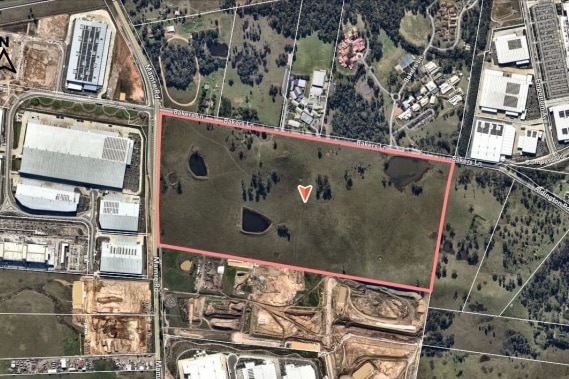
On the corner of Mamre Road and the yet-to-be-built South Link Road, in the western Sydney suburb of Kemps Creek, plans are afoot that could change the way the world works.
It’s here, in this picturesque semi-rural expanse, wedged between Sydney’s rapidly growing outer suburbs and the new international airport at Badgerys Creek, that the AI boom has landed in Australia, with a thud.
If the site owners, IFM Investors, can overcome concerns of local residents, the 52-hectare site will house one of the world’s biggest data centres, to be built and operated by US-owned Airtrunk at a cost of more than $5 billion.
Incorporating six four-storey buildings, 936 cooling units, 852 diesel-powered back-up generators and a huge diesel storage facility, its operator, Airtrunk, is hoping to cash in on the rush to AI and the potential role Australia could play as a regional powerhouse.
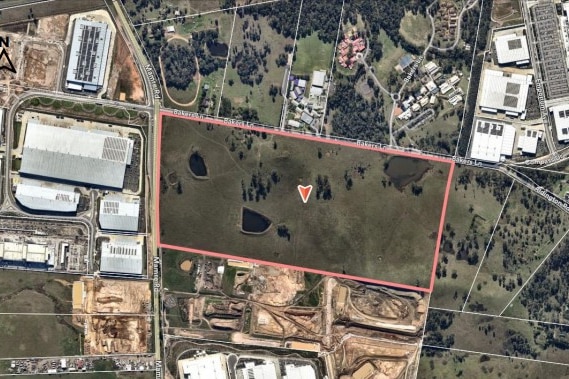
An aerial shot of the site proposed for a data centre in Kemps Creek. (Supplied)
Outside of the US, Australia has emerged as the premier destination for data centre development and investment.
More than $150 billion is lined up, waiting to be poured into this frenzied race to build AI infrastructure, prompting some analysts to invoke memories of the mining boom.
Almost 20 per cent of all non-residential construction is now being directed towards building these temples of technology.
As Westpac senior economist Pat Bustamente points out, this frenzied investment windfall is taking place alongside a huge investment in energy generation and transmission.
“Alongside the potential $200 billion energy transition investment pipeline, Australia is seeing an investment boom, with the total pipeline approaching 13 per cent of GDP, rivalling the size of the mining investment boom,” he says.
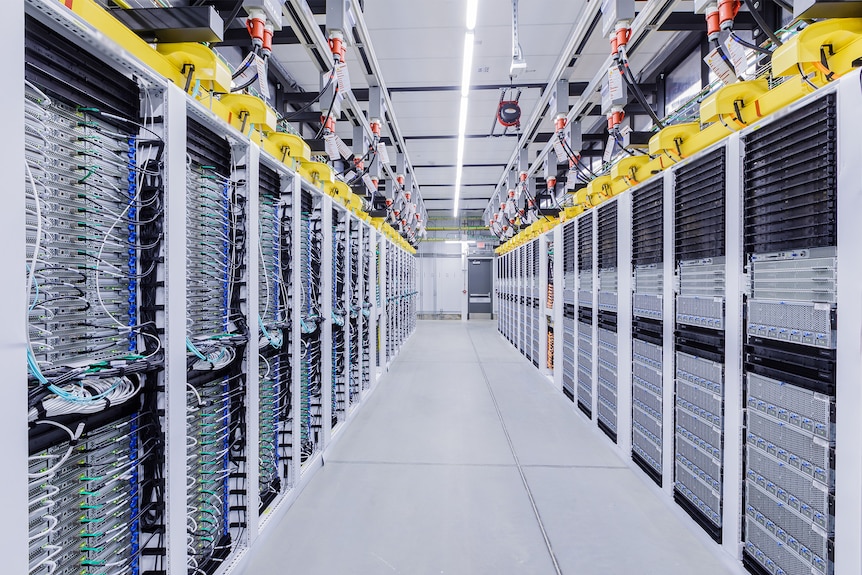
A Microsoft data centre in Washington state. (Supplied: Microsoft)
Data centres save the day. But what about the future?
When the national accounts data dropped on Wednesday, one thing stood out.
Had it not been for the cash pouring in to build AI infrastructure, the Australian economy would have dived deep into a contraction.
About $13 billion was invested into the sector, helping deliver a record 16 per cent rise in machinery and equipment investment, a result that took many by surprise.
On paper at least, it helped offset the pain rippling through households, hit in the March quarter by the impact of two rate hikes and the early impact of the Iran war, which sent fuel prices soaring.
The debilitating combination of an inflation spike and continued rate hikes is expected to become far more acute for Australian households in coming months, coupled with rising unemployment as the economy further slows.
And while this sudden inflow of foreign capital has been welcomed, there are questions as to whether the boom will provide benefits much beyond a short-term construction boost.
For a start, much of the gear inside the new buildings will have to be imported.
As JP Morgan analyst Tom Ryan penned in a note this week, the benefits from fitting out these new centres will mostly flow offshore, given Australia doesn’t produce the required technology.
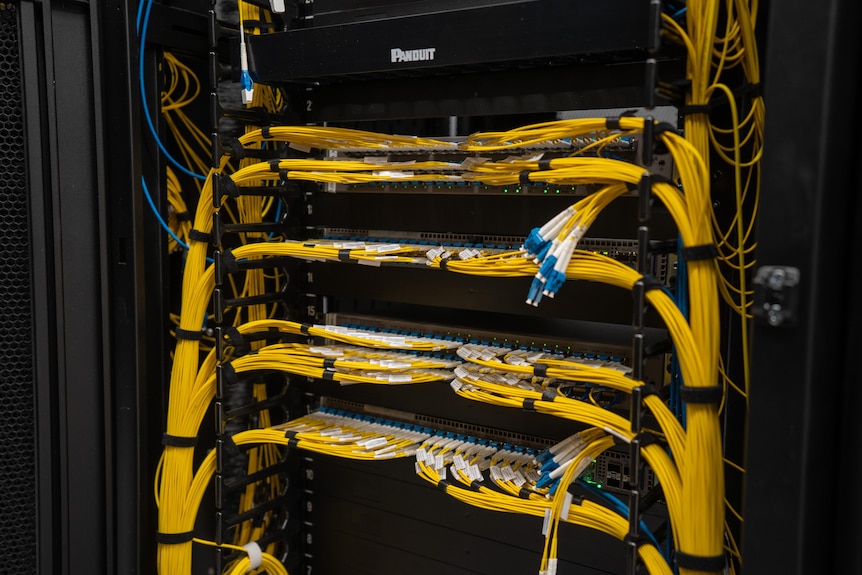
Australia does not produce the technology required to fit out data centres. (ABC News: Rhiannon Stevens)
Those offshore purchases will detract from our economic growth and partly offset the construction boom.
“Compared to Australia’s early 2010s mining capex boom, which peaked at nearly 7 per cent of GDP, the tech dynamic appears much smaller so far,” he wrote.
“While there is likely still upside for technology capital expenditure, a meaningful share of data centre fit-out relies on imported capital equipment.”
And, once up and running, the centres are likely to be highly automated to an extent that there are limited direct job opportunities.
Then there are serious concerns about the power-hungry nature of all this AI infrastructure and the strains it could place on an electricity system already struggling to transition away from fossil fuels.
This latest boom is likely to lay the foundations for a global workplace revolution that could prove to be as painful as it is beneficial.
Big tech doesn’t like tax
Since the start of the year, there’s been a revolving door of US technology heavyweights visiting Down Under.
All are scoping out the landscape for data centre sites.
Microsoft’s Satya Nadella hit town in April, pledging $25 billion in data centre investment while, just last week, OpenAI boss Sam Altman appeared via video link at a conference organised by the Australian Financial Review.
“Australia has among the best natural resources and abundant clean energy [stores] in the world, and if Australia wanted to become a data centre capital of the world, it would certainly be able to,” Altman said.
Why Australia?
An abundance of land, the potential for cheap renewable energy, already established data centre construction skills and the location, particularly for South East Asian clients.
But the longer-term trade-offs could be expensive.
Microsoft’s Nadella was keen to spruik his company’s commitment to upgrading cybersecurity for the nation and its investment on the ground.
Like many of his contemporaries, however, he was unwilling to expand much on whether AI was more likely to replace workers or to help workers perform better, offering soothing words that it should make life easier.
“The state of AI, and quite frankly even for the foreseeable future, is more about what I’ll call task level automation inside of jobs,” he said.
Global tech companies have long been in the firing line from the Australian Tax Office for their innovative approach to reporting earnings and their ability to shift profits to low tax jurisdictions.
Loading
And it would appear, when it comes to data centres, little has changed.
Last year, it noted the tech giants were booking “limited profits” in Australia, “purportedly on the basis that the Australian data centre business is merely providing a service to its foreign associates”.
Keeping the lights on
AI is an incredibly powerful tool, to the extent that even those behind its development, such as Anthropic’s Dario Amodei, are urging caution about its usage, arguing it has the power to tear society apart.
As powerful as it is, AI also requires huge amounts of power.
Australia already has about 162 data centres, most of them scattered through NSW and Victoria close to urban areas. At least another 90, and perhaps double that, are in the wings, many of which are destined to be substantially bigger than those currently in use.
As an illustration, the proposed Mamre Road development in western Sydney will use about 25 per cent more power than the Tomago aluminium smelter north of Newcastle.
The Australian Energy Market Operator expects electricity demand from data centres will treble within the next four years as Australia becomes a regional hub for Asian users.
Most of the pressure, however, will be placed on the grid in Sydney and to a lesser extent Melbourne.
In Sydney, data centres will use about 11 per cent of available power by 2030, up from 4 per cent now.
In Melbourne, while on a much smaller scale than Sydney, the demand will more than quadruple to about 8 per cent of the state’s power.
A study published by the Climate Council last week highlighted the potential impact on electricity prices.
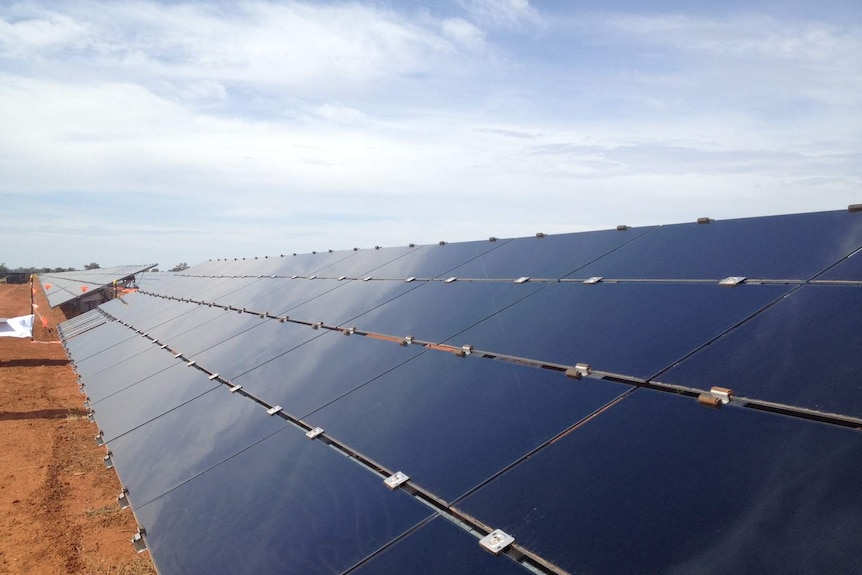
Some are calling for Australia’s new data centres to be powered by renewable energy. (ABC Rural: Sally Bryant)
“If data centre growth is not matched with new renewable generation and storage, this could increase wholesale prices by more than 20 per cent across our main grid by 2035, on average — and up to 26 per cent in NSW and 23 per cent in Victoria,” the study found.
Similar demand growth will be placed on water supply, although by 2030 data centres in Sydney will require about 2 per cent of the city’s water and just under 1 per cent of Melbourne’s needs.
During extended droughts, that increased usage could become critical.
Without extensive oversight and planning, the data centre boom, which promises a mostly short-term growth hit, could become a burden.