
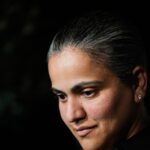




When nursing student Tarhnee was allocated the location of her two-week placement she was “absolutely devastated”.
The 27-year-old was excited to be getting experience in the field but the cost of putting herself up in regional New South Wales, six hours from home, was daunting.
“We started looking at the caravan parks for cabins, and hotel rooms and motel rooms … and the cheapest ones we could find were about $1,800 to $2,000 for the placement, which is just completely out of our budget,” Tarhnee told triple j hack.
Tarhnee said student accommodation was not provided and changing the location was not an option either.
“So the next rational thing to do was attempt camping,” Tarhnee said.
Loading…
She said paying about $30 a night for a site at a caravan park seemed like the best and only real option for her to complete the mandatory placement.
“It was certainly a character-building experience, but I wouldn’t recommend it,”
she said.
As cost-of-living pressures continue to bite some Australian university students have resorted to camping, with one even bunking down with dogs at a veterinary clinic, to afford mandatory placements.
While nurses and midwives qualify for the federal government’s paid prac scheme, many allied health and medical students who must complete hundreds, and in some cases thousands of hours of practical placements, are not eligible for the support.
Nursing student Tarhnee did two weeks of prac in regional New South Wales earlier this year. (Supplied)
The National Union of Students says the cost of accommodation is one of the greatest barriers to students completing placements.
It is calling for the Commonwealth Prac Payment to be expanded to all students completing mandatory placements, echoing previous calls made by independent ACT senator David Pocock and Victorian MP Helen Haines.
‘Doomsday prepping, but for camping’
Tarhnee stocked up on food and water before going on her nursing placement. (Supplied)
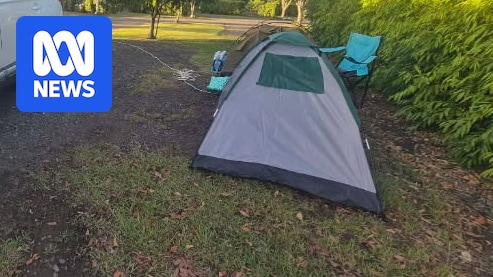
Ahead of her nursing placement Tarhnee borrowed a swag and bought some camping essentials.
“We went shopping in the weeks leading up to placement and just got all the tinned food and easy to cook food while they were on special,” she said.
“My survival kit was food, a swag, a chair and a little table for my laptop.“
Initially she was feeling optimistic.
“The first day I was full of hope, I had set the campsite up and I was, like, this is going to be great. I like camping as a hobby, why not do it for this?” she said.
But her optimism was soon tested as rain and the reality of her situation set in.
“I woke up at 2am … and I noticed that everything was wet. The swag hadn’t actually been weatherproofed properly so it very slowly started to fill with water,” she said.
“I had to wake up the next morning at 5am after not sleeping to get ready to go to my first day of placement.”
Tarhnee’s camping set-up included a tent and a swag. (Supplied)
Tarhnee said after a few nights camping in wet weather the sadness set in.
“I was, like, ‘I just wanna go home, I don’t think I can do it anymore’, which was contradicted by the daytime when I was at placement,” she said.
“I was having a great time [on placement] while I was actually doing what I was supposed to be doing.
“But then I would get back to the campsite and it would just be a cycle of euphoria and depression.“
Tarhnee said she raised the situation with her student placement facilitator when she started getting sick and was able to see out her prac staying in quarters usually reserved for agency nurses.
‘Norm not the exception’
Earlier this year the Health Students Alliance released a survey of more than 1,300 students across Australia that found more than half of participants considered leaving their degree due to the burden of placement.
The survey found 81 per cent took unpaid leave while on placement, 78 per cent struggled to pay bills and 42 per cent went hungry.
National Union of Students president Felix Hughes said students resorting to extreme measures like camping was not uncommon.
Felix Hughes says prac students were often paying for accommodation on top of rent and bills back home. (Supplied)
“We’re hearing again and again that covering accommodation costs while you’re doing unpaid prac is one of the hardest parts, particularly if that prac’s in regional or remote Australia,” Mr Hughes said.
He said there was no designated support for students completing prac away from home, which meant students were often paying for accommodation on top of rent and bills back home.
Last year, students in nursing, midwifery, teaching and social work — fields recommended by the Universities Accord — became eligible for the Commonwealth Prac Payment (CPP).
The payment is currently $338.60 a week which Mr Hughes said was making a difference for some students but “doesn’t go anywhere far enough”.
He wants to see the CPP expanded to all students completing mandatory placements.
“Students should be able to complete mandatory placements without having to go to their mum and dad and beg for money,” he said.
“What it’ll end up doing is locking low socio-economic students out of those fields, out of nursing, out of teaching … the very fields where we need them right now.“
Renovating an old caravan
For Gracie, a medical imaging student from Queensland, sorting out accommodation for an eight-week placement later this year was going to be a challenge.
Medical imaging student Gracie is renovating a caravan so she has accommodation for future pracs. (Supplied)
While friends ahead of her at uni had emphasised the need for financial support from family, Gracie said that was not really an option for her.
“I’m not someone who’s just going to go through uni expecting my parents can pay for it. My parents don’t have lots of money,” she said.
But Gracie’s mother had a different idea: buying and renovating an old caravan.
“It only cost $300 … but the catch is it’s just a shell,” she said.
It is something Gracie hopes will set her up for success and take the weight off financially.
“Once I have this caravan set up it’s mine, and then I can take it on my next placement as well. So I’m hoping to use it all throughout uni,” she said.
And with help from her family the project is well underway.
“Having my mum with the previous knowledge and my dad helping me out to do this has been a huge support for me,” Gracie said.
“I think that’s more worthwhile than them giving me money.”
Jason Clare said the federal government continues to address cost of living for students. (ABC News: Ian Cutmore)
In a statement, Minister for Education Jason Clare acknowledged the reality of “placement poverty”.
“I have met students who told me they can afford to go to uni but they can’t afford to do the prac,”
Mr Clare said.
He said paid prac was a government first.
“Paid prac is a game changer providing real cost of living help,” he said.
The education minister also pointed to changes to youth allowance, rental assistance, and the 20 per cent cut to student debt as ways the government had tried to address cost of living for students.
Gracie hopes for a warm and dry place to sleep and study later this year.
“Best case scenario would be … just sitting on my bed, having everything set up the way that I want, doing my study … and having a safe space like my caravan to go back to,” she said.