




In just a few short weeks, a small country town became One Nation heartland.
Annette Smith didn’t want to approve the post, but she couldn’t think of a reason not to.
Two of the things the 68-year-old takes most seriously – free speech, and her role as the local community Facebook administrator – were in conflict.
Her commitment to the former won out.
She clicked approve, allowing words of support for Michelle Milthorpe, the Climate 200-backed independent candidate in the NSW by-election seat of Farrer, to populate the “Hay Matters” Facebook group.
It sat uneasily.
Ms Smith considered herself non-political, but with a strong anti-renewables streak (“It’s just this massive, rampant ravaging of our land,” she said of large-scale wind and solar projects).
She had tried to keep the private Facebook group for the small town of Hay much the same.
“In order to be fair game so that everybody received the same amount of information from every quarter, I telephoned and wrote emails to all the other parties that had indicated they were putting up a candidate,” Ms Smith said.
Her phone rang the following Saturday morning.
It was David Farley from Narrandera, two hours west.
He had recently been announced as the candidate for One Nation and hoped to replace the toppled Liberal leader Sussan Ley as the Member for Farrer in the upcoming by-election.
“It sort of gave me confidence that One Nation had a bloke that we could trust,” she said.
“In six weeks, I jumped from being a neutral sort of feeling person to… a [One Nation] corflute on the front gate.“
When the results of the Farrer by-election were called last month, Smith and a newly animated orange army drank sparkling wine.
Their town and electorate had given One Nation a once-unimaginable foothold in Australian politics.
For every person who walked in to cast a vote at the Hay War Memorial High School, more than half walked out having put One Nation as their first preference.
“The votes were already there. They were just hiding,” she said.
“We are the voice for the words they were too scared to say.”
Hay now
On the outskirts of town, crows opportunistically pick at kangaroo carcasses left behind on the roadside.
Tufts of cotton float downwind from the nearby gin.
It is Mad Max country, quite literally.
George Miller used the long flat plains around Hay as the backdrop to his 2024 post-apocalyptic epic Furiosa: A Mad Max Saga.
A stream of production staff into the town’s shops may have provided a brief boon during filming, but business has dried to a trickle.
“There’s just so many empty shops in our town,” local butcher Garry McCrae said.
“We don’t have a local veggie shop anymore. Everything’s just so wrong.
“The town is dying.”
It’s not in McCrae’s broad-shouldered, jovial nature to be downbeat.
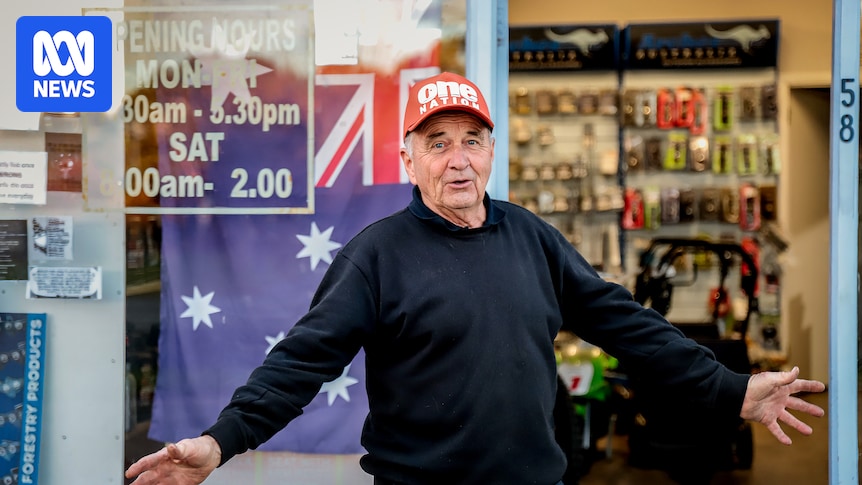
The self-described “old school” butcher double-pumps his fists when talking, physically accentuating the points that matter most to him.
“All us country people have just been neglected and no one wants to help us,” he said with a punch.
“I see the town just getting smaller and smaller.”
Hay’s population of around 2,200 is aging and shrinking.
It is a story repeated around rural Australia, but locals increasingly finger the blame in the direction of environmental policies created in cities hundreds of kilometres away.
“The environment is important, but so is feeding Australia,” said Sandy Symons, one of McCrae’s customers, and a local farming identity.
For years, the federal government has offered voluntary “buybacks” from irrigators in the region, to return water historically used for farming back into the Murray-Darling Basin to improve the environment.
When farmers sell their water entitlements, it typically leads to reduced agricultural production, fewer jobs, less money flowing through the community.
Locals don’t see the tension between ecology and economy as ideological.
For them, it is existential.
“There’s a lot of jobs created through water,” said 62-year-old Hay farmer Paul Porter, who partly links the town’s decline to the water buyback policy.
“Someone in Sydney or Melbourne may not understand this, but water is life and water is commerce.”
David Farley knew how to speak to those concerns.
A former agricultural executive, he made water reform a core part of his campaign.
“Water buybacks [are] a sign of a nation that’s given up on its future. We’re totally against water buybacks,” Farley reportedly told a candidate’s forum in the lead-up to the election.
A few months ago, Farley was in Hay spruiking his case to 15 or so people on a street corner.
Sandy Symons was driving around town and only stopped by because a mate was already there.
“I listened to him for 15 minutes. I was a disciple after that,” he said.
“We all ended up with orange caps on our head.“
What he heard was a portrait of regional decline, accelerated by bad water policy and the decisions of out-of-town, out-of-touch bureaucrats.
It resonated.
“I voted more for David Farley than I did for One Nation.”
A town that went to war
There were only a few weeks to go in the campaign when Symons and Annette Smith joined forces.
They met with a handful of other locals, each linked by a mutual distrust of environmental policies and renewable projects.
One Nation received a mere 95 first preference votes in Hay at the 2025 federal election, but they felt something was bubbling beneath the town’s surface.
The group let One Nation’s head office know of their fledgling movement and were promptly sent boxes of hats, T-shirts and signs.
Actually putting them on and up was another matter.
“That was a really big step for me to openly whack the David Farley sign on my front fence,” Smith said.
“My children were not overly enthusiastic.”
Garry McCrae was among the first to display a One Nation corflute outside his butcher shop.
The nearby Betta Electrical did the same.
The more signs began appearing in shop windows and front gardens around town, the more comfortable locals felt in being open about their new-found allegiance.
“There was an orange wave happening,” said Hay farmer and One Nation enthusiast Julie Lawrence.
Local school teacher Lou Gardam watched on in horror.
“It was really Orwellian,” said the 67-year-old, who spearheaded support in Hay for the Milthorpe campaign.
“The stuff that they were feeding back to me, these slogans that they’d heard…
“Conversations with people that I have known literally for 40 years were very unsettling.”
The threads that bound the country community together began to fray.
Campaign signs were defaced or disappeared.
“NO MORE FASCISTS” read graffiti on a Farley/Pauline Hanson poster affixed to a fence.
“TEAL!” said one typical comment under a pro-Milthorpe Facebook post.
Both sides dug in.
“People openly defacing and tearing down signs and labelling us ‘No Notion’ and you’re a ‘One Neuron’… it not only hardened me, it inspired me,” Smith said.
After preferences, David Farley received 67 per cent of the vote in Hay.
He was sworn-in to Parliament a month later as the first One Nation member to ever sit in the House of Representatives.
In a Facebook post after his win, Farley said he was, “indebted to the fantastic One Nation teams across Farrer who made last week’s victory possible”.
He included a photo of Smith and Symons with other volunteers from Hay, calling them “Great Australians.”
Filling the void
In her maiden speech to Parliament 30 years ago, Pauline Hanson said, “a truly multicultural country can never be strong or united”.
She remained consistent to that credo this week, telling the National Press Club that Australia “cannot be a multicultural society” and instead “must be a monoculture”.
On a recent Saturday night, three weeks after Hay had overwhelmingly endorsed Hanson’s party, the town threw a “Culture Fest”.
The headline in the local paper, the Riverine Grazier, read “Culture Fest Brings Hay Together”.
A flyer for the event featured smiling cartoons of people from different nationalities, included a woman in a hijab.
On Sky News earlier this year, Hanson asked, “how can you tell me there are good Muslims?” (she later partially walked back the comment).
She has twice worn a burka into parliament as a stunt, last year leading to the Senate being shut down for over an hour.
Her very presence of late in Perth and Melbourne has prompted hundreds of people to rally in protest.
James Ashby, the longtime Hanson operative who kicked out an ABC regional reporter from a press event during the by-election, called the protesters “filth”.
Hanson is a popular figure among many One Nation voters in Hay, but some hope the party’s ascendance will see it sand down its sharper edges.
“I’m actually hoping that this sort of groundswell will moderate that outlook of what One Nation stands for,” said Richard Cannon, a farmer and father of four on the town’s outskirts.
Cannon is something of an agrarian pragmatist.
He places himself on the “conservative side of politics” but was open to a renewable project on his farm as a diversified source of income (it didn’t go ahead).
A mixed operation farmer of higher-end cattle, sheep, cropping and cotton, he believes the area has suffered from political abandonment.
“Under the watch of conservative politics in our area, all these things have happened,” he said.
“The overall engagement with the electorate has been dysfunctional. There’s been this sort of coffee shop politics … but it’s just a revolving door of talk.”
With the Liberal and National vote collapsing and Labor not even fielding a local candidate, One Nation eagerly stepped in to fill the void.
Cannon only settled on his decision to swing orange as he walked into the polling both, but he’s wary of how the party’s anti-migrant sentiments could be interpreted.
“I mean, agriculture heavily revolves around migrant workers,” he said.
“Meatworks, horticulture, fruit picking… if there’s not schemes where we can have migrant workers here, they’d cease overnight.
“It’s nothing to go into an abattoir and see 600 people and 540 of them are migrant workers.”
Among the One Nation voters the ABC spoke to in Hay, many were keen to emphasise that support for the party did not equate to there being a broader racist sentiment.
“People would think that Hay now has had a groundswell and voted for One Nation and that we’re sort of pigeonholed as having this ideology of being totally anti-immigration,” Cannon said.
“Well, it’s not the case at all. There’s no racial connotation to any of this.”
Late one Tuesday night, the ABC met with 12 Fijian men and women from various farms in the area.
Seated behind the hall that had held the Culture Fest event just days earlier, the workers spoke on the condition of not being named, fearing reprisal.
Some wore pyjamas with an eye to an early morning start the following day.
Only Orisi Lorima from the local Fijian community association was comfortable sharing his identity.
“We feel we are valuable in the community, but not valued,” one middle-aged woman said.
Each talked of experiencing regular discrimination at work.
“No back pain, no money” was a shared mantra.
One woman cried when talking about the medical bills she’d incurred from a farm injury, which she was now repaying on a payment plan.
Racism, they said, was not unusual.
“They don’t look at us equally. The locals here, sometimes they say things, but none of them can do the job that the Fijians are doing,” said an older woman.
The workers expressed surprise that an election had taken place recently.
Asked what they would say to a politician if they had the opportunity, the older woman responded on behalf of the group.
“Be good, be nice to us.”
‘It’s all hate’
Mechanic Les Lewis has a streak of country humour that’s as blue as the oversized Australian flag he wheels in at the end of each day.
The Donald Trump doll pinned to his garage wall seems as much designed to provoke a reaction from customers as it is a sign of support for the US president.
“That’s my mate Donald,” he chuckled.
The 72 year-old’s antics – and prominent One Nation cap – draw scowls from Kerry Aldred, who helps with office administration at the service station.
“I would prefer to pluck my eyeballs out than vote One Nation,” she said.
Her car windshield is something of a giveaway.
One sticker with the LGBTQIA+ pride colours reads, “Imagine Being Afraid of Pronouns”.
Another, with the colours of the transgender flag, says, “You Will Have To Go Through Me”.
Aldred helped found the first Hay Mardi Gras eight years ago.
Like many people in town, she resists easy categorisation.
Her home garage doubles as a guns and ammunition shop run by her husband Tony.
It’s called Redneck Shootin’ Supplies.
She joked that his recent support for One Nation was almost grounds for divorce, but she understands why some in the shooting community have turned to the party after recent changes to gun law legislation.
Still, her town’s overwhelming support for One Nation has left her feeling, in her own words, “disgusted”.
“It makes you question the intelligence of a lot of people,” Aldred said.
“People don’t look at the big picture of how little Pauline Hanson has done since she first came into public notoriety.
“All she does is stir the pot. It’s all hate.“
Dr Benjamin Moffitt is a populism expert who has researched Hanson for decades.
As One Nation expands its appeal in regional and rural Australia, support for what was once “fringe” is now increasingly normalised.
“There is a shift. This is not hype,” he said.
“To pretend they’re a single-issue party anymore is doing everyone a disservice if they want to actually understand what’s going on.
“This could completely reshape party politics in Australia.”
For Milthorpe-campaigner Lou Gardam, the by-election has reshaped her perspective of her own community.
“In a small town, you actually don’t talk politics, because you know that you probably don’t agree with a lot of people, but you all have to live together,” she said.
“It’s confronting to realise how different your community really is to you.
“I will be more cautious about my community. I’m jaded about my community. That is sad.”
Behind the bar in the main street, the town’s amiable publican David Sloan is an ear to the grumbles and grievances of locals.
“He is not a fan,” laughed Sloan, as a man finished his beer in a sweary anti-Hanson huff.
The pub’s chef is from India.
Sloan worked for many months to get him the right visa.
“The food’s top notch. You won’t find better,” he said.
“He’s brought his family out here, his little girl goes to school and it’s been the best thing for our business.”
Sloan – who describes himself as a Hawke/Keating/Howard/Chris Minns voter – supported One Nation in the by-election.
Whatever the change that’s occurring, he thinks it’s bigger than politics.
“Maybe the blokes at the front of the classroom weren’t the smartest after all,” he said.
“Sure, you need the smart blokes up the front to say the big words, but you need those blokes that sat at the back of the class that just had bloody common sense.
“Maybe they’re not as dumb as people thought they were.”
Credits
Reporting, photography and digital production: Jeremy Story Carter
Producer: Cath McAloon