






The federal government has been accused of selling its cuts to the National Disability Insurance Scheme (NDIS) as a crackdown on fraud, while instead pursuing billions of dollars of dramatic savings by slashing participant packages.
Greens Senator Jordon Steele-John and NDIS minister Jenny McAllister clashed repeatedly in a heated Senate estimates sitting this morning, just days before public hearings into legislation that paves the way for the biggest ever cuts to the scheme.
Treasury modelling tabled in the Senate last week shows that, of the $38.1 billion predicted to be saved from the cuts over the next four years, just $0.9 billion (2 .4 per cent) was expected to come from “making the minister the decision maker on pricing and related fraud measures”.
The same document shows that almost 60 per cent of those overall savings would come from the cutting of participant community participation and therapy budgets ($13.2 billion over four years) and tightening access to the scheme through a new functional capacity test ($9.3 billion).
The government has repeatedly referenced fraud as a justification for its generational overhaul of the scheme, with a separate Senate inquiry hearing last month about $3.7 billion of NDIS funding that was lost to “integrity leakage” last financial year.
Senator Steele-John asked Senator McAllister about the Treasury modelling this morning, saying it appeared the government’s changes to the scheme had more of a focus on “cutting people’s support” than holding the “mongrel” providers who were exploiting participants to account.
“Many people will look at the dollar figures and wonder why they themselves, as participants in the scheme, are bearing the overwhelming weight of the cuts that you are making in a piece of legislation that you’ve overwhelmingly framed as an anti-fraud measure,” he said.
“I think there is a fundamental disconnect here between the government’s language, which is often around tackling fraud, and what the numbers say here in the budget papers.”
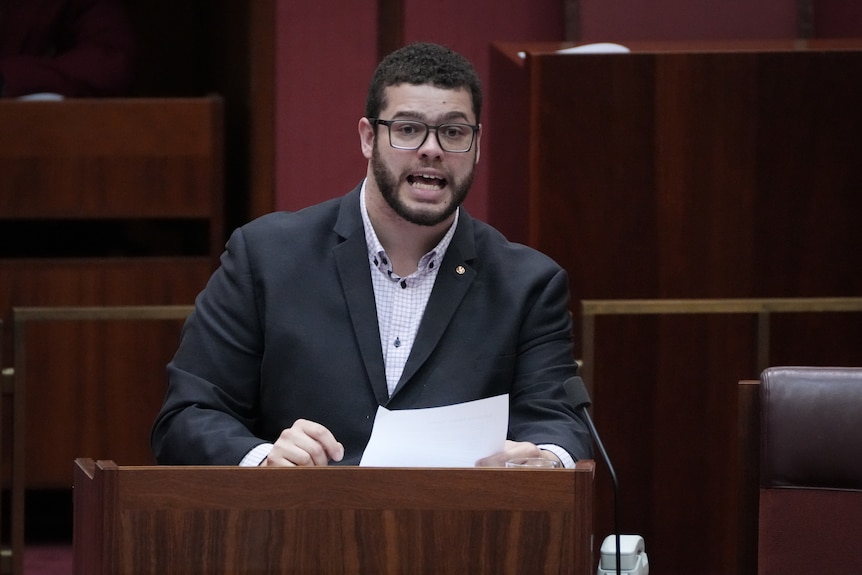
Jordon Steele-John says there is a “fundamental disconnect” between how the government is selling its changes versus what it is actually doing. (ABC News: Matt Roberts)
Senator McAllister repeatedly pushed back in a series of tense exchanges, saying it was misleading to pick one line item from the ten in total contained in the Treasury modelling as the only one that was anti-fraud.
“The package as a whole will have a very significant impact on fraud,” she said.
She accused Senator Steele-John of conflating the fiscal impact of the overhaul to the “overall policy impact”, and that all savings from stopping fraud could not be truly captured on a balance sheet.
“You are correct that for the most part, there are not significant savings to government,” she said.
“There are some savings to government, when we intervene [on fraud], but mostly what occurs is … it generally returns money to people with disability who need it, not to consolidated revenue.”
The hearing continues.