






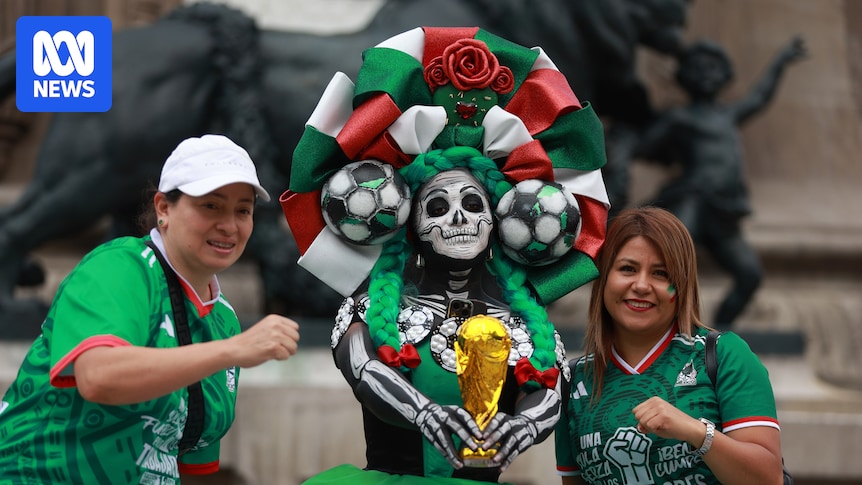
The signs that the World Cup is here are omnipresent in Mexico City.
From the massive billboards featuring Lionel Messi spruiking various products, to the bootleg jerseys sold on footpaths, to the polished exhibitions at the city’s many museums and cultural institutions.
While soccer plays second fiddle in the other co-host nations, the USA and Canada, here, it is life.
But it is at times a torturous love affair, particularly with the sport’s governing body, FIFA.
There are many football related murals and street art throughout Mexico City. (ABC Sport: Amanda Shalala)
Locals locked out
The high ticket prices have been one of the biggest talking points in the lead-up to what will be the most expensive World Cup in history.
The prices hit especially hard in Mexico, where the average yearly wage is around $28,000, amongst the lowest in the OECD.
An aerial view of the Mexico City Stadium ahead of the opener. (Getty Images: Cristopher Rogel Blanquet)
It’s left many locals priced out of attending, including university student Daniela.
Like most of the country’s 133 million people, she loves the sport but has been left disappointed by its inaccessibility, including the fact that only authorised venues can screen matches.
“It was very hard for us as Mexicans to get tickets and also to watch the game here in our home in the country, because we were thinking of going to some restaurants or bars to watch the game, but it’s not allowed,” she said.
Daniela says tickets are unaffordable for most Mexicans. (ABC Sport: Amanda Shalala)
“It’s a sport that we love a lot. And we are not able to be there as Mexicans.”
The high prices are hurting tourists, too.
Some Americans I spoke to saved for three years to visit Mexico for the tournament, but have been unable to afford the final piece of the puzzle, a match-day ticket.
Just breathing the same air as the players will have to be enough.
The World Cup spotlight has also been seized to shine a spotlight on various social issues, including protests over loved ones who have disappeared and protests by the teachers’ union, which included tearing down public installations for the World Cup.
World Cup statues were toppled around the city, during protests by the teachers’ union. (Getty Images: Mariana Martínez)
Daniela says, despite the backlash, Mexicans are ultimately optimistic.
“We always see the good [side] of the bad things. So we have to enjoy the game. We wish Mexico wins.”
Hopeful for humanity
This is a football nation at its very core.
Despite the tangled web of complicated feelings once the world’s most powerful sporting body gets involved, there is still a genuine buzz around hosting the tournament, or co-hosting in this instance, for a record third time.
Those previous two editions remain amongst the most iconic. Pelé guiding Brazil to victory in 1970, and Maradona’s “hand of God” and goal of the century en route to Argentina’s triumph in 1986.
The city’s many museums and cultural institutions have produced special exhibitions and events to celebrate the tournament and to provide a reminder of the good, or at least the feel-good, that can come from it.
Alejandra de la Mora is the curator of an exhibition at the CISS commemorating the three Mexican World Cups.
Alejandra de la Mora speaks to a tour group. (ABC Sport: Amanda Shalala)
“When we put together art, sports, and especially football, it’s the happy face of humanity and civilisation,” she said.
“Because when we see something like a World Cup in a context like we are right now, and we can see that if we can manage to organise and to do something all together, it’s very hopeful for everyone.”
Some of the displays range from quirky… (ABC Sport: Amanda Shalala)
to artistic… (ABC Sport: Amanda Shalala)
to cute! (ABC Sport: Amanda Shalala)
That outlook is shared by Angelica Lovera, the coordinator for a community centre which provides free health and social services in one of the city’s poorest areas.
“These [centres] are located in conflicted areas, violent areas of the city. So there are many problems that need help,” she said.
“For example, domestic abuse is one problem we can find here.
“Drug abuse, there is also an addiction centre here to [combat] that. And abandonment of elders [is a problem].”
Angelica Lovera is the coordinator at the Casa de las 3R del Cuidado Pioneras de la transformación. (ABC Sport: Amanda Shalala)
She believes football can be an important uniting force.
“There are many things missing [in Mexican society], so maybe the FIFA World Cup can be seen as something unnecessary,” she said.
“I think sport and culture in general are also something important.
A mural at one of the city funded community centres. (ABC Sport: Amanda Shalala)
“Sometimes we are caged in survival when we live in conditions that are not the best economically, socially, or politically.
“But I think it’s also important to have something fun, something exciting.”
Will you be in North America for the FIFA World Cup? We want to hear from you