







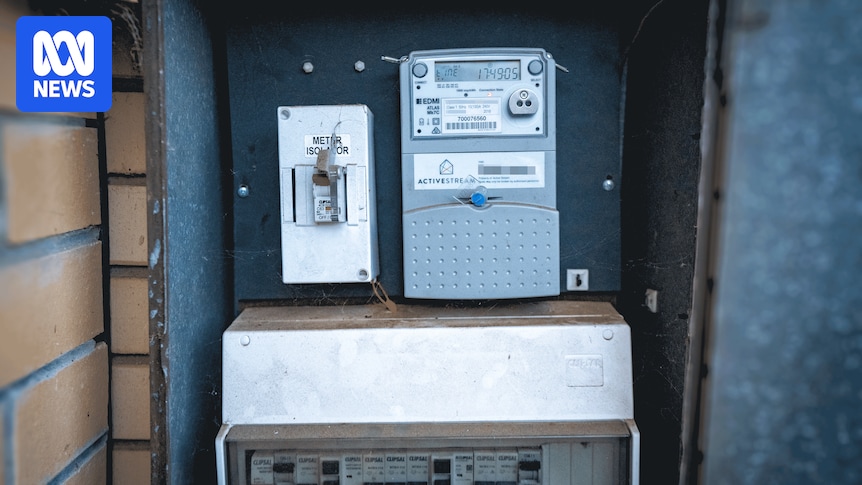
Power companies would be prevented from charging households complicated electricity bills under a proposed shake-up that would also shame providers slugging consumers with ‘loyalty taxes’.
While delivering a comprehensive power pricing review, the Australian Energy Market Commission has called for an overhaul of how people pay for the service.
The AEMC is a key regulator that sets the rules in the national electricity market, the grid spanning Australia’s eastern seaboard.
It said electricity bills had become “too complex, too hard to compare, and too often unfair” in a system it warned was leaving poorer and less advantaged Australians further behind all the time.
The commission says buying power should be no more complex than paying for milk. (ABC News: Erin Parke)
The commission said there needed to be a dramatic simplification of bills, arguing that paying for electricity should be no more complicated than buying a carton of milk.
“Think of how milk is priced at the supermarket,” the commission noted.
“You do not get separate bills for the cow, the carton and the transport. You get one simple shelf price.
“This recommendation applies the same principle to electricity.”
Loyalty taxes targeted
Also in the commission’s sights are so-called loyalty taxes, or the practice by retailers of charging long-term or loyal customers more than new ones.
Late last year, the competition watchdog shone a light on the issue when it noted that barely a quarter of customers were on their retailer’s best offer.
Many more consumers were paying prices above benchmark levels, which are supposed to act as a safety net.
Under the AEMC’s plans, electricity retailers would be required to tell customers who have been on the same plan for four years “how much extra they paid compared to a better offer”.
They would also have to make all their market offers available to existing customers and be required to report relevant data to the Australian Energy Regulator, which would publish it.
“For the first time, Australians will be able to see which energy providers are routinely charging loyal customers more and hold them to account for it,” the commission said.
The wide-ranging recommendations from the commission follow a deluge of complaints from consumers about the growing complexity of power prices, as reported by the ABC.
Across many states, households and businesses have often been unwittingly shifted onto variable prices such as time-of-use tariffs or demand charges.
Previously, most customers were charged a flat rate for their electricity.
Enabling much of the recent complexity has been smart meters, which are installed in more than half of Australian homes but will be in all of them by 2030.
Battery owners could be better rewarded for helping the grid under the proposals. (ABC News: Rhiannon Shine)
According to the AEMC, the electricity system itself was changing rapidly as ever more customers installed solar panels and, increasingly, batteries.
About four million Australian households and small businesses have solar, equivalent to about one in four customers.
Installation rates for batteries, spurred by taxpayer subsidies, are now rocketing as well.
Changing prices, but how?
Anna Collyer says energy pricing needs fixing. (Supplied: Scott Barbour)
Anna Collyer, the commission’s chair, said this was a welcome change that should help to improve the overall efficiency of the grid.
Customers who could “use, store or share energy in ways that reduce pressure on the grid” would lower costs for everyone by avoiding “unnecessary infrastructure”.
“Millions of Australians have invested in solar, batteries and electric vehicles,” Ms Collyer said.
“They are already reshaping our energy system for the better.
“This review makes sure the pricing system catches up with what they have built and rewards them properly for it.”
Central to the commission’s plans are proposed changes to the way consumers pay for the poles-and-wires networks.
These costs are typically one of the biggest components of a power bill, accounting for about 40 per cent of the costs paid by users.
Poles and wires, and how we pay for them, is a central test of the pricing review. (ABC News: Brant Cumming)
In its report, the AEMC stopped short of saying exactly how network charges should be changed, noting a separate review will make those recommendations.
But the commission said redesigned network charges would be the key to unlocking the benefits of clean tech and equitably sharing costs.
It argued that the current system for paying for poles and wires was broken.
This was because network costs were recovered from consumers via the power they purchased from the grid.
The AEMC has argued that households generating their own power pay proportionately less of these network charges, even though they still need the grid for exports and back-up.
Australians’ love of rooftop solar has upended the electricity system as we knew it. (ABC News: Daniel Mercer)
“Under the current framework, as more people generate their own energy, the cost of maintaining the poles and wires network is falling disproportionately on a subset of customers,” the commission wrote.
“This is despite the fact that we all still rely on the shared grid.”
‘In technology we trust’
The AEMC said any changes should not only ensure customers paid for their use of the grid but also reward them properly for any benefits they provide.
This would include price signals that encouraged customers to shift consumption to times when supply was abundant, either by using more or storing it.
Equally, the regulator said consumers with batteries should be adequately rewarded for any exports of power they provide to the grid at times of stress.
Crucially, however, the AEMC stressed the entire experience had to be an easy one for consumers, with technology doing the work on their behalf.
“As technology advances, this can be increasingly managed by devices and service providers, with consumers not needing to lift a finger,” the commission said.
Some of the commission’s recommendations are likely to be hotly contested.
Energy Consumers Australia, which represents household and small business customers, wanted the commission to go further in its curbs on loyalty taxes.
Tristan Edis from Green Energy Markets has also rejected suggestions that solar households are not paying their fair share for the upkeep of poles-and-wires networks.
In a recent opinion piece on a news website, Mr Edis said the owners of networks needed to take greater responsibility for the viability of their businesses and shoulder a greater share of the risks.
“Our regulatory framework governing electricity networks needs to place some level of responsibility and risk on the shareholders of these networks to manage their costs properly, including anticipating the emergence of technological substitutes,” Mr Edis wrote.
“Customers shouldn’t face a zero-sum game where one household’s gain from new technology must come at another customer’s expense.
“Meanwhile, the shareholders in networks are treated like some kind of infant who can’t be expected to take any responsibility for the fact they’ve blown the credit card buying way more capacity than they needed to.”
Among the commission’s other recommendations was a call to improve price comparison tools to ensure punters could better shop around in the market.
And the AEMC has also recommended regular reviews to make sure pricing can keep up with technological change.
Ms Collyer said the review was a “road-map” rather than a prescription, and recommendations would realistically take up to 10 years to implement.