






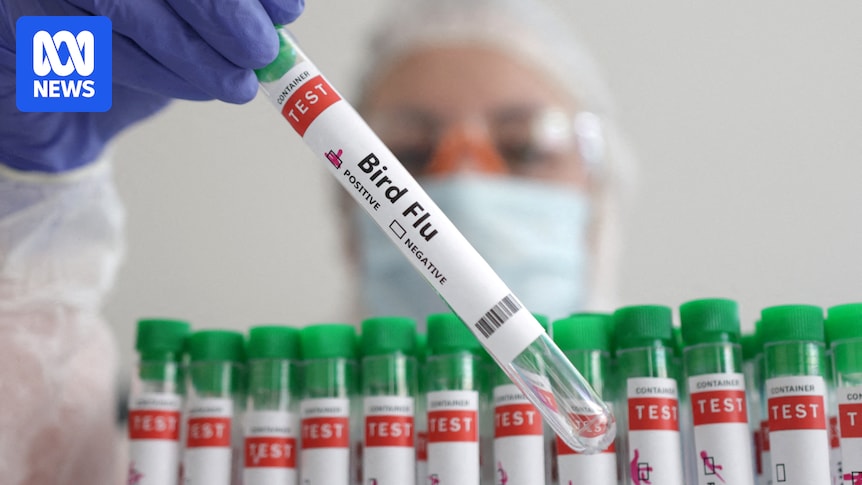
The deadly H5 variant of avian influenza has been detected in a bird that washed up on a remote beach in Western Australia’s south, the first time the disease has been found in Australia.
On Saturday federal Agriculture Minister Julie Collins said further testing had confirmed the bird had the H5 strain, after a suspected positive result for avian influenza was returned on Friday.
Live updates, reactions and contributions from ABC readers.
Collins pointed to a $100 million investment in preparedness for the virus spreading to Australian shores.
“We have looked at what has happened overseas we have learnt from that, which is why we have invested early,” she says.
“I have been talking about our investments in bird flu preparedness now for almost two years.
“We all knew that we couldn’t be bird free forever and that we are the only continent that was bird free.”
The brown skua bird was found on a remote beach at the Cape Le Grand National Park near Esperance, about 700 kilometres south-east of Perth. The bird was isolated after it was found on Sunday and died that night.
The result means the virus, which has infected millions of birds worldwide, has finally spread to every continent on the planet.
Australia has spent years preparing for an H5 bird flu incursion, committing $95 million in biosecurity, environmental and public health funding last October and a further $11.2 million less than 24 hours before news of the infected bird was announced on Friday.
It comes as the nation’s poultry industry recovers from Australia’s largest outbreak of the H7 variant of the disease that left egg shelves in shops bare for almost a year.
More than two million laying hens were killed during the outbreak in line with biosecurity requirements.
Are we prepared?
Australia has been preparing for an incursion of H5N1 with government-run “war-game” crisis scenarios.
Victorian farmers spent much of 2024/25 restocking egg-laying chickens after the H7 bird flu outbreak. (ABC News: Bill Ormonde)
Hundreds of people working in industries such as emergency services, supermarkets, health, telecommunications, animal welfare, transport and logistics run annual exercises to train for the response to and recovery from extreme to catastrophic disasters.
Joe Buffone, deputy coordinator-general with the National Emergency Management Agency (NEMA), said while the scenarios were hypothetical, they were based on the worst-case reality of an outbreak.
“We’ve had [real life] examples with the H7 variant of bird flu impacting the poultry industry,” he said.
“That then impacts the egg industry, that impacts on providing people affordable protein — so there are direct correlations there [between departments].
“It brings all the agencies together, the human health element, the animal element and biosecurity all coming together and connecting into the broader emergency management arrangements.
“The prevention and surveillance work, the communication … there’s a big effort going into understanding the risk, and if there is an incursion Australia is well placed to respond quickly.”
Protecting WA’s poultry industry
Western Australia’s Chief Veterinary Officer Michelle Rodan said the main focus was to protect the poultry industry, as well as checking if the virus had spread.
“We will be doing surveillance across the coast of Australia, not just here, to make sure that there’s no other detections across Australia,” she said.
“A lot of our primary focus is on the poultry industry to make sure they can protect, the poultry sector in Western Australia and in Australia.“
Authorities had extensively engaged with the poultry industry in preparation, Dr Rodan said, with key measures including farmers managing the water and feed birds had access to.
Protocols have been put in place to protect the poultry industry in WA. (ABC News: Morgan Timms)
“Obviously our free-range industry has trouble with that, and hence a possibility of putting housing orders in place to allow them to do that,” Dr Rodan added.
Housing orders would require animals to be kept indoors to prevent further spread.
Housing orders may be put in place to help protect free-range poultry. (ABC News: Andrew Chounding)
State Agriculture and Food Minister Jackie Jarvis said the sick bird was found “a long way from commercial poultry producers”.
“The biggest risk to poultry is from wild birds coming into contact with them, so obviously making sure birds are housed rather than in the open,” she said.
The brown skua migratory bird that later died of suspected avian flu is pictured at Esperance Wildlife Hospital. (Supplied: Esperance Wildlife Hospital)
Protocols in place
Albany Poultry Club secretary Sharon Cliff said the prospect of flocks becoming infected was “quite scary” for breeders, but many already had protocols in place.
“I love my birds, but to have the stress of potentially getting them sick … if they ended up with the strain here, that would be the end of it,” she said.
Sharon Cliffe says bird owners have to be prepared. (ABC News: Andrew Chounding)
“We’ve just got to keep prepared, look after the health of our birds, quarantine everything.”
But she said any new biosecurity controls could significantly impact the club.
“The movement of birds will be lessened or stopped, and as a club, that is how we function, the selling and breeding of birds and eggs,” she said.
Wildlife carers prepared
Esperance Wildlife Hospital Carer Lori-Ann Shibish said wildlife workers in the region had received extensive training on how to handle birds that may be sick or that could be possible carriers of the virus.
Lori-Ann Shibish says wildlife workers have been trained on how to handle potentially sick birds. (ABC Esperance: Andrew Williams)
“We have been very fortunate to have the support of DPIRD and Murdoch University,” she said.
A second bird, a giant northern petrel, was found exhausted on an Esperance beach and unable to stand on Thursday.
It is being cared for by the Esperance Wildlife Hospital and is in quarantine.
Loading