








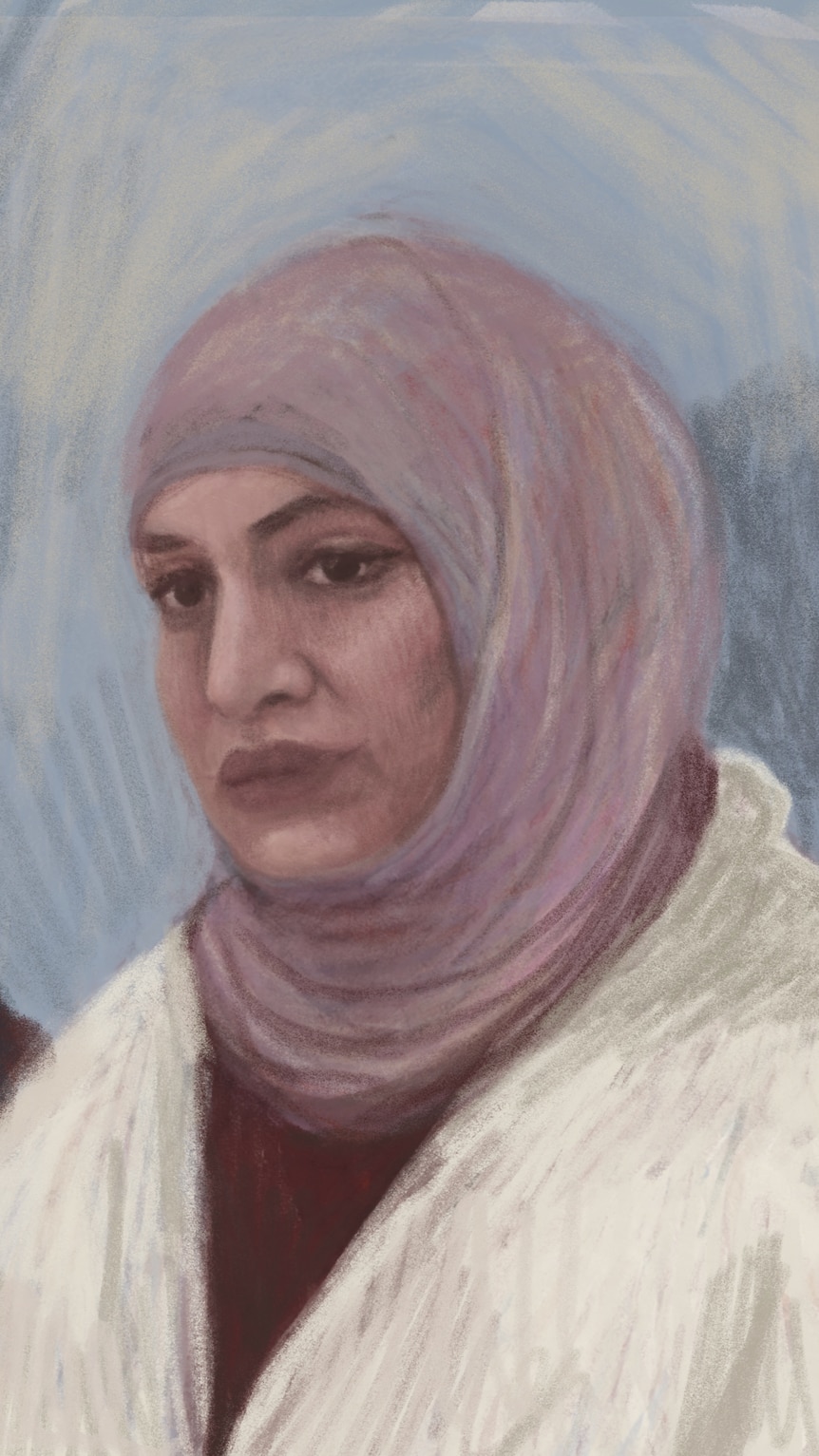
Police officers have told a court a woman that allegedly joined the Islamic State group (IS) and owned a Yazidi slave while in Syria could not be forced to wear an ankle monitoring bracelet as part of any bail conditions.
Zeinab Ahmad, 31, is seeking bail after she was charged with slavery offences after allegedly crossing into Syria with her family to support IS in 2015.
In 2017, her father, Mohammad Ahmad, purchased Yazidi teenager for $US10,000 ($14,000), to be forced into sexual servitude and completing house duties, the court heard.
While the court heard he sexually and physically assaulted the girl multiple times, Detective Senior Constable Marc Clendenning said Ms Ahmad, then aged 22 and 23, did not “physically hurt” the teenager, but did treat her “badly”.
The girl was on-sold more than a year later.
The Australian Federal Police have argued Ms Ahmad would pose an unacceptable risk if she was released on bail.
Defence lawyer Grace Morgan outlined her client would not contest any application for a control order, which can force a person to wear an electronic monitoring bracelet.
But Senior Constable Clendenning told the court such an order can only be applied after a conviction, and it was not something the Magistrate’s Court could enforce if bail was granted.
“It’s not a tool in bail conditions,” he said.
Victoria Police Detective Sergeant Matthew Archer, who has helped the investigation for over three years, agreed.
“The control order cannot be put in place because the charges are before the court,” he told the court.
The court heard Ms Ahmad also agreed to participate in countering violent extremism (CVE) programs, administered by Victoria Police and the Board of Imams Victoria.
But Senior Constable Clendenning said such programs were intended for people on a “path of radicalisation”, but Ms Ahmad was beyond that point.
He said Ms Ahmad had not renounced support for Islamic State.
“No conditions of that nature would ameliorate the risk because there’s a lot of unknowns with the accused’s ideology,”
he said.
Detective Sergeant Archer also said CVE could not be “cherry picked”, and was not available for someone charged under Ms Ahmad’s circumstances.
‘Association with Islamic State linked networks’
On the first day of the bail hearing, a federal police statement of facts read to the court outlined the Ahmad’s family movements into Syria.
It’s alleged Zeinab Ahmad’s father, Mohammad Zeinab, arrived in Turkiye in 2013, before his family, including the accused, joined him the year later, before crossing into Syria.
Mohammad and his wife Kawsar Ahmad accepted donations via a social media page purporting to be a charity, called Global Humanitarian Aid, which police suspect was used to pay for the family to travel into Syria.
During their time in Syria, the court heard social media posts show the family were together in territory controlled by Islamic State.
Zeinab Ahmad made multiple social media posts supporting Islamic State, she carried an Islamic State identification card, and earned an income from the group, the court heard.
In 2015, Ms Ahmad posted her husband, Dawod, had made a decision to “Hijrah to the land of Khalifah”, which means to migrate and join the Islamic State caliphate, the court heard.
“The actions my husband made, and which I had to follow, have nothing, absolutely nothing to do with my parents or myself,” her account posted.
It’s believed Dawod was killed in 2016, and Ms Ahmad was subsequently married to two other Australian men during her time in Syria.
The Australian Federal Police statement of facts state she is currently married to a member of Islamic State, which shows “her proximity to, and association with Islamic State linked networks”.
The court heard all women, including the accused, had severe restrictions placed upon their “liberties”.
The court also heard details about how Islamic State trafficked Yazidi women and children, an ethnic minority that live in Syria, Iraq and Turkiye.
Some 6,800 women and children were captured by ISIS, to be sold in markets to serve men for sex and household duties.
Many remain unaccounted-for.