







Listen to this article
Estimated 4 minutes
The audio version of this article is generated by AI-based technology. Mispronunciations can occur. We are working with our partners to continually review and improve the results.
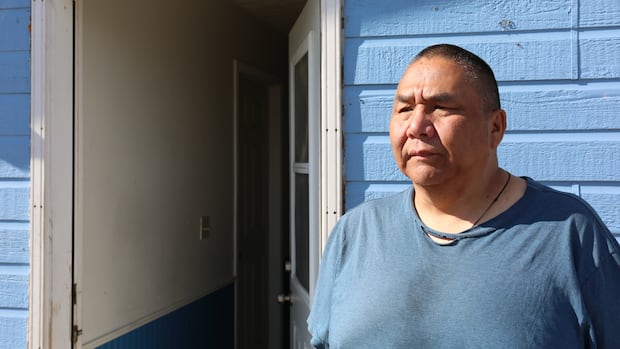
Chris Dryneck says his deteriorating home in Behchokǫ̀, N.W.T., has needed repairs for years, but especially now with his 14-year-old disabled daughter recovering from a spinal surgery.
Dryneck says the home was left to him by his mother when she died, and he’s been looking for help with repairs for more than 10 years.
Dryneck is legally blind and says that makes it difficult for him to do repairs himself.
The most immediate need are repairs to the washroom. The sink tap doesn’t run, the bathtub is falling apart, and holes let bugs and spiders inside.
“No water, nothing is working … 10 years of no water. It’s been a long time. We can’t even wash our hands,” Dryneck said during an interview in his home.

His daughter, Chris Lynn Dryneck, underwent a six-hour spinal surgery for scoliosis in January. And in both that month and in May, doctors signed letters emphasizing the urgency of access to a functional washroom and kitchen during her recovery.
“Please consider helping the family in accessing repairs for their home,” one of the letters reads.
Dryneck says he sent the letters to N.W.T. Health and Social Services and to the Tłıchǫ government.
CBC News reached out to the N.W.T. Health and Social Services Authority and the Tłı̨chǫ government to confirm if the medical letters were received.
The health authority told CBC the request fell under N.W.T. Housing. In a statement, N.W.T. Housing said it had not received medical letters from Dryneck.
In a statement, the Tłıchǫ government said it is aware of Dryneck’s situation and understand his concerns, adding that the property has been “assessed through the Tłı̨chǫ government’s Housing Repair Program and is among the homes being advanced for repair.”
The statement says that based on current planning, repair work is scheduled for this fall’s construction season, “subject to contractor availability and final project planning.”
It adds that the government remains “committed to supporting citizens through its housing programs.”

Dryneck says he’s heard promises of repairs coming soon for years, and is hopeless that they will follow through.
Other issues are windows that let wind or rain inside, and a door that freezes shut in the winter.
Dryneck says that over the years people have come and gone to inspect the house but with minimal repairs being made. He says two men were sent by the Tłıchǫ government to assess what needed to be fixed about two or three years ago.
“They went into the house, they wrote down everything. They took video inside the house, every room, every inch of the house,” Dryneck said. But nothing came of it.
Dryneck says the issues have persisted or worsened, including suspected mould throughout the home, a large crack in the ceiling that lets water in when it rains, and plumbing needing immediate repair.

In a statement, Housing N.W.T. confirmed that Dryneck had applied to its home repair programs in 2020, but his application was denied for failing to meet requirements for aid.
“To access Housing N.W.T.’s home repair programs, applicants must meet key eligibility requirements such as income thresholds, proof of property ownership, and residency requirements, among others,” the statement reads.
“Housing N.W.T. understands that safe and suitable housing is essential to health and well-being, and we recognize how challenging it can be for residents facing significant housing issues, such as leaks and mould, particularly when there are health or accessibility concerns.”
Dryneck said he’s made phone calls to try and figure out how to meet housing aid requirements, including contacting legal aid. He believes there may be some paperwork he needs to complete regarding the home transfer from his deceased mother to himself, but he says he can’t do it on his own.
“All we want is our house to be fixed,” he said.
“That’s all we want, nothing else.”