







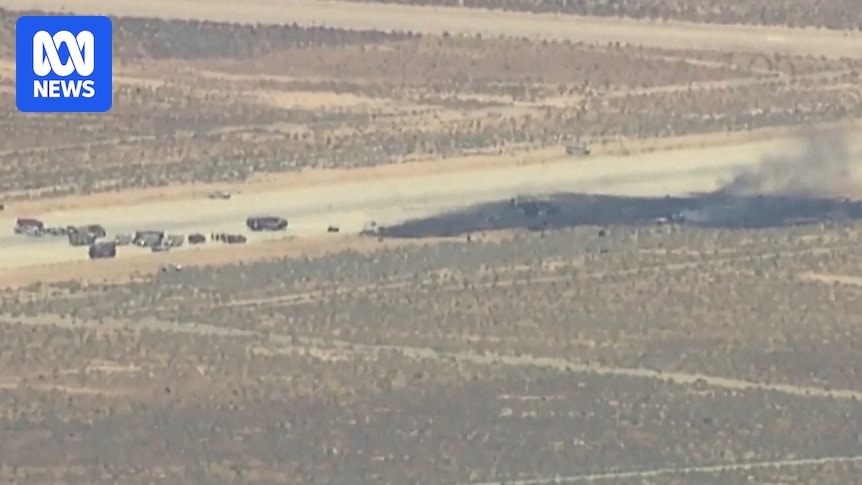
A B-52 bomber aircraft that crashed at a US Air Force base in California, killing eight people aboard, made a sharp right and then nearly completed a 180-degree turn before plunging to the ground at more than a kilometre per minute, according to initial tracking data.
The Boeing B-52 Stratofortress was taking part in a routine mission on Monday, local time, as part of an overall program to keep the long-running aircraft flying for decades to come.
It was not yet clear what caused the plane to crash shortly after take-off, and officials at the Edwards Air Force Base said it could take up to six months to complete the investigation.
Eight people aboard a B-52 bomber aircraft were killed in the fiery crash. (Reuters: Supplied)
The airfield remained closed on Tuesday while crews worked to make the crash site safe for search and recovery teams to enter, after fires flared up overnight, Mike Paoli, a spokesperson for the 412 Test Wing at Edwards, said.
Flight tracking data that was available on Tuesday showed the bomber turning to the north-east after taking off and nearly completing a sharp turn before crashing on another runway, according to AirNav Systems.
The data, which comes from a system called multilateration, does not show precise altitude and speed information, but it does show the plane fell to earth at a rate of descent of 1,541 metres per minute; nearly 10 times as fast as a plane normally descends when preparing to land.
The aircraft was supporting a “radar modernisation program,” Colonel James Hayes, the deputy commander for the 412 Test Wing, said on Monday.
In 2025, Boeing sent a B-52 to the base with a modernised radar system that was key to keeping the bomber in the air until at least 2050, nearly a century after it first entered service.
A test team planned to conduct ground and flight test activities on the aircraft throughout 2026 to feed a production decision, the Air Force said in a 2025 news release.
The airfield remains closed and all inbound aircraft are being diverted. (Reuters: Supplied)
The modern Active Electronically Scanned Array (AESA) radar system replaced the aircraft’s antiquated radar for efficacy. It was unclear if that was the same aircraft involved in Monday’s crash.
AESA replaced 1960s radar technology and offers improved navigation and targeting capabilities, according to a 2023 news release from Raytheon, which designed the new system for the Air Force’s entire B-52 fleet.
Aviation expert suspects flight control caused crash
The way the B-52 crashed so quickly after take-off without getting very high or going far makes aviation safety expert Jeff Guzzetti suspect some kind of flight control malfunction.
It is possible the controls were rigged incorrectly after maintenance, or there was a catastrophic engine problem or a failure of a piece of equipment that was being tested, he said.
“I think it was definitely a controllability issue,”
he said.
“Now, whether that was tied to an engine failure, a flight control failure, or some new testing device failure, I’m not sure.”
In recent years, fatal Air Force training accidents in the US have included an instructor pilot who was killed in 2024 when the ejection seat activated while the aircraft was still on the ground in Texas and an Air Force ROTC cadet’s death in a 2022 accident involving a Humvee during a training exercise in Idaho.
Two Air Force pilots were also killed when a trainer jet crashed near an Alabama airport in 2021.
The B-52 began flying in the 1950s
The B-52, a long-range bomber that entered service in 1955, is designed to carry conventional and nuclear weapons. It has been used in conflicts involving the US military from Vietnam to Iran.
Along with a new radar, the fleet of 76 B-52s is scheduled to receive additional upgrades, including new engines, crew compartments, conventional and nuclear communication systems, avionics and weapons.
The military said the goal was to make the B-52 a complement to the Air Force’s newest strategic bomber, the B-21 Raider.
The Stratofortress is a long-range, subsonic aircraft that has long served as the backbone of the US crewed strategic bomber force. (Reuters: Toby Melville)
Aerial footage showed virtually nothing left of the aircraft that went down at the base in the Mojave Desert, about 161km north-east of Los Angeles.
Officials determined no-one could have survived after reviewing footage of the crash. Those on the B-52 included government contractors and uniformed military.
Aircraft manufacturer Boeing confirmed that two of its employees were on board.
Edwards Air Force Base is home to a large portion of the US Air Force’s aircraft test and development efforts.
The 412th Test Wing, which runs the base, also conducts developmental testing of all Air Force aircraft, weapons systems, software and components before purchase by the service as well as throughout their life span.
The base is where Air Force test pilot Chuck Yeager reached a speed of Mach 1.05 to break the sound barrier for the first confirmed time in 1947.
AP