





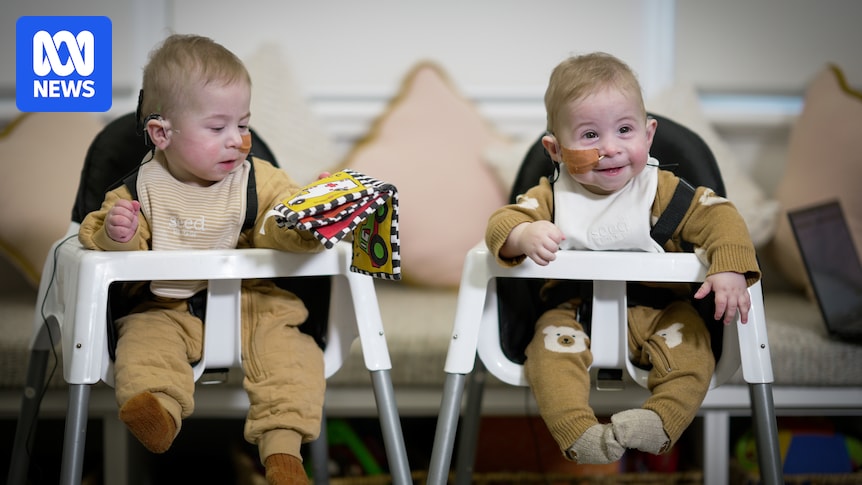
For the first nine months of their young lives, baby twins Artie and Jack Porter lived in a world without sound.
But no longer.
In what is believed to be an Australian-first, the boys had cochlear implant surgery on both ears on the same day.
The eight-hour surgical feat had one main purpose — for Artie and Jack to hear their mother’s voice at the same time.
“It was incredible and emotional … for them to turn their head to the sound of my voice and see their little eyes widen at the sound of that was just, it’s just mind blowing,” their mother Emily Porter said.
Artie and Jack Porter received cochlear implants on the same day in an Australian-first eight hour surgical feat. (ABC News: Billy Cooper)
Artie and Jack were born premature and profoundly deaf because of a genetic condition.
In April, they each had cochlear implants surgically placed under the skin, which then connect to an external processor with a magnet.
Working together, these pieces bypass parts of the ear, sending sound directly to the hearing nerve.
Dr Rithvik Reddy was the ENT surgeon who spent eight hours operating on the boys. (ABC News: Billy Cooper)
Ear Nose and Throat (ENT) surgeon Rithvik Reddy and his team worked to allow the babies who have had many milestones together, to celebrate another.
“The surgery on the day involved performing four cochlear implants on both boys on one day,” Dr Reddy said.
Emily holds Jack in recovery. (Supplied)
“It was a bit of an organisational feat … but it makes such a big difference for them and the family to try and get it all done on the same day to minimise not just inconvenience, but also maximise the gain of them going through their journey together.”
Waiting anxiously outside the theatre room were Artie and Jack’s parents.
“It was a long, exhausting, emotional day,” their father Ewan Porter said.
“To see them with their little heads bandaged up after we had gone in there with them in really happy moods — it was really brutal.”
Ewan holds Jack with Artie in the pram as they sit in the waiting room ahead of the procedure. (Supplied)
A few weeks after the surgery, a team from the Shepherd Centre — a provider that helps children with hearing loss — assembled in a small room in Wollongong, south of Sydney.
Firstly, the cochlear implants were programmed to each of the boys’ unique hearing needs.
Then came the moment everyone had worked tirelessly for.
A close up of a cochlear implant sound processor. (ABC News: Billy Cooper)
The implants were activated, as the boys received a sensory awakening.
“It was kind of the pinnacle day in this huge lead up,” Emily Porter said.
“It’s really the start of the rest of their lives, it’s the beginning of the next chapter,” Ewan added.
The gift of sound comes at a cost
The wonder of the moment will alter the Porters’ lives forever, however it comes at a cost.
The way cochlear implants services are funded is complex, with both the federal and state governments picking up aspects of the care leading up to the surgery, the procedure itself, and the follow-up therapies.
The parents of Jack and Artie say watching their children experience sound has been “joyful”. (ABC News: Billy Cooper)
In most states, this is fully funded by governments, however in New South Wales and the ACT there is an average gap of $7,000 per child per year.
The Shepherd Centre CEO Alicia Davis said they cover this gap through philanthropic funds, and it was most acute in NSW, where the bulk of the more than 900 people it supported last year were based.
“We cannot sustain continuing to fund this program and we shouldn’t have to because it’s a government responsibility,” she said.
Emily with three-year-old Tommy and twins Artie and Jack. (Supplied)
“So we are having to make very difficult decisions in the future around the ability to provide this cochlear implant program.“
Adult and paediatric ENT and Macquarie University professor Payal Mukherjee said because children born deaf had never been exposed to language or sound before, they needed extensive follow-up care.
“Extra funding — to make sure that the entire journey of the child’s care pathway is covered — is critical for them to get good outcomes and it’s really important for equity,” Professor Mukherjee said.
Dr Payal Mukherjee said the twins needed extensive follow-up care. (ABC News: Billy Cooper)
“If they are not funding everything equitably, patients do fall through the cracks.”
After the ABC approached the NSW government for comment, it revealed the upcoming state budget would contain more than $20 million over four years for The Shepherd Centre and another provider, NextSense.
NSW Health Minister Ryan Park said the money would not only help fund the moment children hear sound for the first time, but also the ongoing specialist support needed.
Jack and Artie Porter play together after receiving their cochlear implants. (ABC News: Billy Cooper)
“I think this will be one of the most important decisions I make as a part of this budget and indeed during my time as a health minister,” Mr Park said.
“This is game changing for these children.
“These kids deserve the very best start to life and we’re hopefully playing a role in delivering that for them and their families.”
NSW Health Minister Ryan Park said the state budget would contain more than $20 million for The Shepherd Centre and another provider, NextSense. (ABC News: Billy Cooper)
Responding to the announcement, Dr Davis said the investment provided certainty for families.
“This is a life changing moment for children with cochlear implants and their families in NSW,” she said.
“Cochlear implants are only one part of the journey. Children need ongoing specialist support after surgery to learn how to listen, communicate and connect with the hearing world around them. This funding ensures more families can access that support and focus on their child’s future.”
Aleisha Davis, CEO of Shepherd Centre, said the funding would ensure more families could access support. (ABC News: Billy Cooper)
An ACT government spokesperson said it provided cochlear implants for a “small number of children from the ACT and surrounding region.”
“The ACT government runs a process for community budget submissions every year and welcomes input from community organisation,” they said.
Jack Porter will soon be turning one. (ABC News: Billy Cooper)
Artie and Jack discover the possibilities of sound
A month after their cochlear implants were first activated, Artie and Jack are discovering the endless possibilities of sound.
The cochlear implants were programmed to each of the boys’ unique hearing needs. (ABC News: Billy Cooper)
Cuddled on the couch with their parents at their home in Moss Vale, south of Sydney, the almost 11-month-old twins listen to an enthusiastic rendition of the children’s classic “Where is the Green Sheep”.
The boys hang on to every word.
“It’s just been joyful,” Emily said of the past few weeks.
“Just to watch them experience sound for the first time and see their eyes widen or them turn their head to our voices is just incredible.”
The twins look forward to switching on the boys’ cochlear implants each morning. (ABC News: Billy Cooper)
The Porters — including their three-year-old son Tommy — look forward to switching on the boys’ cochlear implants each morning.
“They smile… you can tell that they’re understanding what you’re saying. You’re talking to them… it really is a gift and a miracle,” Ewan said.
The family are looking forward to what the future holds. (ABC News: Billy Cooper)
The boys will still require extensive ongoing therapy to manage their cochlear implants, but as they near their first birthday, Emily and Ewan are looking ahead to the future.
“I think when we got the initial diagnosis … you grieve or you mourn what you thought their lives would look like,” Emily said.
“After we kind of got over that initial shock and learned more about cochlear implants and the fantastic outcomes of that technology, I think I’ve come to the realisation it will look different, and it might be a little bit harder at times, but it will still be really positive, it’s still really optimistic.
“This is not going to hold them back.”
Jack Porter enjoys playing with a musical instrument with his dad and Artie nearby. (ABC News: Billy Cooper)