






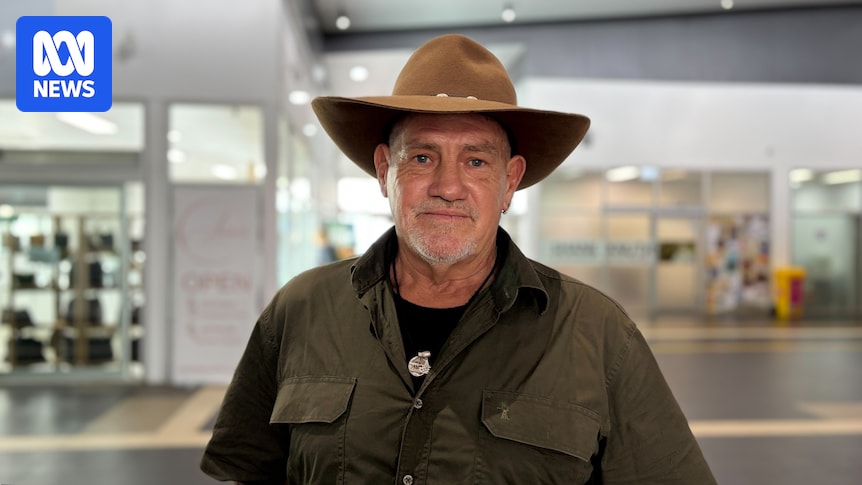
Greg English is ropeable that the drive to his local MP’s electorate office will go from taking just 15 minutes to potentially more than 11 hours.
The fourth-generation dairy farmer lives in the Far North Queensland seat of Hill, which will be abolished at the next state election in a redistribution announced this week.
Hill is centred on the Atherton Tablelands, in the Cairns hinterland, which is known for its rainforests, waterfalls, rolling hills and farmland.
But come 2028, the seat will be divided between the three neighbouring seats of Mulgrave, Hinchinbrook and Traeger, the latter to be renamed Flinders.
The sprawling Flinders electorate will exceed 400,000 square kilometres making it significantly larger than the state of Victoria. (Supplied: Queensland Redistribution Commission)
The region’s main town, Atherton, will go into the southern Cairns seat of Mulgrave while Mr English, 15 minutes down the road, will be in the gargantuan seat of Flinders, which extends to the Northern Territory border.
“We live in Malanda and we’re going to be in the seat that’s based in Mount Isa, which is absolute stupidity, complete and utter lunacy at its best,” Mr English said.
“It’s the old saying, bureaucracy gone mad.“
The nearby towns of Atherton and Malanda will be in different state electorates. (ABC News: Sharnie Kim)
North Queensland ‘disenfranchised’
The independent Queensland Redistribution Commission’s (QRC) decision will reduce the number of North Queensland seats from 13 to 12 to provide a net increase of one electorate in the rapidly growing south-east of the state.
The outcome has sparked widespread outrage among Hill voters, who lodged more than 200 objections to the QRC’s proposal to abolish their seat.
But the QRC ultimately made few changes to northern boundaries in its final determination, saying it had carefully weighed multiple considerations including the need to balance the number of voters in each electorate.
Atherton resident Eric Hallforde, who will join Mulgrave, said regional Queenslanders felt “disenfranchised” by the loss of a seat.
Eric Hallforde is furious about the ousting of his much-loved local MP Shane Knuth. (ABC News: Sharnie Kim)
“Tablelanders, Queenslanders, Australians are sick of this kind of thing, hence the rise of One Nation,” Mr Hallforde said.
“We’ve had a gutful of this kind of underhanded politics.“
Watsonville resident Roger Hockey, who will soon be in Flinders, was concerned about the prospect of losing “face-to-face” representation.
“[In the far west], the industries are different, the towns are different, the demographics are different,” he said.
Watsonville resident Roger Hockey with his sons. (ABC News: Sharnie Kim)
Kairi resident Caroline Rushton, who will also end up in Mulgrave, questioned whether her rural community could be well-represented by a largely urban seat.
“Rural people always get left out of everything. I know it sounds like [whingeing] but it’s not,”
she said.
Meanwhile, Babinda District Community Association president Dalitta Wright had hoped to become part of Mulgrave, with an electorate office 30 minutes’ drive away, but was disappointed to instead join Hinchinbrook, with an office more than two hours away.
Caroline Rushton is concerned her small rural town of Kairi won’t be well-represented by a reconfigured Mulgrave. (ABC News: Sharnie Kim)
Hinchinbrook Shire Mayor Ramon Jayo said the new-look electorate, which stretches about 300 kilometres along the coast, would now be harder to cover for the local member.
“[Hinchinbrook MP] Wayde Chiesa is going to have to trade his e-bike in for a Ferrari now, or maybe a plane, because going from basically Townsville to Cairns, that’s a big area,” Cr Jayo said.
Redistribution not gerrymandering
The abolition of Hill will be the third time local member Shane Knuth loses his seat in a redistribution rather than at the ballot box, having previously held the defunct electorates of Charters Towers and Dalrymple.
The Katter’s Australian Party (KAP) MP described the latest boundary overhaul as a “disgrace” and a “political hit job”.
Hill has remained a safe KAP seat thanks to Shane Knuth’s popularity with his constituents. (ABC News: Sharnie Kim)
But James Cook University political scientist Maxine Newlands said it was not an example of gerrymandering, the redrawing of electoral boundaries to favour a party, though some past redistributions had been politically motivated.
“Historically in Queensland, they have been used a little bit to, particularly under [former premier] Joh Bjelke-Petersen, kind of advantage the party,” Dr Newlands said.
“But in this case, it’s been done because of the massive shift in population down in the south-east corner and because it hasn’t been done for 10 years.”
Maxine Newlands says the changes reflected population changes. (Supplied: Maxine Newlands)
Mr Knuth said Hill could have been saved if state parliament voted to increase the number of electorates as it last did in 2016 when it added four seats.
The QRC does not have the power to change the number of seats but said in its report even a modest increase could help “minimise the impact on regional and remote electorate districts” in future redistributions.
Dr Newlands said any electoral changes needed to reflect the whole state, not just regional interests.
“What you also don’t want is what happened in the Bjelke-Petersen era, where the regions actually had far more power than the city because of the way of the distribution,”
she said.
Mr Knuth, who entered parliament 22 years ago, has not confirmed if he will contest the next election, nor if he will stand in another electorate.
“I’m just going to keep the options open,” he said.
“Talking about retirement may be a little bit early but we may have to see what’s around the corner.”
Electors have 21 days to appeal against the redistribution to Queensland’s Court of Appeal.