



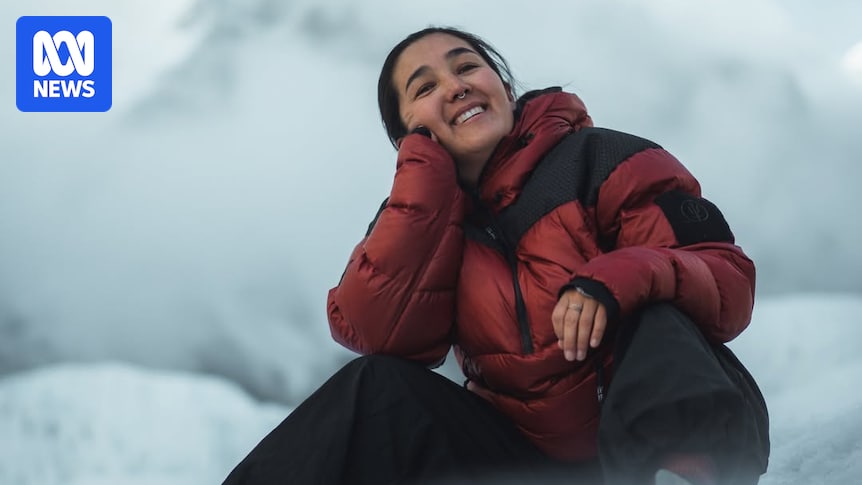
Melbourne woman River Ahmad braved ice and snow to reach the world’s highest peak.
Her muscles were sore and she was cold to her core.
She had climbed so high, breathing support had become essential in the desperately thin air.
But by reaching Mount Everest’s summit, the Afghan refugee had conquered one of Earth’s toughest natural challenges — and become the only woman from her country to do so.
Hers is a story built on a dream to inspire women and girls in Afghanistan, at a time when conditions for women there are at their worst levels in decades.
But first, she had to get there.
River Ahmad faced ice and snow on her way to the summit in May 2026. (Supplied)
No mountain too high
Ms Ahmad’s story is one of resilience.
In Afghanistan, she said, she climbed snow-capped peaks despite being just a child.
Her brother Ahmed’s death by suicide, only months after the family reached Australia in 2023, was a major motivator for success. As was a period she spent homeless.
It was a profoundly personal mission.
“You can climb a struggle, you can climb depression, you can climb anything,” Ms Ahmad told 774 ABC Melbourne.
For a young woman who had watched freedoms vanish for women as Afghanistan’s fragile democracy collapsed in 2021, conquering the world’s tallest mountain became a dream.
In Ms Ahmad’s home region of Ghazni, in south-central Afghanistan, the Taliban blocked access to healthcare and education for women and girls, according to Human Rights Watch.
River Ahmad says she climbed to raise awareness of women’s struggles in Afghanistan. (Supplied)
There were further restrictions on movement, expression, association and income. Taliban mismanagement had been blamed for a prolonged water shortage across the region.
Ms Ahmad fled and settled in Melbourne with her family. Although she now enjoys life in Australia, she said she continued to carry the weight of what she left behind.
“Back home … women don’t have any rights to even walk in the park,” Ms Ahmad told the ABC before leaving for Nepal in February.
“Afghan women are not weak.
“I have to prove we are resilient, as an Afghan woman refugee, and we can do more things,” she said, hoping her story would reach and inspire women who remain subjugated in her home country.
Years of preparation
Ms Ahmad underwent weeks of training in the Himalayas ahead of her Everest attempt, and a lengthy preparation in Australia.
She woke at 4am six days a week, ran 26 kilometres, spent two hours at the gym, and swam for 40 minutes.
“We don’t have big mountains in Australia, [so] the training … is very intense,” she said.
Then there were video calls with the climbing company to discuss the route and how to best prepare herself.
Her passion was built upon a lifetime of struggle. Ms Ahmad said when she was in Afghanistan, the walk to school and back took four hours.
“I’ve climbed all my life for education and I’m now climbing for education [again],” she said.
She also needed to raise tens of thousands of dollars to fund the ascent.
Reaching Everest’s summit, on May 21, required enormous effort and a bit of good timing.
The Himalayan climate offers limited opportunities for successful climbs. There are only a few weeks a year of suitable weather.
Even with modern supports, the physical challenge of ascending nearly 9,000 metres can test the most enthusiastic and skilled climbers.
River Ahmad climbed multiple mountains in the Himalayas before attempting Mount Everest. (Supplied)
Then there is the danger. Adventure group Climbing Kilimanjaro estimates 300 people have died on the mountain.
The most common causes of death included avalanches, falls, or exposure to the deadly conditions.
These concerns did not weigh on Ms Ahmad’s mind long.
“It is beautiful to be alive,”
she said.
“I was thinking a lot all the way [up the mountain] how to process what happened in my life, and to inspire more women … more people around the world, for their health, for their mental health.”
Atop the world, a call was made to her mum who, remarkably, had only recently learnt what Mount Everest was.
“My mum used ChatGPT and [searched], ‘Where is the highest mountain?'” Ms Ahmad said.
For a month, her mum refused to support the challenge. Eventually, she relented.
“My mum cannot speak English, when our manager called … [she] was crying, she was so happy,” she said.
Back to earth
Following the climb, Ms Ahmad was invited to a reception at the Australian embassy in Nepal.
It was an offer she said left her feeling “genuinely touched”.
Her story was soon on American cable news, though she lamented a lack of interest from Australian media before her climb.
River Ahmad is hoping to launch an online school for girls in Afghanistan. (Supplied)
“But that evening [at the embassy] reminded me that recognition comes in many forms,” she wrote on social media.
Speaking to 774 ABC Melbourne, Ms Ahmad said she now hoped to raise $200,000 to fund an online school accessible to Afghan girls, called River Beyond Summits.
“Right now, it’s my responsibility to be their voice and to help them. The world should not forget about them,”
she said.
“That small River from a small village can be a big voice right now for women.”