






The day before Croatia’s first World Cup game against England, thousands of fans filled the streets of downtown Dallas for a parade and pre-game party.
There were plenty of fans who had travelled from Croatia, but many who were part of the diaspora in the USA, Canada, and even Australia. Even more were locals, eager to wear red and white, and be part of the tournament in some way.
A Dallas local gets amongst the Croatian fan parade. (ABC Sport: Amanda Shalala)
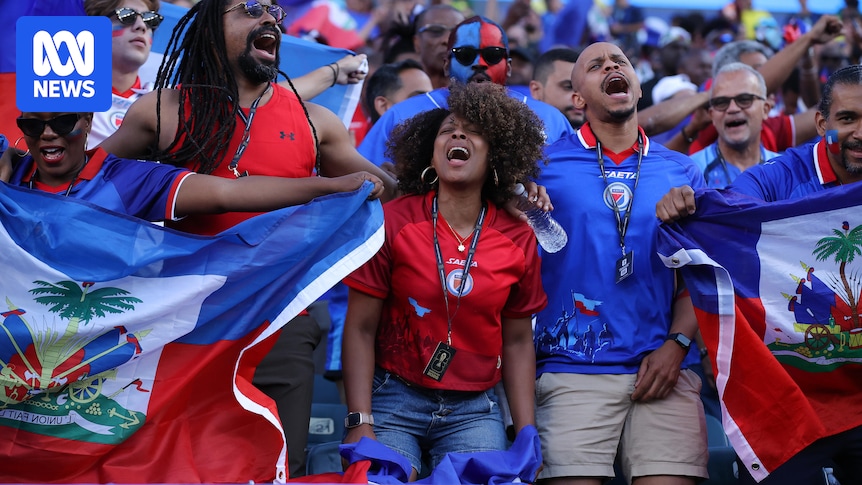
These scenes have been replicated across the US, Canada, and Mexico, including locals adopting teams where fans have not been allowed to travel due to US visa restrictions on countries like Haiti, Senegal, and Iran.
Nationalities and on-field rivalries have made way for revelry in cultural exchanges, which are a hallmark of many major sporting events.
But can that make a difference under a US administration increasingly cracking down on immigration?
Hosting ‘friends and neighbours’
The months leading up to the tournament have seen US President Donald Trump tighten immigration enforcement, with the deployment of ICE agents around the country.
The government has denied visas for some fans and officials, and formal negotiations are underway to end the months-long war in Iran.
Senegal fans in New York. Senegal is subject to partial travel restrictions in the US. (Getty Images: Erick W. Rasco)
While some have felt welcomed in the US, others, like the Iranian team, have criticised their reception.
They can only travel from their training base in Tijuana, Mexico, to their group games in the US within 24 hours of the fixtures, and must leave immediately after.
“I think perhaps our team is the most oppressed one in the whole World Cup,” coach Amir Ghalenoei said after their first game against New Zealand in Los Angeles.
Iran has been frustrated by restrictions around travelling to and from games in the US. (Getty Images: Dean Mouhtaropoulos)
The executive director of the White House task force for the tournament, Andrew Giuliani, told Reuters the team would leave straight after the second game in Los Angeles, but that may be reviewed for the third game in Seattle, which is a longer flight.
Despite being engaged in a war with Iran, locals who attended the team’s first game spoke of a largely positive atmosphere inside the stadium, celebrating both teams.
Texas is hosting the most World Cup matches, with 16 across Dallas and Houston.
And while it is a Republican heartland, some believe politics should make way for a more human-focused approach when it comes to immigration.
Anne Wicks is the Don Evans Family Managing Director of Opportunity and Democracy at the George W. Bush Institute in Dallas.
The George W. Bush Institute has an exhibition celebrating transformative moments in sport. (ABC Sport: Amanda Shalala)
It is a non-partisan research and policy institute, and she said it believed in a “modern immigration system that supports our economy and also respects safety, security, and human rights”.
“We have a border [with Mexico], and we want to have a safe and secure border. So that’s why you’ll see a lot of discussion about what this should look like here in Texas,” she said.
“But there’s no question, immigrants are such an important part of our community and our economy and have been for many, many years.”
One of the displays at the Bush Museum celebrates the Paralympics.
She said the tournament could leave a mark and bring people together.
“I think we see that happening here today, there’s such excitement to welcome people from around the world and to celebrate watching incredible soccer or football,” she said.
“I hope people just remember what it’s like to host so many friends and neighbours from around the world.”
Multicultural playing group
The celebration of diversity extends to the pitch, too.
This is the most culturally diverse World Cup in history, with nearly a quarter of players born outside the country they represent, and many more are second- or third-generation migrants.
Nestory Irankunda celebrates scoring in the Socceroos’ first game. He was born in a Tanzanian refugee camp. (Reuters: Agustin Marcarian)
The Socceroos squad include four former refugees, and more than half of the 26 players have different cultural and ethnic backgrounds.
“When I reflect back, we all belong to this world together, we’ve all just got to thank Australia and do our very best for the country that has taken in so many refugees over the years and has done that for a long time,” Awer Mabil said when speaking to the media during Refugee Week.
Loading Instagram content
And the smallest-ever nation to qualify for the tournament, Curaçao, has only one player actually born on the Dutch Caribbean island, with the rest from the Netherlands.
Ben Brindle, a researcher at the Migration Observatory at the University of Oxford, said many countries, including 2022 semi-finalist Morocco, were using sophisticated scouting networks to identify foreign-born players with links to the country.
Tahith Chong is the only member of Curaçao’s squad who was born there. (Getty Images: Megan Briggs)
He added that colonial and postcolonial links had also made an impact.
“When France won the World Cup in 2018, there were about 13, 14 players who had an African-born parent,” he said.
“You see it with the England squad at this World Cup, there are a lot of people who have parents or grandparents from the Caribbean following some of that colonial migration after the Second World War.
France superstar Kylian Mbappé was born in France, but has Cameroonian and Algerian heritage. (Getty Images: FIFA/Shaun Botterill)
“So we see these patterns play out, but it often takes quite a lot of time before we end up seeing it on the pitch.”
Dr Brindle said some studies had shown that more diverse teams were more successful on the pitch, due to a larger talent pool and a wider array of physical attributes and playing styles.
“The Democratic Republic of Congo, about 85 per cent of their squad was born in a different country,” he said.
“And that’s because they have more advanced footballing systems elsewhere in the world, and that will produce better players too.”
Although he noted that Argentina did not have any foreign-born players in its 2022 World Cup-winning squad.
Lionel Messi has made a bright start to this tournament, with a hat-trick in Argentina’s opening win. (Getty Images: Charlotte Wilson)
“Migration isn’t necessarily the only way to get success. I think having Messi in your team probably helps as well,” he said.
Unity or division
There is a sense of optimism around this tournament in the US, helped by the national men’s team’s success so far and by the belief that cultural exchanges between fans and players, in person and on TV, can play a part.
Côte d’Ivoire fans having fun at a game in Canada. (Getty Images: Zou Zheng)
“The [US] has historically accepted the largest number of migrants in the world and the resulting interactions have led to an indelible cultural impact over generations,” Professor of Communications at Howard University, Chuka Onwumechili, wrote in The Conversation.
“The men’s World Cup, which celebrates 100 years in 2030 and is co-hosted by an African country [Morocco], remains a key event in fostering cultural understanding and exchange.
“While the 2026 World Cup will do this, it has also brought to the fore the event’s ability to create division.”
Whether the unity or division will ultimately triumph will be seen in the weeks and years to come.