





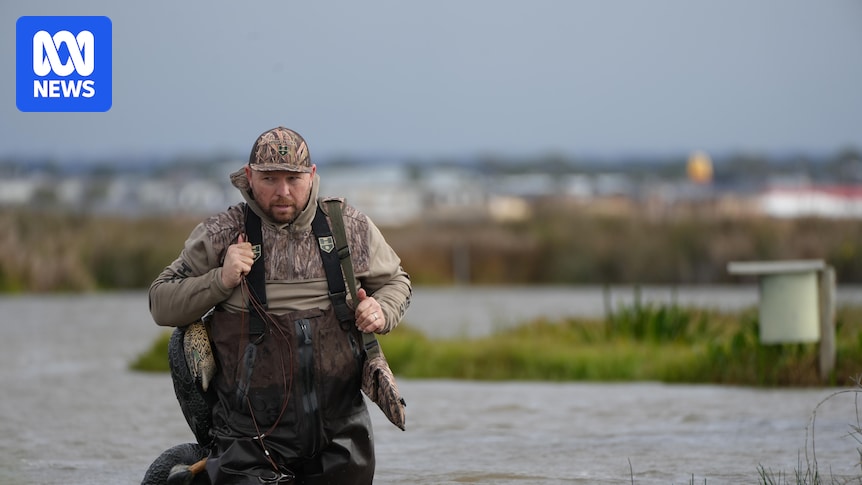
Trent Leen grew up on the banks of Lake Connewarre and has been hunting ducks on the wetlands since he was first allowed to fire a shotgun.
But these days, the area looks very different.
The golden sunsets that once fell over farmland to the west of the lake now shine through the golden arches of a mammoth fast food chain sign, erected less than 1 kilometre away.
Trent Leen says suburban encroachment on Lake Connewarre is a worry for hunters and conservationists. (ABC News: Harrison Tippet)
The region of then-sparse farmland about 10km south of Geelong’s CBD was designated a new growth area suburb called Armstrong Creek in 2012.
It has since become one of Australia’s fastest growing contiguous growth zones, jumping from less than 1,000 residents to almost 30,000 today — with plans to peak at up to 65,000.
“I owned 40 acres across the other side of Barwon Heads Road,” said Mr Leen, the conservation officer for Geelong Field and Game.
“Our neighbours beside us were on 40 acres, and the neighbours to the north of us were on nearly 100 acres.
“There’s, I don’t know, 1,000-plus houses on there now.
“So yeah, there’s been significant, significant changes in that time.”
Geelong’s southern boundary has edged closer to wetlands around Lake Connewarre over the past decade. (ABC News: Harrison Tippet)
It is this urban sprawl which Mr Leen sees as a threat to both wildlife numbers and duck hunting on the western end of the lake — an area dubbed the Nursery.
Housing is now just a few hundred metres away from shooters during duck season — with hundreds more homes planned nearby — and an informal walking track straddles part of the hunting zone border itself.
“Some people don’t like me saying that the biggest threat that waterfowl have right here, right now, is urban encroachment,”
Mr Leen said.
“There seems to be continual encroachment … that could lead to that [banning of hunting in the Nursery], for sure.”
Unlikely birds of a feather
Hunters and wildlife rescuers rarely see eye to eye, particularly when it comes to the contentious activity of duck shooting.
But local wildlife rescuer Jodie Oliver agreed Armstrong Creek’s urban sprawl had pushed too close to the Lake Connewarre wetlands, interrupting wildlife corridors and displacing animals.
Jodie Oliver says Armstrong Creek’s urban sprawl has pushed too close to the Lake Connewarre wetlands. (ABC News: Harrison Tippet)
“It’s devastating to see how much it’s grown and how quickly, and I just don’t know where the end is going to be, which is scary,” she said.
Ms Oliver also believes the “days are numbered” for hunting on Lake Connewarre’s Nursery, as more houses are built nearby.
“I can’t see it continuing, because there are already complaints about gunshot noises from residents who have moved here in the recent few years,” she said.
“The more it’s encroaching on these hunting areas, the development, there’s going to be more complaints.
“I really can’t see how it’s going to continue. There hasn’t been a big enough buffer in the overall planning scheme.
“I think it’s poor planning in this instance, definitely poor planning.”
Suburbia fears date back to 2014
The Armstrong Creek Urban Growth Plan was first adopted by the City of Greater Geelong in 2008, laying out a proposal to build about 22,000 homes for up to 65,000 new residents.
Next, the city created Precinct Structure Plans (PSPs), the long-term strategic documents designating what can be built and where.
Lake Connewarre is located about 10km south-east of central Geelong. (ABC news: Harrison Tippet)
The area directly north of the Nursery hunting zone is earmarked for parkland and sporting ovals, with the nearest housing about 600 metres away.
But to the west, a pocket of vacant land allocated for residential housing will be just 300 metres from where shooting is permitted.
Monash University architecture lecturer Suzanne Barker is a planning expert who also worked on the Armstrong Creek PSPs.
Because of that work, she cannot talk specifically about that process, but she does believe one thing is clear — the council and state government need to consider whether hunting on the Nursery site can continue so close to housing.
Suzanne Barker worked on the Armstrong Creek precinct structure plan (ABC News: Harrison Tippet)
“There is a conflict there, or an emerging conflict,” Dr Barker said.
“If the hunting grounds continue into the future … then I imagine that it would be a wise thing to do to actually commission some sort of report, to consider whether or not any mitigation measures need to be undertaken.“
Concerns around allowing the urban sprawl to creep up on the Lake Connewarre hunting zone were raised with the City of Greater Geelong as early as 2014.
A discussion paper examining how Armstrong Creek’s new residents would interact with Lake Connewarre and Barwon River found environmental and public safety risks were a “key issue”.
“Increasing public access to the [Lake Connewarre game reserve] area via the Barwon River and from new urban development areas at Armstrong Creek may threaten environmental values and increase risks to public safety,” the report noted.
Concerns over suburban encroachment on Lake Connewarre date back more than a decade. (ABC News: Harrison Tippet)
The report also found there would be increasing public access along the Barwon River into the State Game Reserve hunting area itself.
“Exclusion of public access would be difficult to enforce along such a large uncontrolled boundary,”
the report noted.
Despite these planning concerns, the City of Greater Geelong this week declined to respond to the ABC’s questions over whether the new residential neighbourhoods were too close to a designated hunting area.
It did not indicate whether it would conduct any form of review of the issue.
Instead, the council referred the ABC to the Victorian government, “as duck hunting is the responsibility of the state”.
Victorian Outdoor Recreation Minister Enver Erdogan did not respond to questions, but a statement attributed to an unnamed government spokesperson noted a review of hunting on Lake Connewarre was “not currently scheduled”.
They did not say whether they held concerns about the proximity of duck shooting to residential housing.