
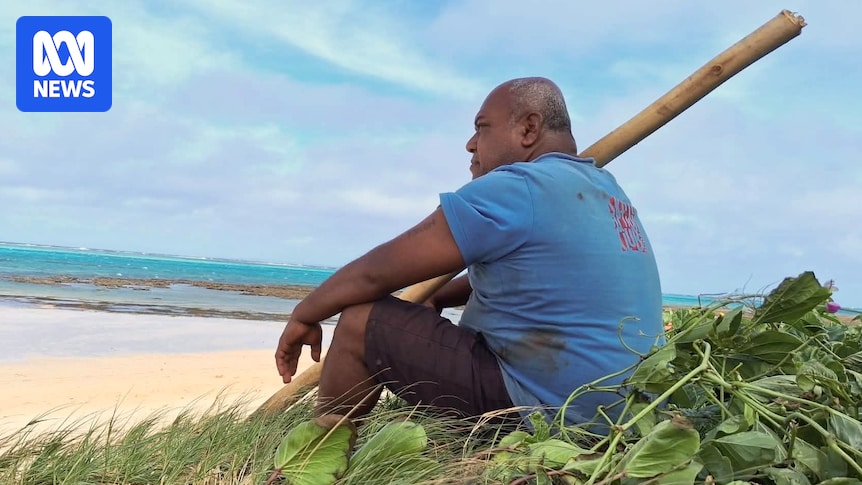
Locals on Fiji’s Komo Island have a saying: the place is so beautiful that every day is like Christmas day.
The remote islands, a full three days’ sail from the capital Suva, are like a tropical postcard, with the small population of 200 people living a simple life.
But even on these islands, so far from the bright lights of any city, the small population is being drawn into a dark world they know very little about.
“When I first saw it, I didn’t immediately think of drugs,” Komo Island local Sevuloni Tagimoce told the ABC.
“It was lying on the beach, on the sand, at the high water mark.
“I knew I had to bring it back to the village headman. I needed for him to see it. When I brought it back, he weighed it, and it was exactly one kilogram.”
Mr Tagimoce had found a brick of cocaine.
One of the cocaine bricks with ‘Tesla’ markings found by the Komo Island locals. (ABC News: Supplied)
And he is not alone.
The ABC can confirm 27 similar 1kg bricks have been found washed ashore in and around Komo Island area over the past few weeks.
Depending on the purity of the cocaine, the finds could be worth more than $15 million.
Fiji Police revealed another 35 bricks were reported found on nearby Munia Island on Thursday.
Yachts and drugs
Fiji is ground zero in the Pacific’s drug crisis, with cartels increasingly using the Pacific hub to attempt to bring huge shipments of cocaine and meth through unpoliced stretches of the coast on the way to the highly lucrative Australian market.
A recent ABC investigation found Fijian connections to the Alameddine crime network and the KVT, a street gang consisting mostly of young Fijian men.
In January, police seized 2.6 tonnes of cocaine worth $780 million during a raid on a suspected drug operation in the remote north-west of the country.
And across the Pacific, since the start of the year, more than 17 tonnes of illicit substances have been discovered, with traffickers using a range of methods to avoid detection on the way to Australia.
Mr Tagimoce said the 1kg parcel he found was tied to a balloon or floating device — a method smugglers use to transfer small amounts of narcotics from a larger vessel, or mothership, onto smaller ones for delivery into Australia.
The bricks of cocaine found near his island have been reported to have similar flotation devices.
Mr Tagimoce’s nephew, Jone Ledua, told the ABC at the time of their discovery two weeks ago, there were “yachts sailing up and down” the coast.
“As soon as we wake up, there’s one yacht going up, another one coming down, another coming from the side,” he said.
“When we go to fish in the uninhabited islands, we see suspicious yachts in the area too.
“Now, when we see yachts, we assume it’s drugs.“
The use of private yachts has become a common method for drug smugglers to transfer product in the region, with Vanuatu police in March finding close to two tonnes of product inside an abandoned yacht.
The cocaine bricks found on Komo Island had ‘Tesla’ markings (ABC News: supplied )
Recent bad weather in Fiji meant the 27 cocaine bricks were still with the communities who found them until the weekend, with most islands so remote that they do not have a police presence.
Mr Ledua said the Kumo Island community were aware of the types of people involved in the drug smuggling trade, and they were nervous.
“These drugs were here for [almost three] weeks and were not been picked up, and that was a worry for us.
“We had been thinking [maybe] they will come looking for their drugs?”.
Fiji Police said the 27 bricks were being tested in the capital Suva and a crew had been deployed to retrieve the 35 bricks found on nearby Munia Island.
“We would advise those living along our coastline to report any suspicious finds and not to open packages,” a spokeswoman said.
‘Brutal’ crackdown
The recent cocaine find in Fiji comes as its police force and military continue a highly visible “joint taskforce” crackdown on drug-related gang activity in the country.
Fiji’s government believed the threat to public safety was so real that the country’s prime minister, Sitiveni Rabuka, last month flirted with the idea of declaring a state of emergency in the country, which would give the military and police special powers.
That idea was later abandoned, but the joint crackdown continues with heavily armed police and military officers conducting raids and checkpoints across the country.
Human rights advocates have called for it to be disbanded after the suspected murder of well-known underworld figure Jone Vakarisi — locally referred to as a “drug kingpin” — while he was being held in military custody, and local media reported accusations of torture and beatings.
Jone Vakarisi’s death during a military interrogation is being treated as a murder. (Supplied)
Two months after Mr Vakarisi’s death, Fiji Police say the murder investigation is “reaching its conclusion”.
And earlier this month, Fiji Police revealed they are questioning 12 officers after the death in custody of 32-year-old Sakiasi Ose Radravu, who was brought in for questioning over an alleged burglary.
His family told the ABC’s Pacific Beat program they want an independent post-mortem to verify the cause of his death.
The view of Komo Island from the water. (ABC News: supplied)
Back on Komo Island, the advent of satellite internet has meant they are aware of the drug-related issues in the capital.
“When the beatings were happening in Suva, they knew it was all because of drugs,” Mr Tagimoce said.
“We have been are watching it all here, the updates of drugs, but the community had never seen drugs.
“They are worried about the police; they thought the police and the army would reach here, and they’d be arrested, investigated and apprehended.”
Fiji Police said they were working “regional and local law enforcement stakeholders” to identify the “source and destination” of the bricks.