







When Wolfram actor Joe Bird experiences déjà vu, it’s next level. The last time he travelled to the Sundance Film Festival, a bidding war broke out over the Philippou brothers’ hot-ticket horror, Talk to Me.
Returning to Park City earlier this year, Bird took it in his stride when it happened again, this time with Melbourne filmmaker Adrian Chiarella’s frighteningly good debut feature, Leviticus.
“It was more of a shock for Adrian,” Bird says, grinning.
“I knew, just from reading his amazing script, ‘This is so Sundance’. You’ve gotta have belief and manifest it.”
We’re sitting with Chiarella in a cavernous hall at Australian Theatre for Young People’s wharf-side home during Sydney Film Festival, a few hours before the competition film’s Australian debut.
“I didn’t ever imagine that my first feature would go to Sundance, so it was quite a shock when we got in,” Chiarella says.
Reality set in fast.
“We weren’t finished, so we had to get the film done in time.”
Who do you love?
Bird plays Naim, a closeted high-schooler in a country town with a fervent religious community. Unsurprisingly, he’s keeping his head down, with his mum, played by Mia Wasikowska, none the wiser.
She presents an intriguingly ambiguous character, underlining Leviticus’s nuanced depiction of the small-town stresses often faced by queer kids.
Naim has a tenuous relationship with his ultra-religious mother (Mia Wasikowska). (Supplied: Maslow Entertainment)
“There were points where I thought maybe she’s like one of those horror mums, like Piper Laurie in Carrie,” Chiarella says.
“But when Mia came on board, I knew that what would be truly terrifying about this character is how much you underestimate her, who she really is underneath.”
There’s an off-kilter feel to her church.
“The villainy in those sorts of communities often presents as something quite friendly and nice, and that’s what’s so scary.”
Bird loved bouncing off Wasikowska.
“It’s such an interesting dynamic,” he says. “These characters only have each other, to begin with, so losing that is a very prevalent theme in the queer community.”
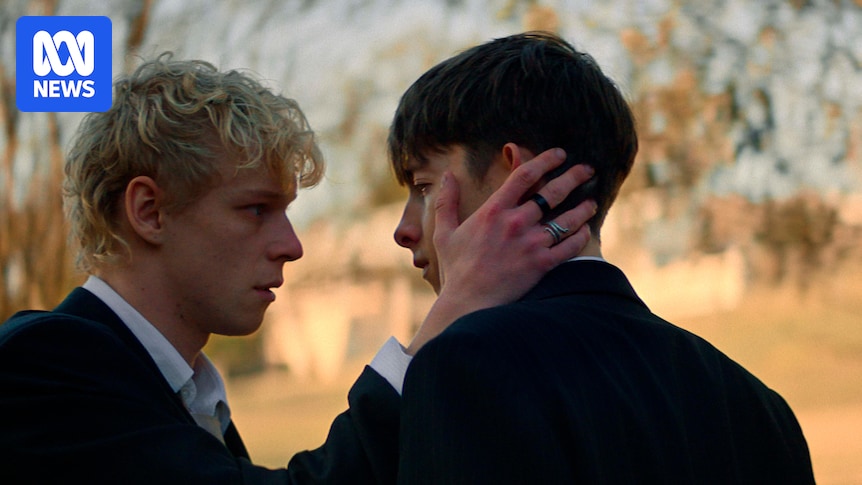
Stacy Clausen’s jock, Ryan, takes an interest in Naim, who promptly falls hard for the more confident lad.
But Ryan’s also mucking around with their classmate, Hunter (Jeremy Blewitt). Naim’s jealousy erupts, leading to a foolish decision to out both boys.
“Teenagers make stupid mistakes,” Bird says.
“It’s human; it’s real, and Naim’s guilt is carried forward in the film.”
When Hunter’s dad, the local pastor (Ewen Leslie), calls in Bad Boy Bubby star Nicholas Hope’s exorcist to pray away the gay, a vengeful spirit is unleashed that takes the form of whoever the boys’ lust after most.
Leviticus is a love story and a nightmare all wrapped into one film. (Supplied: Maslow Entertainment)
“This monster is very good at manipulating, and you probably would get tricked by it in real life,” Bird says.
Chiarella adds: “For me, the best horror movies have this thing where someone commits a transgression, and then that unleashes the monster.”
Working with Clausen, Bird and intimacy coordinator Amy Cater, Chiarella helped define that line between erotic excitement and dread.
“We knew that a lot of the violence came out of the intimacy, both in terms of the rough-housing stuff at the start, but then of course with the monster,” Chiarella says.
“So it was really important that Joe and Stacy did their own stunts, mimicking the stunt doubles who were their rehearsal stand-ins.”
When Naim has to face off with the evil alter-Ryan, Chiarella encouraged Clausen to lean into his animal instincts.
“Predatory animals will sneak up on their prey and then pounce,” he says.
“That’s what this monster does. It lulls them into a false sense of security by appearing as the person they desire the most, so it can get as close as possible to its victim.“
Be real
Leviticus’s spooky exploration of the harms of homophobia, both internal and external, is inherently truthful; we’ve all faced our demons.
“It’s not just about conversion therapy,” Chiarella notes.
“It’s about all forms of homophobia, including those little microaggressions and young LGBTQIA+ people being coerced out of their feelings.”
A religous exorcism is the catalyst for chaos in Leviticus. (Supplied: Maslow Entertainment)
To make matters worse, the mimicking monster only strikes when its victims are alone, exacerbating the lads’ sense of isolation.
“That’s something that a lot of queer teenagers can relate to,” Chiarella says.
Bird and Clausen ground the story brilliantly, with Causeway producers Sam Jennings and Kristina Ceyton, the driving force behind hits including Talk to Me, The Babadook and The Nightingale, giving great notes.
“They really kept me in check through the writing and on set,” Chiarella says. “It’s great to have people you can bounce off.”
They included gifted cinematographer Tyson Perkins and production designer Bethany Ryan, who worked hard to get the look and feel of the film right, shooting around the edges of Melbourne and out to Geelong to create the fictional town.
“Tyson, Beth and I, we had a very specific aesthetic in mind for the world we were trying to create,” Chiarella says.
“There are some films and TV shows where it feels like a busload of actors have just pulled up with their looks pressed and washed straight out of the costume truck.”
That wouldn’t work for Leviticus and the moment Australian horror is having more broadly, Chiarella argues.
“What makes Australian horror is that it doesn’t talk to the audience like you’re just watching a movie,” he says.
“We cast people who feel real for their age, and we’re always presenting the truest version of their story. We don’t just expect audiences will accept a shiny, plasticky version of reality.”
Scream King
In achieving Leviticus’s lived-in reality, Chiarella tasked Bird and Clausen with in-character exercises, including going to a shopping mall together. But Bird was promptly recognised.
“Ten or so young guys with rat tails came up to me, and they’re like, ‘You’re that kid from the movie with the hand’,” he laughs. “And I just said, ‘That’s not me, sorry’. I’m excellent at staying in-character.”
Joe Bird burst onto the scene as a tween in Talk to Me (2022). (Supplied: A24)
As for his emerging status as a Scream King, Bird is proud, with a caveat: “I definitely don’t want to be typecast, but horror is a very good genre to say different things.”
Leviticus has a lot to say, and unlike that malevolent copycat entity, audiences are hungry for uniqueness.
“These past few years, we’ve been living in a remake/sequel type of world, and it kind of feels like maybe we’re at a turning point,” Bird says.
“Especially with the whole AI of it all, people are craving human creativity and original stories from filmmakers putting their heart out there.”
Chiarella’s heart is all over Leviticus. The director recalls growing up with that niggling sense of dread that his Australian-Italian-Chinese family might not accept his homosexuality. They did.
“Leviticus is about my personal experiences, and those others have shared with me,” Chiarella says.
“That’s what’s amazing about it, is that I hope it’s about our collective experience.”
Leviticus is in cinemas from June 18.