





The ACT government has been accused of failing to uphold its agreement with the Ngambri people over the recognition of traditional ownership of the Canberra area.
Three years after settlement between the Ngambri people and the ACT government over traditional ownership, the matter is back before the ACT Supreme Court.
‘Our people are connected to this country’
The original settlement was reached after Ngambri custodians Leah House and Paul Girrawah House brought a case under the Human Rights Act.
Following that case, the ACT government apologised to the Ngambri people over its failure to recognise them as traditional owners, and said it would put in place an interim Indigenous protocol while it conducted a review of the policy.
Representing the House family in the current case, barrister Sarala Fitzgerald SC said the government’s actions had sought to “deny the very existence” of her clients.
“For two decades the ACT government has treated Ngambri as an illegitimate splinter group that are part of the Ngunnawal,” she said.
“They are not a part of the Ngunnawal, they are their own peoples.“
Alongside potential breaches of human rights, Justice David Mossop is considering whether the ACT government has correctly adhered to the terms of settlement.
The promised review of legislation and the Indigenous recognition protocol has not happened.
The Ngambri case argues the review should have been completed within 12 to 18 months of the settlement.
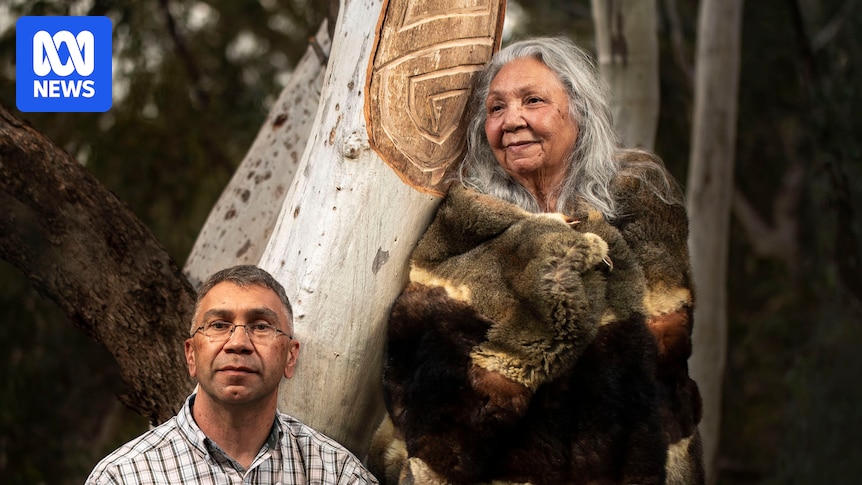
Ngambri custodian Paul Girrawah House was among those who took the government to court over its Indigenous protocol, which listed only the Ngunnawal people as traditional custodians of the land. (ABC News: Harry Frost)
But the ACT government’s lawyer Stephen Lloyd said this was not set out in the agreement.
“The review was linked to a wider process of healing and reconciliation, not an individual desk-based study to be completed by public servants,” Mr Lloyd told the court.
Following a terse exchange in court, Mr House agreed that a timeframe for the review had not been set out.
Ngambri case argues for respect, inclusion
A key element of the case is that the interim Indigenous protocol does not mention the Ngambri people by name.
But the ACT government maintains it cannot be the body to determine the legitimacy of claim to any traditional ownership.
Instead, it says this must be established by self-identification among the Aboriginal groups who make the claims, or by establishing a native title case in the federal court.
The protocol’s phrasing, “any other people or families with connection to the lands of the ACT and region” was agreed on by both parties in 2023, but central to the current case is the length of time the interim protocol has been in place.
“We are not ‘other’,” Mr House told the court.
“Our people are connected to this country; all we want is respectful and inclusive acknowledgement.“
Mr House told the court he estimates there to be 300-400 Ngambri people in the Canberra region, and read sections of his affidavit in Ngambri-Kamberri and Walgalu language.
“I acknowledge my mother Dr Aunty Matilda House who is in the court…there are four generations of Ngambri here today,” he said.
The case was heard in the ACT Supreme Court and Justice David Mossop has now retired to consider his decision. (ABC News: Matt Roberts)
Named and recognised by the territory, the Ngunnawal traditional owners labelled the government’s 2023 apology to the Ngambri people as an “affront” to their custodianship.
Acknowledgement of country a new focus
A new focus of the Ngambri case is its exclusion in some acknowledgements of country.
Since 2010, the standing orders for the House and the Senate in federal parliament include an acknowledgement of country on sitting days that names both Ngunnawal and Ngambri.
This acknowledgement was also followed in the numerous departmental offices and national institutions in Canberra.
In June 2023, then-ACT Minister for Indigenous Affairs Rachel Stephen-Smith wrote to her federal counterpart Linda Burney to explain the new settlement, how the interim protocol had been worded, and clarify its application.
In July, Commonwealth departmental secretaries, Australian Public Service Commissioner and the CEO of the National Indigenous Australians Agency jointly endorsed switching to the ACT’s protocol.
In June 2023, then-ACT Minister for Indigenous Affairs Rachel Stephen-Smith wrote to her federal counterpart Linda Burney about the interim protocol. (ABC News: Joel Wilson)
Ms Fitzgerald said the letter was designed to influence the Commonwealth’s adoption of the ACT’s protocol — something not agreed to in the 2023 settlement.
“It was objectively likely to, and in fact did, discourage the use of the name Ngambri by Commonwealth bodies, and that this was the intention of the ACT Government,” she said.
But Mr Lloyd refuted this claim.
“Seeking clarity is good governance, not acting in bad faith,” he said.
Senior ACT public servant Jacinta Evans, an executive group manager with detailed knowledge of the matter, told the court assertions the letter was designed to discourage the Commonwealth’s use of Ngambri “were not correct”.
“The Commonwealth does not make decisions based on ACT policy,”
Ms Evans said.
The standing orders in Parliament are unchanged, still naming both Ngambri and Ngunnawal in acknowledgements.
No witnesses for the Commonwealth were called, meaning no evidence was heard about why the Australian Public Service Commission adopted the ACT wording.
The Australian Public Service Commission told the ABC in a statement that “the current wording is based on ACT Government advice”.
“It was provided to Accountable Authorities across the APS, however they are ultimately responsible for the protocol they wish to use,” they said.
The court heard that the ACT government considered the protocol to be a preference, rather than a directive, with public servants not prevented from acknowledging the Ngambri by name.
Justice Mossop has now retired to consider his decision, with a definitive outcome unlikely until next year.