




It’s not the first time this stretch of sunburnt country in outback Queensland has been tipped as ideal for solar.
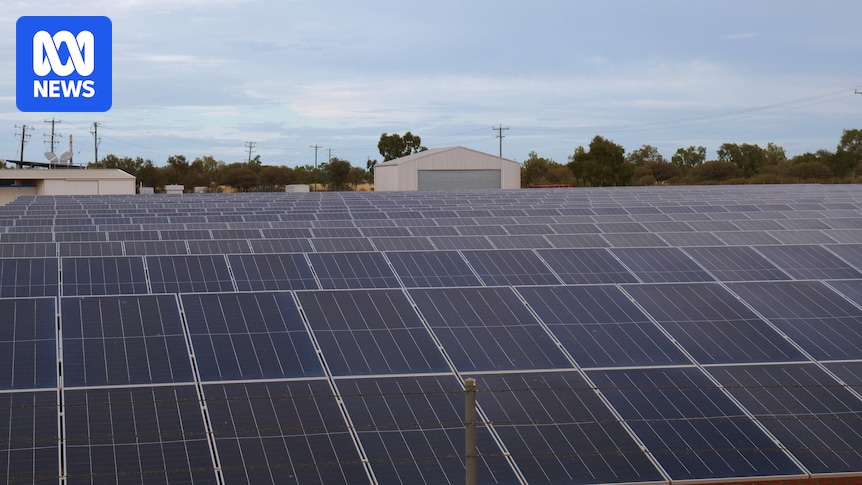
While previous attempts have failed, almost 2,000 panels now shimmer against the red dirt, feeding into Windorah’s isolated energy grid.
Engineers and locals hope this solar and battery project will deliver the resilience the community needs, despite no expectations of lower power bills.
The new Windorah 850-kilowatt solar farm and one-megawatt battery system is expected to power the town for days at a time when demand is low during winter. (ABC Western Queensland: Jay Carstens )
Ergon Energy senior engineer Kein Jones said the new installation would cut fuel use from the town’s diesel generators by more than 50 per cent.
“The whole community [of 100 people] will be powered from the solar farm for days and potentially weeks when the loads are low and the weather’s sunny,” Mr Jones said.
The 850-kilowatt solar farm and one-megawatt battery storage system have been three years in the making as part of a state- funded shift from diesel in remote Queensland.
“It’s a pretty exciting milestone for us now to transition into utilising that system to power the community,” Mr Jones said.
Solar array in disarray
Windorah, about 1,200 kilometres west of Brisbane, became well known locally for its solar array project — large metal ‘sunflower-like’ dishes constructed on the edge of town in 2009 as part of an experimental energy project.
The large dishes of Windorah’s failed solar array project were dismantled to make way for the new solar farm. (ABC Western Qld: Cameron Simmons)
Mr Jones said expensive upkeep, inefficient power generation and faltering market interest meant, more than a decade later, the accidental tourist attraction was being dismantled.
“The sunflower part of it were all mirrors, and those mirrors reflected sunlight back into a very small solar panel, which was called a solar concentrator, to produce electricity,” Mr Jones said.
“[Then, flat-plate solar went] into mass production and the unit cost of building that solar-panel material just came right down.”
Mr Jones says diesel stored for the town’s generators will last twice as long as a result of the solar farm connection. (ABC Western Queensland: Jay Carstens)
The new fixed, flat-plate system is expected to generate five times as much energy as the old solar array, reducing the town’s reliance on trucked-in diesel.
Building ‘resilience’
Publican Marilyn Simpson has lived in Windorah all her life and hopes the new development will make the town more self-reliant.
“Especially when we’re already diesel-generated and we’re not hooked up to … the main lines,” Ms Simpson said.
“Our towns are lucky sometimes that we don’t have to deal with having our power cut and we have a consistent supply.”
Windorah publican Marilyn Simpson says some locals had expected the savings from the solar farm to be passed onto residents, which is not the case. (ABC Western Queensland: Jay Carstens)
The town can be isolated by road for weeks at a time during floods.
Mr Jones said the project would lower the risk of running out of diesel when the town is cut off by floodwaters.
“The amount of fuel we use will essentially be half of what we currently use, so that’s half the amount of trucks needing to come in,” he said.
“Our existing storage will last twice as long as well. Resilience is a big one for the community.”
Outback towns can be isolated for weeks at a time when floods cut off roads. (ABC Western Queensland )
Locals will not benefit from cost savings
Ms Simpson said she would have liked to see savings passed on to locals, and through to reduced power bills.
“It’s really just a business venture for Ergon to save on the use of diesel,” Ms Simpson said.
Ms Simpson says the renewable energy project is “just a business venture for Ergon”. (ABC Western Queensland: Jay Carstens)
The longtime local said despite the failure of the last project, people in town held mostly neutral views on the new build.
“I don’t know that anyone’s unhappy, but I’m not sure that it [will] have a direct benefit to our bill or anything,” Ms Simpson said.
“I think most people perceived that was the idea [to reduce energy costs], and it’s not.”
In regional Queensland, the sta106763978te Competition Authority (QCA) sets a uniform price offering for everyone outside the south east corner, which is usually heavily based on the National Energy Market offer.
The state government subsidises the cost of electricity in rural areas to match the rate paid by urban customers, with any local savings from renewables likely to only reduce the public subsidy paid to Ergon.
Barcoo Shire mayor Sally O’Neil says other remote towns in the region, like Jundah, can benefit from a similar solar farm and battery system. (ABC Western Queensland: Jay Carstens)
Barcoo Shire mayor Sally O’Neil said the success of the Windorah solar farm could pave the way for more diesel-reliant communities to make the shift.
“Long-term, their [Ergon’s] intention is to, like Jundah being a diesel-run town as well, their intention is to convert to solar,” Ms O’Neil said.
“But we’re on a list of several towns in Queensland that require to go to solar because we’re still on diesel-run generators.
“The solar panels they’ve got in place now are tested and proven, they’re everywhere and they work.”
Boulia and Doomadgee are next in line to install solar farms — backed by batteries — under Ergon’s decarbonisation program.