




China and Russia helped shape the US-Iran ceasefire deal, experts say, with future deals between Washington and Tehran also likely to be influenced by the two countries.
Donald Trump and US Vice-President JD Vance have reportedly electronically signed the deal, which is yet to be made public.
The announcement of the US-Iran ceasefire came after a flurry of diplomatic activity between Iran, China and Russia, including one meeting at the weekend.
Iran’s Deputy Foreign Minister Kazem Gharibabadi said that the Memorandum of Understanding was discussed and “exchanges of views were held” with Russian and Chinese ambassadors in Tehran on Saturday.
“The strategic partnership between Iran, China, and Russia, as well as the coordination and interactions among the three countries, will continue with full strength,” Mr Gharibabadi said in a post translated from Persian on X.
Saturday’s meeting in Tehran was the latest in a string of engagements between the three countries since the conflict began in February.
Iranian Foreign Minister Abbas Araghchi visited Beijing in early May before Donald Trump’s state visit.
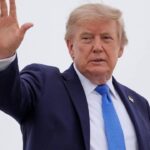
Donald Trump met with Xi Jinping last month and said they both agreed Iran could not have a nuclear weapon. (Reuters: Evan Vucci, file)
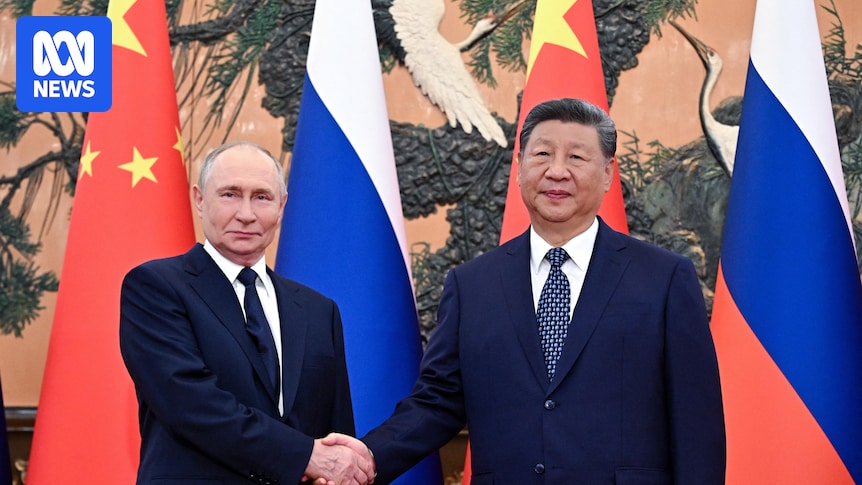
Russian President Vladimir Putin visited the Chinese capital less than a week after Mr Trump.
China also heavily backs Pakistan, which has played a key role in the negotiations between the US and Iran.
Beijing welcomed Pakistani Prime Minister Shehbaz Sharif late last month, where the war was a key talking point.
Iranian Foreign Ministry spokesperson Esmaeil Baghaei said in late May that China had played “a highly constructive role in all processes related to Iran’s nuclear negotiations”, and added that Russia had done the same at the UN Security Council.
Shehbaz Sharif was one of a number of international leaders to visit Beijing last month. (China Daily via Reuters)
Chen Jei, an associate professor of Chinese politics and international relations at The University of Western Australia, said China had played a key role in the ceasefire deal and wanted peace quickly.
“China still depends heavily on oil and gas supplies passing through the Persian Gulf and the Strait of Hormuz. That’s an unchangeable reality,” Dr Chen told the ABC.
“For a government already anxious about an economic slowdown, China wants this war to end as soon as possible.“
Dr Chen said that China had become a diplomatic bridge between Arab states, who were traditional US allies, and Iran, adding that China was “the only major power that maintains normal, even friendly, relations with all sides of every conflict”.
He said he expected future deals between Washington and Tehran to be shaped by Beijing.
“Meanwhile, the United States and Israel have been engaged in relentless bombardment. Putin hasn’t directly joined in, but he has his own bombardment underway in Ukraine. Every major power and alliance has tied itself to violence and war. China alone has played the role of peacemaker,” he said.
“The trend is clear; of all the players in this conflict, China is the only one to have emerged with greater influence, a significantly improved image, and an ever-louder voice on the world stage.“
China’s foreign ministry welcomed news of the ceasefire MoU late on Monday.
Ministry spokesperson Lin Jian said China hoped that the Strait of Hormuz would be reopened as soon as possible and that the deal would be signed on Friday as planned.
“China stands ready to join the international community in playing an active role in restoring peace and tranquillity to the Middle East and Gulf region at an early date,” he said.
Russia and China not ‘passive observers’
Geopolitical strategist and founder of FACE Intelligence in Austria, Velina Tchakarova, said it was significant that the MoU was signed after Tehran met with representatives from Moscow and Beijing.
She said the three countries had met at the highest levels in recent years, including trilateral deputy foreign minister meetings held in Beijing in March 2025, expert-level sessions in Moscow a month later, plus coordination at the United Nations.
“Russia and China have not been passive observers. They have actively shaped Iran’s negotiating posture and materially supported Iran throughout the ongoing war,” Ms Tchakarova told the ABC.
She said that Mr Gharibabadi’s statement on X on Saturday was aimed at multiple audiences, including the US.
“It tells Washington: the MoU does not dissolve Iran’s security architecture. It tells Tehran’s hardliners: accepting the deal is not capitulation because the axis remains intact. And it tells the broader international community: the world is not returning to a US-centric order simply because a ceasefire has been announced,” she said.
Russia was interested in “demonstrating that US military pressure cannot achieve regime change, which the MoU outcome validates”, she said, while China needed the war to end to ensure it had stable, ongoing access to Iranian crude oil.
“Both Moscow and Beijing therefore had every incentive to tell Tehran: accept the framework, preserve the gains, and use the 60-day negotiation window to protect your core interests on nuclear enrichment and sanctions relief,” she said.
The MoU agreement would be stronger in the short-term, she added, because Iran is less likely to walk away from a pact its key allies have supported.
“It also means the subsequent negotiations on the nuclear file will not be purely between Washington and Tehran,” she said.
“Moscow and Beijing will continue to coordinate with Iran on the terms of any nuclear verification architecture, and they have demonstrated at Beijing and Moscow meetings since early 2025 that they have both the standing and the capacity to do so.”
The MoU is set to be signed in Switzerland on Friday, but the final details are yet to be officially confirmed by either Iran or the US.