






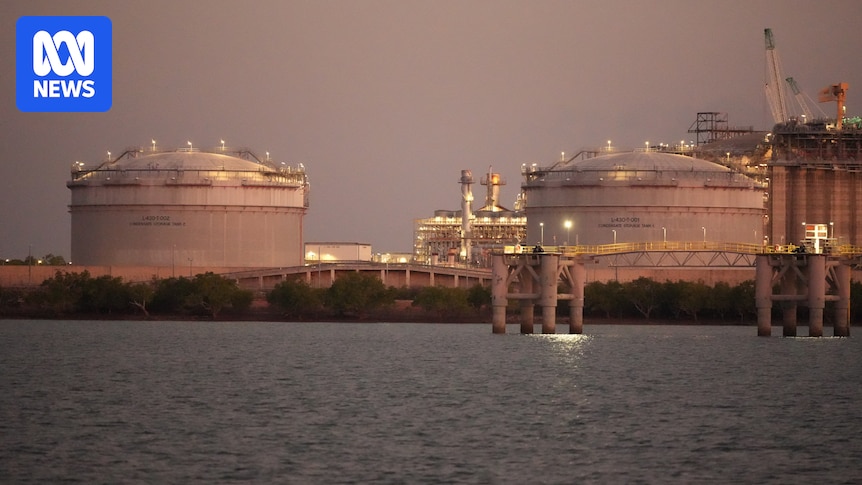
The Northern Territory government has announced plans to monitor toxic industrial air pollutants for the first time, after an independent review found gas giant Inpex had “systematically underestimated” emissions from its Darwin Ichthys LNG project for years.
Lands, Planning and Environment Minister Joshua Burgoyne said the Country Liberal Party government would introduce legislation later this year to expand the NT Environment Protection Authority’s (NTEPA) responsibility for industrial air quality monitoring and public reporting.
Currently, the NTEPA monitors for ozone, sulphur dioxide, carbon monoxide and nitrogen oxides, but not other potentially harmful emissions associated with gas production, while businesses are only required to estimate and self-report their own emissions.
“We know we want to continue to grow the Middle Arm [industrial precinct] and to continue to grow the gas industry right across the territory,” Mr Burgoyne said.
Joshua Burgoyne says the introduction of air quality testing will provide the community with certainty about their safety. (ABC News: Marcus Kennedy)
“It’s about giving the community certainty that those big emitters that we see at Middle Arm are regulated … and that the air quality monitoring that will be brought on, industry will have to pay for it.
“We have already had independent analysis — and this was confirmed by recent reports by the chief health officer — that the air we breathe is safe.
“But as we continue to grow industries across the territory, what this air quality monitoring will do is give Territorians certainty they continue to be safe, as we continue to industrialise the NT.”
Carcinogenic emissions to be monitored
Volatile organic compounds (VOCs) are colourless chemicals emitted as a by-product from the liquefied natural gas (LNG) extraction process.
They include benzene, a known carcinogen; sulphur dioxide, a chemical the US Environmental Protection Agency says is harmful to the respiratory system; and hydrogen sulphide.
According to the Australian Department of Climate Change, Energy, the Environment and Water (DCCEEW), exposure to benzene, depending on the intensity, can result in symptoms such as skin and eye irritations, drowsiness, dizziness, headaches and vomiting.
According to DCCEEW, benzene is also potentially harmful to the immune system.
While the exact list of new emissions that will be monitored is not yet publicly available, Mr Burgoyne said benzene would be a focus.
In 2023-24, Inpex self-reported 4 tonnes of benzene emissions, but later revised that figure to more than 500 tonnes.
Inpex has previously under-reported its benzene emissions. (ABC News: Dane Hirst)
The NT government estimates technology upgrades to expand the NTEPA’s monitoring capacity to include VOCs will cost around $2 million, with industry to foot the bill.
NTEPA chief executive Paul Vogel said the upgrades would “provide the community with much greater confidence that their health is protected from air pollution”.
“[It] will also enable the NTEPA to validate predictive modelling used in assessing development proposals,” he said.
Paul Vogel says the new air quality monitoring will help ensure community safety against air pollutants is prioritised. (Supplied)
Community taking action
While the reforms make their way through parliament, local volunteers are already taking action to monitor Darwin’s air quality.
Community Healthy Air NT has been fundraising to buy a mobile air monitor to screen for VOCs.
Local paediatrician Louise Woodward said she hoped the citizen science project could still work alongside the NTEPA after the changes came into effect.
Louise Woodward says the monitoring should have been introduced earlier but is glad it is finally happening. (ABC News: Marcus Kennedy)
“It was really concerning for me and our group that the government was not measuring these pollutants,” she said.
“We will be able to go to urban areas where people live and work, where their children play, and be able to measure these pollutants in the air where people are.
“We will be able to detect what direction the pollution is coming from and we will be able to report that to the government.
“I’d like to congratulate the government on doing this, better late than never.
“This is a really good development.”