






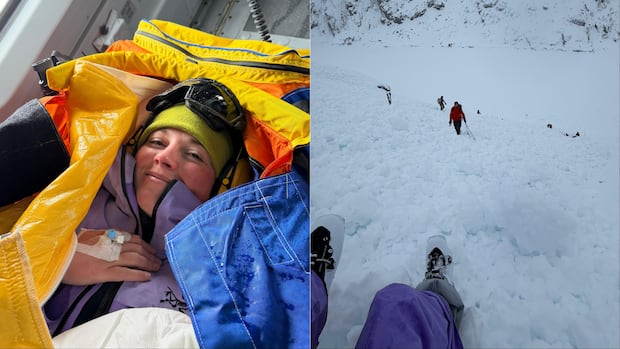
What On Earth25:35Here’s how it feels to get caught in an avalanche
Hannah Hughes was backcountry skiing on a Norwegian mountain in March, when she heard a rumbling.
“Someone yelled avalanche … it was maybe 20 or 30 metres away,” said Hughes, a massage therapist and travel content creator in Whistler, B.C.
“It was like being hit by a truck … it just took me off my feet instantly and I was under the snow … it’s like crushing weight, it was dark, I couldn’t see anything,” she told What On Earth.
Hughes had booked a guided sailing and skiing trip to Norway, planning to produce content for her travel social media account. But she started to feel nervous just weeks before she travelled, when nine people died in an avalanche near Lake Tahoe in California on Feb. 18. She ultimately decided to proceed with her trip, keeping a close eye on avalanche forecasts.
“You kind of expect the professionals to keep you safe as much as they can,” she said.
On March 4, her tour group was set to head up into the mountains from the Trollfjorden fjord in northern Norway. But Hughes says it had been raining on and off that day, and she was worried about what that meant for conditions, and whether their presence could trigger an avalanche.
“I asked the main guide, like, ‘Are we worried about loose, wet avalanches today?’ And … he said he wasn’t worried about that.”
Swept down slope at 40 km/h
The avalanche hit 12 people, carrying them down the mountain. A tracker worn by one person showed they were dragged a distance of up to 170 metres at a speed of 40 km/h.
During the ordeal, Hughes was sure she wouldn’t survive.
“By some absolute miracle, when the snow stopped moving, I could see some light … and I managed to clear my face and I could breathe.”
Hughes and most of the group were able to dig themselves out, but two people were buried in more than a metre of snow, according to an internal review compiled by the tour company, SeilNorge. They were located within roughly 15 minutes, and regained consciousness soon after. Almost two hours after the avalanche hit, a search-and-rescue helicopter airlifted the group to a nearby town.
Hughes dislocated and fractured her ankle, and tore two ligaments in her knee. She needed surgery on her ankle and hasn’t been able to walk in the three months since the avalanche.

CBC asked SeilNorge if Hughes’ concerns were taken seriously that day. In a statement emailed on April 29, the company said “the guide did not agree to those specific observations posing any avalanche risk in themselves.” The statement said the guide “tried to comfort her, saying that these things were not dangerous.”
In the subsequent internal review, compiled from discussions with guides and participants, released May 27, SeilNorge says its findings “indicate that this was a naturally released avalanche from around 700 metres altitude.”
‘Hindsight is always easy’: tour company
The report says the tour was led by two experienced guides, who assessed several avalanche and weather forecasts the day prior and conditions on the ground that day. Norway’s avalanche warning system, Varsom, had issued a level 3 or “considerable” risk warning, with potential for medium-sized (class 2) avalanches. The company says the avalanche risk did not change between March 3 and 4.
The guides reported seeing no danger signs, such as rolling snowballs or distant loud sounds, only some ice falling from rock walls. The guides also felt the group was unlikely to remotely trigger an avalanche because, according to one guide’s account, there was only about five centimetres of wet snow over the snowpack.
The guides saw evidence there had been an avalanche one to two days prior, “therefore they found it safe to skin up the area where the old avalanche had been, so tensions in the snowpack were gone.”
The report acknowledges the guides’ assessment of the avalanche risk turned out to be wrong, but suggested “hindsight is always easy.”
“The question is if the guides could have or should have known better in advance. Our conclusion is that they likely could not.”

Nine people have been killed in avalanches in B.C. since December. Tyson Rettie, a forecaster with Avalanche Canada, told BC Today host Michelle Eliot that planning ahead and checking conditions before leaving are important. He also listed the warning signs of avalanche activity.
Hughes told CBC she’s taking the report “with a grain of salt.”
“It’s not an independent investigation by an independent body of avalanche experts,” she said, adding that she thinks the report downplays concerns she claims she expressed “multiple times that day.” The report notes that none of the participants had asked to turn around.
She pointed to a line in the report which noted that one of the rescuers, from the vantage point of the helicopter, suggested the avalanche was triggered by the skiers. The report argues that “is not clear.”
A police investigation found no criminal liability on the part of SeilNorge, and dropped the case.
SeilNorge said it consulted external experts for the report.
In light of the review, the company said it has introduced checklists and mandatory daily reports to ensure guide deliberations are thorough, as well as making satellite phones mandatory.
The company said it will put a greater emphasis on pre-tour training, in particular around self-rescue techniques, as well as how guides and guests communicate about expectations and risk.
Making informed choices about risk
Avalanche expert Pascal Haegeli was not involved in SeilNorge’s report. His work focuses on understanding the people who venture into the backcountry and finding ways to help them make informed decisions.
“The challenge is that … there’s a bigger variety of people going into [the] backcountry and they have different objectives. They also have different levels of knowledge and experience,” said Haegeli, who was an associate professor at Simon Fraser University’s avalanche research program, before moving to the Swiss Institute for Snow and Avalanche Research this year.
Haegeli said warning systems generally do “an excellent job” of highlighting the risks, but the question is whether people always understand that information. He says that’s particularly important as winters become more unpredictable, due to the effects of climate change.

“Risk is a personal choice,” he said.
“The most tragic accidents are the ones when people don’t even know that they expose themselves to avalanche hazard and then they get killed because they’re at the wrong spot at the wrong time,” he said.
There were 150 avalanche-related deaths this season in Europe, exceeding an annual average of roughly 100. Over the past 30 years, an average of 13 people die annually in Canada in avalanche-related incidents.
I miss the adventure, says survivor
Hughes needs to undergo further rehabilitation on her knee before she can have surgery, after which she faces at least a 12-month recovery. Right now she can’t work, or do any of the things she loves doing outdoors.
“My knee will never be the same, my ankle will never be the same,” she said.
“It’s definitely been a big mental health struggle as well as just the physical limitations.”
She misses the connections she makes with people outdoors, and conquering her fears in unfamiliar terrain, whether that’s backcountry skiing in winter, or mountain biking in the summer.
“I really miss just being out in the mountains with people, pushing myself, pushing my body and just going on adventures,” she said.