








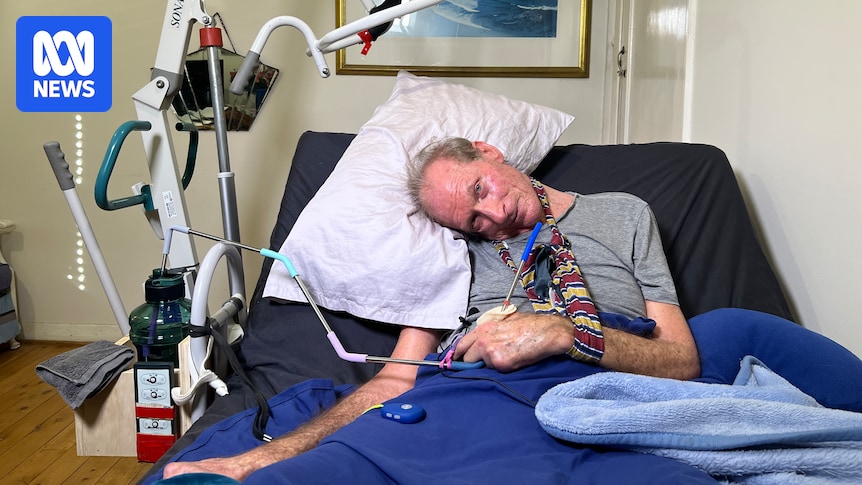
Glenn Rowan’s degenerative motor neurone disease (MND) has forced him to make a difficult choice: bleed money to fund his own 24/7 care, or die prematurely.
He says others like him will also be pushed into early euthanasia by the high cost of managing the muscle-wasting disorder.
Australians diagnosed with MND after turning 65 are ineligible for the National Disability Insurance Scheme (NDIS) and are instead supported through the aged care system, which is not designed for severe disabilities and offers a fraction of the funding.
“Unless someone’s got a good bank account, they’ve got major problems,” Mr Rowan said.
“This will force people into premature euthanasia, which is one of the things I’m considering myself.“
Mr Rowan’s push follows the recent death of AFL star Neale Daniher, aged 65, whose fight against MND cast a national spotlight on the neurological disease, which causes paralysis by damaging nerve cells in the brain and spinal cord.
Neale Daniher was honoured with a state funeral at the Melbourne Cricket Ground. (Supplied)
Many Australians diagnosed with MND are given priority access to the NDIS, as the average life expectancy after diagnosis is about 24 months, depending on the type.
Because Mr Rowan was diagnosed in 2022 at the age of 71, he is not eligible for the NDIS, but he can receive some funding through My Aged Care.
Glenn Rowan lived an active life in Newcastle before his diagnosis. (Supplied: Glenn Rowan)
The highest Support at Home package at Level 8 offers up to $78,200 for at-home care, plus the option of up to $15,000 in one-off funding for things like home modifications.
It’s well short of the roughly $300,000 or more available to people with MND on the NDIS.
Now aged 78, Mr Rowan said he was paying about $7,000 a week in disability support costs out of his own pocket.
“The simple task of getting out of bed is impossible,” he said.
“The simple task of even rubbing my nose when I have a head cold — any of the most basic things of human existence are things that I can’t do.”
Glenn Rowan relies on his friends and family to keep him alive. (ABC News: Ross McLoughlin)
Mr Rowan said the aged care funding was adequate for managing day-to-day needs up until “the second the paralysis hits”.
“The paralysis in my case is both arms, legs and neck, and at that point a patient is completely bedridden,” he said.
“It’s impossible on $78,200 to fund a person 24/7. It costs $400,000 at least.”
Glenn Rowan regularly headed off on outdoor adventures. (Supplied: Glenn Rowan)
Fast-tracked aged care funding falls short
Recent figures show older people are waiting 12 months on average to access in-home support or a place in an aged care home under the government’s overhaul of the aged care system.
Last week, the federal government announced urgent priority access to funding under the Support at Home program for people over 65 diagnosed with MND, recognising its unique “characteristics”.
It means older people with MND should now receive their funding within 30 days.
MND Australia chief executive Clare Sullivan welcomed the fast-tracked pathway, but said it did not address the issue of inadequate funding.
“We’re seeing it financially cripple — if not bankrupt — families all the time,”
she said.
Ms Sullivan also said the government’s automated assessment tool, which uses an algorithm to determine aged care package funding levels, did not necessarily categorise people with MND at the highest funding level.
Clare Sullivan says the aged care system is not designed for people with MND. (ABC News: Ian Cutmore)
“People with MND are generally being assessed at Level 3 or Level 4, or about $30,000 a year in funding support,” she said.
“That’s enough to buy someone to help you get out of bed and have a shower, twice a week.”
Adding to Ms Sullivan’s concerns is the lack of price caps regulating the increased cost of at-home care services charged by providers.
“For people with MND, who are supported through Support at Home, the funding support they get is buying them less,” Ms Sullivan said.
Independent Senator David Pocock said MND was a “really clear case where there are such higher needs”.
“You shouldn’t have to be a millionaire to deal with a debilitating disease,”
he said.
David Pocock says the aged care system needs more flexibility to account for severe cases. (ABC News: Adam Kennedy)
Senator Pocock also said the government’s auto-assessment tool failed to consider exceptional cases.
“There’s no flexibility to actually say, ‘Hang on, this person has MND and they are very likely to see this drastic decline in their motor function, and they’re going to need more and more supports’,” he said.
“The algorithm doesn’t take any of that into account.”
Neurology professor Dominic Rowe, clinical lead of MND Research at Macquarie University, said the median age for when a person develops MND symptoms is 64.
“Half of my patients qualify for the NDIS, and half of them don’t,” Professor Rowe said.
“So if you’re 64 years, you get $300,000. If you’re 65 years and one day, you get $80,000 in a Level 8 package.
“Sometimes, with the evolution of voluntary assisted dying legislation, they decide to exit because they’ve got no practical way of being looked after in the community.”
Dominic Rowe says motor neurone disease warrants special treatment. (Supplied: Dominic Rowe)
Professor Rowe said MND stood out from other neurological diseases usually associated with ageing due to its rapid physical deterioration.
“The aged care residential sector is mostly set up to look after people with Alzheimer’s disease,” he said.
“They can’t look after people with severe physical disability.”
A government spokesperson said the NDIS and the Support at Home program were “two distinct and separate programs underpinned by different legislation, rules and funding considerations”.
“The NDIS supports eligible people who apply before age 65, while older Australians are supported through the aged care system,” they said in a statement.
“Support at Home provides aged care services based on the assessed ageing-related needs of the individual, regardless of their location, background and life experiences.
“This may include individuals who are living with disability.”
Mr Rowan said it was too late for him, but he wanted government action to protect others with MND from financial ruin.
Glenn Rowan enjoys the sunshine as a younger man. (Supplied: Glenn Rowan)
“Look at the consequences of the legislation, appreciate the damage to the person and their family, and measure the cost of giving some type of dignity to people like myself in the last part of their life,” he said.
“Most of us are bedridden. We have a short life prognosis, and for that reason, the government cost is not great.“
Mr Rowan’s request to access voluntary assisted dying has been accepted.